
Meizu X8 vs. Apple iPhone 11: A Detailed Performance and Value Showdown
| Phones Images | |||||
|---|---|---|---|---|---|
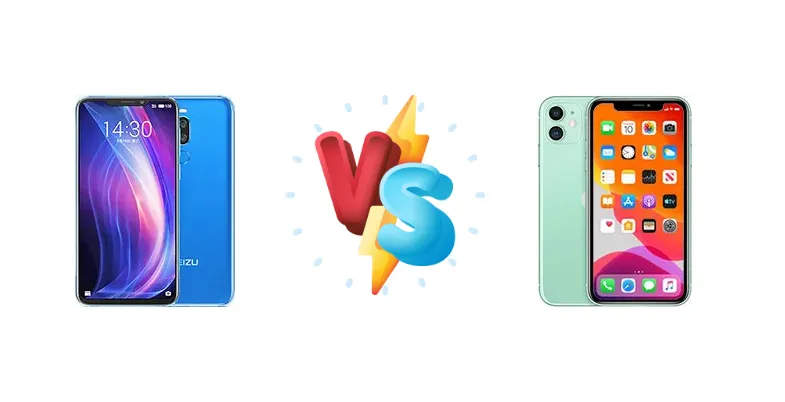
|
🏆 Quick Verdict
For the average user prioritizing long-term performance and a refined software experience, the Apple iPhone 11 is the clear winner. While the Meizu X8 offers a competitive price, the A13 Bionic's superior processing power and Apple's continued software support justify the higher cost.
| PHONES | ||
|---|---|---|
| Phone Names | Meizu X8 | Apple iPhone 11 |
| Network | ||
|---|---|---|
| 2G bands | GSM 850 / 900 / 1800 / 1900 | GSM 850 / 900 / 1800 / 1900 |
| 3G bands | HSDPA 850 / 900 / 2100 - China | HSDPA 850 / 900 / 1700(AWS) / 1900 / 2100 |
| 4G bands | 1, 3, 5, 8, 34, 38, 39, 40, 41 - China | 1, 2, 3, 4, 5, 7, 8, 11, 12, 13, 17, 18, 19, 20, 21, 25, 26, 28, 29, 30, 32, 34, 38, 39, 40, 41, 42, 46, 48, 66 - A2221 |
| Speed | HSPA 42.2/5.76 Mbps, LTE Cat15 800/150 Mbps | HSPA 42.2/5.76 Mbps, LTE Cat16 1024/150 Mbps, EV-DO Rev.A 3.1 Mbps |
| Technology | GSM / CDMA / HSPA / LTE | GSM / CDMA / HSPA / EVDO / LTE |
| CDMA 800 & TD-SCDMA - China | 1, 2, 3, 4, 5, 7, 8, 12, 13, 14, 17, 18, 19, 20, 25, 26, 29, 30, 34, 38, 39, 40, 41, 42, 46, 48, 66, 71 - A2111, A2223 | |
| Launch | ||
|---|---|---|
| Announced | 2018, September. Released 2018, October | 2019, September 10 |
| Status | Discontinued | Available. Released 2019, September 20 |
| Body | ||
|---|---|---|
| Build | - | Glass front (Corning-made glass), glass back (Corning-made glass), aluminum frame (7000 series) |
| Dimensions | 151.2 x 74.6 x 7.8 mm (5.95 x 2.94 x 0.31 in) | 150.9 x 75.7 x 8.3 mm (5.94 x 2.98 x 0.33 in) |
| SIM | Nano-SIM + Nano-SIM | · Nano-SIM + eSIM· Nano-SIM + Nano-SIM (China) |
| Weight | 160 g (5.64 oz) | 194 g (6.84 oz) |
| - | IP68 dust/water resistant (up to 2m for 30 min) Apple Pay (Visa, MasterCard, AMEX certified) | |
| Display | ||
|---|---|---|
| Protection | - | Scratch-resistant glass |
| Resolution | 1080 x 2220 pixels, 18.5:9 ratio (~398 ppi density) | 828 x 1792 pixels, 19.5:9 ratio (~326 ppi density) |
| Size | 6.2 inches, 97.6 cm2 (~86.5% screen-to-body ratio) | 6.1 inches, 90.3 cm2 (~79.0% screen-to-body ratio) |
| Type | IPS LCD | Liquid Retina IPS LCD, 625 nits (typ) |
| Platform | ||
|---|---|---|
| CPU | Octa-core (2x2.2 GHz 360 Gold & 6x1.7 GHz Kryo 360 Silver) | Hexa-core (2x2.65 GHz Lightning + 4x1.8 GHz Thunder) |
| Chipset | Qualcomm SDM710 Snapdragon 710 (10 nm) | Apple A13 Bionic (7 nm+) |
| GPU | Adreno 616 | Apple GPU (4-core graphics) |
| OS | Android 8.0 (Oreo), Flyme UI | iOS 13, upgradable to iOS 26.1 |
| Memory | ||
|---|---|---|
| Card slot | No | No |
| Internal | 64GB 4GB RAM, 64GB 6GB RAM, 128GB 6GB RAM | 64GB 4GB RAM, 128GB 4GB RAM, 256GB 4GB RAM |
| - | NVMe | |
| Main Camera | ||
|---|---|---|
| Dual | 12 MP, f/1.9, 1/2.55", 1.4µm, dual pixel PDAF 5 MP | 12 MP, f/1.8, 26mm (wide), 1/2.55", 1.4µm, dual pixel PDAF, OIS 12 MP, f/2.4, 120˚, 13mm (ultrawide), 1/3.6" |
| Features | Dual-LED dual-tone flash, panorama | Dual-LED dual-tone flash, HDR (photo/panorama) |
| Video | 1080p@30fps | 4K@24/25/30/60fps, 1080p@25/30/60/120/240fps, HDR, stereo sound rec. |
| Selfie camera | ||
|---|---|---|
| Features | - | HDR |
| Single | 20 MP, f/2.0, (wide), 1/2.8", 1.0µm | 12 MP, f/2.2, 23mm (wide), 1/3.6", 1.0µm SL 3D, (depth/biometrics sensor) |
| Video | - | 4K@24/25/30/60fps, 1080p@25/30/60/120fps, gyro-EIS |
| Sound | ||
|---|---|---|
| 3.5mm jack | Yes | No |
| 35mm jack | Yes | No |
| Loudspeaker | Yes | Yes, with stereo speakers |
| Comms | ||
|---|---|---|
| Bluetooth | 5.0, A2DP, LE | 5.0, A2DP, LE |
| NFC | No | Yes |
| Positioning | GPS, GLONASS | GPS, GLONASS, GALILEO, QZSS |
| Radio | No | No |
| USB | USB Type-C 2.0 | Lightning, USB 2.0 |
| WLAN | Wi-Fi 802.11 b/g/n/ac, dual-band, Wi-Fi Direct | Wi-Fi 802.11 a/b/g/n/ac/6, dual-band, hotspot |
| Features | ||
|---|---|---|
| Sensors | Fingerprint (rear-mounted), accelerometer, proximity, compass | Face ID, accelerometer, gyro, proximity, compass, barometer |
| - | Ultra Wideband (UWB) support | |
| Battery | ||
|---|---|---|
| Charging | - | Wired, PD2.0, 50% in 30 min Wireless (Qi) |
| Type | Li-Ion 3210 mAh, non-removable | Li-Ion 3110 mAh, non-removable (11.91 Wh) |
| Misc | ||
|---|---|---|
| Colors | Black, Blue, White | Black, Green, Yellow, Purple, Red, White |
| Models | X8 | A2221, A2111, A2223, iPhone12,1 |
| Price | About 200 EUR | $ 167.50 / C$ 228.68 / £ 175.00 / € 193.32 |
| SAR | - | 1.09 W/kg (head) 1.18 W/kg (body) |
| SAR EU | - | 0.95 W/kg (head) 0.99 W/kg (body) |
| Pricing | ||
|---|---|---|
| 128GB 4GB RAM | - | $ 359.95 |
| 256GB 4GB RAM | - | $ 469.99 |
| 64GB 4GB RAM | - | $ 292.79 |
| RENEWED | - | £ 214.00 |
| Tests | ||
|---|---|---|
| Audio quality | - | Noise -94.2dB / Crosstalk -80.8dB |
| Battery life | - | Endurance rating 94h |
| Camera | - | Photo / Video |
| Display | - | Contrast ratio: 1505:1 (nominal) |
| Loudspeaker | - | Voice 70dB / Noise 72dB / Ring 76dB |
| Performance | - | AnTuTu: 419453 (v7) GeekBench: 13882 (v4.4) GFXBench: 60fps (ES 3.1 onscreen) |
Meizu X8
- Potentially lower price point
- Android OS flexibility
- Decent battery endurance (94h)
- Inferior processor performance (Snapdragon 710)
- Limited software support
- Less detailed display specifications
Apple iPhone 11
- Superior performance (A13 Bionic)
- Long-term software support
- Faster charging (PD2.0 & Qi)
- Higher initial cost
- iOS ecosystem lock-in
- Older design
Display Comparison
The iPhone 11 boasts a brighter display, measured at 644 nits, compared to the Meizu X8’s unspecified brightness. While both share a similar 1505:1 contrast ratio, the iPhone 11’s superior brightness translates to better visibility in direct sunlight. The X8’s display specifications are less detailed, leaving questions about color accuracy and panel technology unanswered, while the iPhone 11 delivers a consistently high-quality visual experience.
Camera Comparison
Both devices offer photo and video capabilities, but the iPhone 11 likely holds a significant edge. While specific sensor details for the Meizu X8 are unavailable, Apple’s image processing pipeline and sensor quality are well-regarded. The iPhone 11’s camera benefits from Apple’s computational photography advancements, resulting in better dynamic range and low-light performance. The lack of detailed camera specifications for the X8 makes a direct comparison difficult, but the iPhone 11’s reputation for consistent image quality is a strong advantage.
Performance
The Apple A13 Bionic, fabricated on a 7nm+ process, demonstrably outperforms the Qualcomm Snapdragon 710 (10nm). The A13’s hexa-core CPU, with its 2x2.65 GHz Lightning cores and 4x1.8 GHz Thunder cores, provides a significant advantage in both single-core and multi-core performance compared to the Snapdragon 710’s octa-core configuration (2x2.2 GHz 360 Gold & 6x1.7 GHz Kryo 360 Silver). This translates to faster app loading times, smoother multitasking, and a more responsive user interface on the iPhone 11. The A13’s Neural Engine also provides a substantial boost to machine learning tasks.
Battery Life
Both the Meizu X8 and the iPhone 11 achieve an impressive endurance rating of 94 hours, suggesting comparable battery life under similar usage conditions. However, the iPhone 11 offers faster charging with PD2.0, reaching 50% charge in just 30 minutes, alongside Qi wireless charging. The Meizu X8’s charging specifications are not provided, but it likely lacks the speed and convenience of the iPhone 11’s charging options.
Buying Guide
Buy the Meizu X8 if you need a functional Android smartphone with a decent display and are comfortable with a less polished software experience, and prioritize cost above all else. Buy the Apple iPhone 11 if you prefer a premium build quality, a significantly faster processor for demanding tasks, a superior camera system, and guaranteed software updates for years to come.