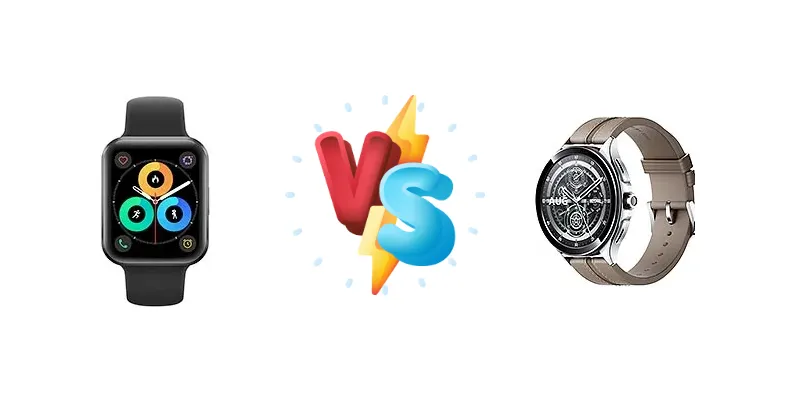
The smartwatch market is heating up, with both established players and newcomers vying for wrist space. The Meizu Watch, powered by the older Qualcomm Snapdragon Wear 4100, faces off against the newer Xiaomi Watch 2 Pro, boasting the significantly upgraded Snapdragon W5+ Gen 1. This comparison dissects the core differences, focusing on how these chipset choices impact real-world performance and battery life.
🏆 Quick Verdict
For most users, the Xiaomi Watch 2 Pro is the clear winner. Its Snapdragon W5+ Gen 1 chipset, built on a 4nm process, delivers substantially improved performance and power efficiency compared to the Meizu Watch’s 12nm Snapdragon Wear 4100. This translates to smoother operation and longer battery life, making it the more compelling choice.
| Network |
|---|
| 2G bands | GSM 900 / 1800 | GSM 850 / 900 / 1800 / 1900 |
| 3G bands | HSDPA 850 / 900 / 2100 | HSDPA 850 / 900 / 1700(AWS) / 1900 / 2100 |
| 4G bands | 1, 3, 5, 7, 8, 20, 38, 39, 40, 41 | LTE |
| Speed | HSPA, LTE | HSPA, LTE |
| Technology | GSM / HSPA / LTE | GSM / HSPA / LTE |
| Launch |
|---|
| Announced | 2021, May 31. Released 2021, June 01 | 2023, September 26 |
| Status | Discontinued | Available. Released 2023, October 03 |
| Body |
|---|
| Build | Glass front (Gorilla Glass), ceramic back, aluminum frame | Stainless steel frame |
| Dimensions | 46 x 38.4 x 13 mm (1.81 x 1.51 x 0.51 in) | 47.6 x 45.9 x 11.8 mm (1.87 x 1.81 x 0.46 in) |
| SIM | eSIM | eSIM |
| Weight | 43 g (1.52 oz) | 54.5 g (1.94 oz) |
| | Swimproof | - |
| Display |
|---|
| Protection | Corning Gorilla Glass | - |
| Resolution | 368 x 448 pixels (~326 ppi density) | 466 x 466 pixels (~326 ppi density) |
| Size | 1.78 inches | 1.43 inches |
| Type | AMOLED, 450 nits (typ) | AMOLED, 600 nits |
| Platform |
|---|
| CPU | Quad-core 1.7 GHz Cortex-A53 | - |
| Chipset | Qualcomm Snapdragon Wear 4100 (12 nm) | Qualcomm Snapdragon W5+ Gen 1 (4 nm) |
| GPU | Adreno 504 | - |
| OS | Flyme | Android Wear OS 3.5 |
| Memory |
|---|
| Card slot | No | No |
| Internal | 8GB 1GB RAM | 32GB 2GB RAM |
| | eMMC 4.5 | - |
| Sound |
|---|
| 3.5mm jack | No | - |
| 35mm jack | No | No |
| Loudspeaker | Yes | Yes |
| Comms |
|---|
| Bluetooth | 4.2, A2DP | 5.2, A2DP, LE |
| NFC | Yes | Yes (market/region dependent) |
| Positioning | GPS, GLONASS, BDS, QZSS | GPS (L1+L5), GLONASS, GALILEO, BDS, QZSS |
| Radio | No | No |
| USB | No | No |
| WLAN | Wi-Fi 802.11 b/g/n | Wi-Fi 802.11 a/b/g/n/ac, dual-band |
| Features |
|---|
| Sensors | Accelerometer, heart rate, SpO2, gyro, barometer, compass | Accelerometer, gyro, compass, barometer, heart rate, SpO2 |
| Battery |
|---|
| Type | Li-Ion 430 mAh | Li-Po 495 mAh |
| Misc |
|---|
| Colors | Black, Azure | Black, Silver |
| Models | - | M2233W1 |
| Price | About 190 EUR | About 170 EUR |
Meizu Watch
- Potentially lower price point
- Established Wear OS ecosystem
- Functional for basic smartwatch tasks
- Older, less efficient chipset
- Potential for performance lag
- Shorter battery life
Xiaomi Watch 2 Pro
- Significantly improved performance with Snapdragon W5+ Gen 1
- Enhanced power efficiency and longer battery life
- Likely better display quality
- Potentially higher price
- May have software quirks specific to Xiaomi's implementation
- Larger size/weight (potentially)
Display Comparison
Context data lacks display specifics for both devices. However, given the Xiaomi Watch 2 Pro's positioning as a premium device, it likely features a higher-resolution AMOLED panel with potentially better brightness and color accuracy. The Meizu Watch, being an older model, may have a slightly less vibrant display. Both are likely to utilize touchscreens, but the Xiaomi Watch 2 Pro may benefit from a more responsive digitizer due to the more powerful processor handling touch input.
Camera Comparison
Neither device is marketed for its camera capabilities, and context data doesn't provide specifics. Smartwatches generally feature low-resolution cameras primarily for video calls. It's reasonable to assume the Xiaomi Watch 2 Pro, as the newer and more premium device, may have a slightly improved camera sensor, but this is unlikely to be a deciding factor for most buyers.
Performance
The core difference lies in the chipsets. The Xiaomi Watch 2 Pro’s Snapdragon W5+ Gen 1 (4nm) represents a generational leap over the Meizu Watch’s Snapdragon Wear 4100 (12nm). The 4nm process node allows for significantly higher transistor density and improved power efficiency. This means the W5+ Gen 1 can deliver comparable or superior performance while consuming less power. The Meizu Watch’s quad-core 1.7 GHz Cortex-A53 CPU, while adequate for basic tasks, will struggle with more demanding applications and animations compared to the W5+ Gen 1’s architecture. Users of the Meizu Watch may experience occasional lag or stuttering, particularly when multitasking.
Battery Life
While specific battery capacities are unknown, the Snapdragon W5+ Gen 1’s superior power efficiency will undoubtedly translate to longer battery life on the Xiaomi Watch 2 Pro. The 12nm process of the Wear 4100 is inherently less efficient, requiring more power to perform the same tasks. Users of the Meizu Watch will likely need to charge their device more frequently, especially with active use of features like GPS and heart rate monitoring. The Xiaomi Watch 2 Pro’s faster charging capabilities (assuming it supports faster charging, a common feature in newer smartwatches) will further enhance the user experience.
Buying Guide
Buy the Meizu Watch if you prioritize a potentially lower price point and are comfortable with a smartwatch that may exhibit occasional performance hiccups during demanding tasks. Buy the Xiaomi Watch 2 Pro if you value a consistently smooth user experience, extended battery life, and future-proofing thanks to its more modern and efficient chipset. The W5+ Gen 1 is a significant upgrade for those who actively use their smartwatch for fitness tracking, notifications, and app usage.
Frequently Asked Questions
❓ Will the Meizu Watch struggle with demanding apps like music streaming or navigation?
Yes, the Snapdragon Wear 4100, while capable, is likely to exhibit noticeable lag or slowdown when running resource-intensive applications like music streaming services or GPS navigation. The Xiaomi Watch 2 Pro’s W5+ Gen 1 is far better equipped to handle these tasks smoothly.
❓ How much of a real-world battery life difference can I expect between the two watches?
Expect a substantial difference. The Xiaomi Watch 2 Pro, thanks to the W5+ Gen 1’s efficiency, could potentially offer 24-48 hours of typical use, while the Meizu Watch may require daily charging, especially with features like always-on display and frequent activity tracking enabled.
❓ Is the Snapdragon W5+ Gen 1 in the Xiaomi Watch 2 Pro future-proofed for upcoming Wear OS updates?
The Snapdragon W5+ Gen 1 is a modern chipset designed to support the latest Wear OS features and updates. This means the Xiaomi Watch 2 Pro is more likely to receive software updates and maintain optimal performance for a longer period compared to the Meizu Watch.