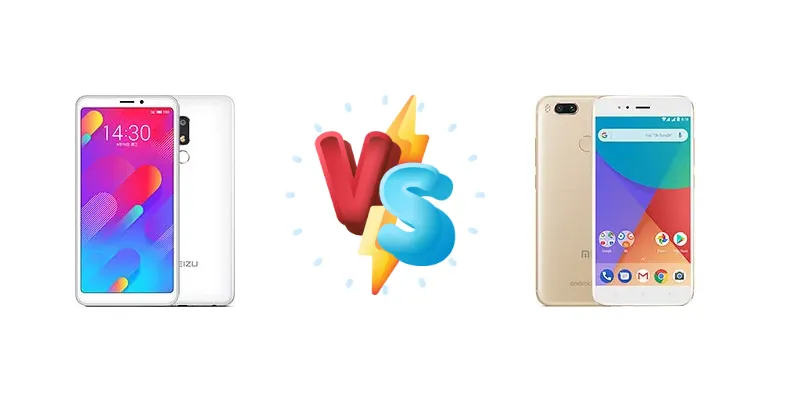
Released around the same timeframe, the Xiaomi Mi A1 (also known as the Mi 5X) and the Meizu V8 represent attempts to deliver affordable Android experiences. However, beneath the similar price points lie significant differences in chipset architecture and overall performance. This comparison dissects these differences, helping you determine which device best suits your needs.
🏆 Quick Verdict
For the average user, the Xiaomi Mi A1 (Mi 5X) is the superior choice. Its Snapdragon 625 chipset, built on a more efficient 14nm process, delivers noticeably better performance and thermal management compared to the Meizu V8’s Mediatek MT6739. While both offer similar battery endurance ratings, the Mi A1’s processing power provides a smoother, more responsive user experience.
| Network |
|---|
| 2G bands | GSM 850 / 900 / 1800 / 1900 | GSM 850 / 900 / 1800 / 1900 - SIM 1 & SIM 2 |
| 3G bands | HSDPA 850 / 900 / 2100 - China | HSDPA 850 / 900 / 1900 / 2100 |
| 4G bands | 1, 3, 5, 7, 8, 38, 39, 40, 41 - China | 1, 3, 5, 7, 8, 20, 38, 40 |
| Speed | HSPA 42.2/5.76 Mbps, LTE Cat4 150/50 Mbps | HSPA 42.2/5.76 Mbps, LTE (2CA) Cat6 300/50 Mbps |
| Technology | GSM / CDMA / HSPA / LTE | GSM / HSPA / LTE |
| | CDMA 800 & TD-SCDMA - China | - |
| Launch |
|---|
| Announced | 2018, September. Released 2018, September | 2017, September. Released 2017, September |
| Status | Discontinued | Discontinued |
| Body |
|---|
| Build | - | Glass front (Gorilla Glass 3), aluminum back, aluminum frame |
| Dimensions | 148 x 73 x 8.4 mm (5.83 x 2.87 x 0.33 in) | 155.4 x 75.8 x 7.3 mm (6.12 x 2.98 x 0.29 in) |
| SIM | Nano-SIM + Nano-SIM | Nano-SIM + Nano-SIM |
| Weight | 145 g (5.11 oz) | 165 g (5.82 oz) |
| Display |
|---|
| Protection | - | Corning Gorilla Glass 3 |
| Resolution | 720 x 1440 pixels, 18:9 ratio (~282 ppi density) | 1080 x 1920 pixels, 16:9 ratio (~403 ppi density) |
| Size | 5.7 inches, 83.8 cm2 (~77.6% screen-to-body ratio) | 5.5 inches, 82.6 cm2 (~70.1% screen-to-body ratio) |
| Type | IPS LCD | IPS LCD |
| Platform |
|---|
| CPU | Quad-core 1.5 GHz Cortex-A53 | Octa-core 2.0 GHz Cortex-A53 |
| Chipset | Mediatek MT6739 (28 nm) | Qualcomm MSM8953 Snapdragon 625 (14 nm) |
| GPU | PowerVR GE8100 | Adreno 506 |
| OS | Android 8.0 (Oreo), Flyme UI | Android 7.1.2 (Nougat), upgradable to Android 9.0 (Pie), Android One |
| Memory |
|---|
| Card slot | microSDXC | microSDXC (uses shared SIM slot) |
| Internal | 32GB 3GB RAM | 32GB 4GB RAM, 64GB 4GB RAM |
| | eMMC 5.1 | eMMC 5.1 |
| Main Camera |
|---|
| Dual | - | 12 MP, f/2.2, 26mm (wide), 1/2.9", 1.25µm, PDAF
12 MP, f/2.6, 50mm (telephoto), 1.0µm, AF, 2x optical zoom |
| Features | Dual-LED dual-tone flash, panorama | Dual-LED dual-tone flash, HDR, panorama |
| Single | 13 MP, f/2.2, AF | - |
| Video | 1080p@30fps | 4K@30fps, 1080p@30fps, 720p@120fps |
| Selfie camera |
|---|
| Single | 5 MP, f/1.9 | 5 MP |
| Video | - | 1080p@30fps |
| Sound |
|---|
| 3.5mm jack | Yes | Yes |
| 35mm jack | Yes | Yes |
| Loudspeaker | Yes | Yes |
| Comms |
|---|
| Bluetooth | 4.2, A2DP, LE | 4.2, A2DP, LE |
| Infrared port | - | Yes |
| NFC | No | No |
| Positioning | GPS, GLONASS | GPS, GLONASS, BDS |
| Radio | No | FM radio |
| USB | microUSB 2.0 | USB Type-C 2.0 |
| WLAN | Wi-Fi 802.11 b/g/n, Wi-Fi Direct | Wi-Fi 802.11 a/b/g/n/ac, dual-band, Wi-Fi Direct |
| Features |
|---|
| Sensors | Fingerprint (rear-mounted), accelerometer, proximity, compass | Fingerprint (rear-mounted), accelerometer, gyro, proximity |
| Battery |
|---|
| Charging | - | 10W wired |
| Type | Li-Ion 3200 mAh, non-removable | Li-Po 3080 mAh, non-removable |
| Misc |
|---|
| Colors | Black, White | Black, Gold, Rose Gold, Red |
| Models | - | MDG2, MDI2 |
| Price | About 100 EUR | About 170 EUR |
| SAR | - | 1.75 W/kg (head) 0.76 W/kg (body) |
| Tests |
|---|
| Audio quality | - |
Noise -91.0dB / Crosstalk -82.5dB |
| Battery life | - | Endurance rating 87h |
| Camera | - |
Photo / Video |
| Display | - |
Contrast ratio: 1570:1 (nominal), 2.689 (sunlight) |
| Loudspeaker | - |
Voice 74dB / Noise 73dB / Ring 90dB |
| Performance | - |
GeekBench: 4292 (v4.4)
GFXBench: 3.5fps (ES 3.1 onscreen) |
Meizu V8
- Superior performance due to Snapdragon 625
- More efficient 14nm process for better battery life under load
- Android One program guarantees software updates
- Charging speed is relatively slow at 10W
- May be slightly more expensive than the Meizu V8
Xiaomi Mi A1 (Mi 5X)
- Potentially lower initial purchase price
- Similar battery endurance rating to the Mi A1
- Compact form factor (likely, based on Meizu’s design language)
- Significantly weaker performance due to Mediatek MT6739
- Less efficient 28nm process leads to more heat and throttling
- Uncertainty regarding software updates and long-term support
Display Comparison
Both devices share a similar display contrast ratio of 1570:1 (nominal) and 2.689 (sunlight), suggesting comparable outdoor visibility. However, detailed display specifications like resolution and panel type are missing for the Meizu V8. The Mi A1’s display, while not groundbreaking, benefits from Xiaomi’s color calibration, offering reasonably accurate colors for the price point. Without further data on the V8’s panel, it’s difficult to assess its color accuracy or viewing angles.
Camera Comparison
Both phones are listed as having Photo/Video capabilities, but specific details are absent. Given the era of these devices, it’s likely both feature similar sensor sizes and image processing limitations. The absence of details prevents a meaningful comparison. However, Xiaomi generally focused on camera improvements in their mid-range devices, suggesting the Mi A1 might offer slightly better image quality and software features. The lack of information on the Meizu V8’s camera makes a definitive assessment impossible.
Performance
The core difference lies in the chipsets. The Xiaomi Mi A1’s Snapdragon 625 (14nm) features an octa-core Cortex-A53 CPU clocked at 2.0 GHz, while the Meizu V8 utilizes the Mediatek MT6739 (28nm) with a quad-core 1.5 GHz Cortex-A53 CPU. The 14nm fabrication process of the Snapdragon 625 is significantly more efficient, resulting in lower power consumption and better thermal performance. This translates to less throttling under sustained load and a smoother overall experience. The Mi A1 will handle multitasking and moderately demanding apps with greater ease.
Battery Life
Interestingly, both devices boast an endurance rating of 87 hours. This suggests similar battery life despite the differing chipsets. The Snapdragon 625’s efficiency likely offsets the Meizu V8’s potentially smaller battery capacity (specific mAh is unknown). Both support 10W wired charging, indicating relatively slow charging speeds by today’s standards. Expect around 2-3 hours for a full charge on both devices.
Buying Guide
Buy the Meizu V8 if you prioritize a potentially lower initial cost and are primarily focused on basic smartphone tasks like calls, texts, and light social media use. Buy the Xiaomi Mi A1 (Mi 5X) if you value smoother multitasking, better app performance, and a more future-proofed experience, especially if you enjoy occasional gaming or photography. The Mi A1 also benefits from the Android One program, guaranteeing timely updates.
Frequently Asked Questions
❓ Will the Mediatek MT6739 in the Meizu V8 struggle with modern app updates?
Yes, the Mediatek MT6739 is a relatively old and low-powered chipset. As apps become more demanding, the V8 will likely experience slowdowns and compatibility issues with newer updates. The Snapdragon 625 in the Mi A1 is better equipped to handle these updates.
❓ Does the Xiaomi Mi A1's Android One program still provide security updates?
While official support from Google has ended, the Mi A1 received updates for a reasonable period. However, it's unlikely to receive further security patches at this point. This is a consideration for security-conscious users, but the risk is mitigated by the phone's limited use case as a secondary device.
❓ Is the 10W charging on either phone a significant drawback?
Yes, 10W charging is quite slow by modern standards. Expect a full charge to take around 2-3 hours. This isn't ideal for users who need a quick top-up, but it's typical for phones in this price range and age.