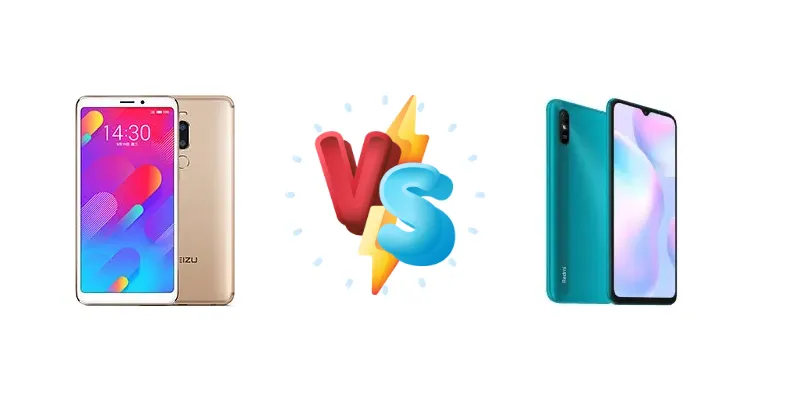
The Meizu V8 Pro and Xiaomi Redmi 9A represent the ultra-budget end of the smartphone spectrum. Both devices rely on Mediatek's Helio series of chipsets, but a key difference lies in the silicon: the V8 Pro utilizes the Helio P22, while the Redmi 9A features the Helio G25. This comparison dissects the nuances of these processors to determine which phone delivers the better user experience for everyday tasks and light gaming.
🏆 Quick Verdict
For the average user prioritizing basic functionality, the Xiaomi Redmi 9A offers a slight edge due to its Helio G25 chipset's optimized CPU configuration. While both phones share a 12nm process, the G25's combination of faster and slower Cortex-A53 cores provides a more balanced performance profile, and the inclusion of 10W charging is a practical benefit.
| Network |
|---|
| 2G bands | GSM 850 / 900 / 1800 / 1900 | GSM 850 / 900 / 1800 / 1900 |
| 3G bands | HSDPA 850 / 900 / 2100 - China | HSDPA 850 / 900 / 1700(AWS) / 1900 / 2100 - International |
| 4G bands | 1, 3, 5, 8, 34, 38, 39, 40, 41 - China | 1, 2, 3, 4, 5, 7, 8, 20, 28, 38, 40, 41 - International |
| Speed | HSPA 42.2/11.5 Mbps, LTE (2CA) Cat6 300/50 Mbps | HSPA, LTE |
| Technology | GSM / CDMA / HSPA / LTE | GSM / HSPA / LTE |
| | CDMA 800 & TD-SCDMA - China | 1, 3, 5, 8, 40, 41 - India |
| Launch |
|---|
| Announced | 2018, September. Released 2018, September | 2020, June 30. Released 2020, July 07 |
| Status | Discontinued | Discontinued |
| Body |
|---|
| Dimensions | 147.5 x 72.7 x 8.1 mm (5.81 x 2.86 x 0.32 in) | 164.9 x 77.1 x 9 mm (6.49 x 3.04 x 0.35 in) |
| SIM | Nano-SIM + Nano-SIM | Nano-SIM + Nano-SIM |
| Weight | 159 g (5.61 oz) | 196 g (6.91 oz) |
| Display |
|---|
| Resolution | 720 x 1440 pixels, 18:9 ratio (~282 ppi density) | 720 x 1600 pixels, 20:9 ratio (~269 ppi density) |
| Size | 5.7 inches, 83.8 cm2 (~78.2% screen-to-body ratio) | 6.53 inches, 102.9 cm2 (~81.0% screen-to-body ratio) |
| Type | IPS LCD | IPS LCD, 400 nits (typ) |
| Platform |
|---|
| CPU | Octa-core 2.0 GHz Cortex-A53 | Octa-core (4x2.0 GHz Cortex-A53 & 4x1.5 GHz Cortex-A53) |
| Chipset | Mediatek MT6762 Helio P22 (12 nm) | Mediatek MT6762G Helio G25 (12 nm) |
| GPU | PowerVR GE8320 | PowerVR GE8320 |
| OS | Android 8.0 (Oreo), Flyme UI | Android 10, upgradable to Android 11, MIUI 12 |
| Memory |
|---|
| Card slot | microSDXC | microSDXC (dedicated slot) |
| Internal | 64GB 4GB RAM | 32GB 2GB RAM, 32GB 3GB RAM, 64GB 4GB RAM, 128GB 4GB RAM, 128GB 6GB RAM |
| | eMMC 5.1 | eMMC 5.1 |
| Main Camera |
|---|
| Dual | 12 MP, f/2.2, AF
5 MP, f/2.2 | - |
| Features | Dual-LED dual-tone flash, panorama | LED flash, HDR |
| Single | - | 13 MP, f/2.2, 28mm (wide), 1.0µm, PDAF |
| Video | 1080p@30fps | 1080p@30/60fps |
| Selfie camera |
|---|
| Features | - | HDR |
| Single | 5 MP, f/1.9 | 5 MP, f/2.2, (wide), 1.12µm |
| Video | - | 1080p@30fps |
| Sound |
|---|
| 3.5mm jack | Yes | Yes |
| 35mm jack | Yes | Yes |
| Loudspeaker | Yes | Yes |
| Comms |
|---|
| Bluetooth | 5.0, A2DP, LE | 5.0, A2DP, LE |
| NFC | No | No |
| Positioning | GPS, GLONASS | GPS, GLONASS, BDS |
| Radio | No | FM radio |
| USB | microUSB 2.0 | microUSB 2.0, OTG |
| WLAN | Wi-Fi 802.11 a/b/g/n, dual-band, Wi-Fi Direct | Wi-Fi 802.11 b/g/n, Wi-Fi Direct |
| Features |
|---|
| Sensors | Fingerprint (rear-mounted), accelerometer, proximity, compass | Accelerometer, proximity |
| Battery |
|---|
| Charging | - | 10W wired |
| Type | Li-Ion 3100 mAh, non-removable | Li-Po 5000 mAh |
| Misc |
|---|
| Colors | Black, Gold | Carbon Gray (Midnight Black), Sky Blue (Sea Blue), Ocean Green (Nature Green) |
| Models | - | M2006C3LG, M2006C3LI, M2006C3LC, M2004C3L |
| Price | About 150 EUR | € 64.30 / $ 56.50 / £ 95.56 |
| SAR | - | 0.90 W/kg (head) 0.65 W/kg (body) |
| SAR EU | - | 0.40 W/kg (head) 1.19 W/kg (body) |
Meizu V8 Pro
- Potentially lower price point.
- Simple and streamlined software experience (depending on Meizu's UI).
- Reliable Mediatek Helio P22 chipset.
- Less efficient CPU architecture compared to the G25.
- No specified charging standard (likely slower charging).
- Potentially less responsive user interface.
Xiaomi Redmi 9A
- More efficient CPU architecture with big.LITTLE configuration.
- 10W wired charging for faster top-ups.
- Slightly improved GPU performance for light gaming.
- May be slightly more expensive than the V8 Pro.
- Xiaomi's MIUI can be resource-intensive.
- Still limited by the budget chipset.
Display Comparison
Neither device is known for display prowess, and detailed display specs are unavailable. However, given their market segment, both likely employ IPS LCD panels with 720p+ resolutions. The focus here isn't on visual fidelity, but rather on basic usability. Bezels are expected to be substantial on both, and color accuracy will likely be standard for this price range. The absence of high refresh rates or advanced features like HDR is expected.
Camera Comparison
Camera performance on both devices is expected to be basic. Detailed sensor information is unavailable, but both likely feature a primary camera paired with a depth sensor. The Redmi 9A may have a slight edge due to Mediatek's image signal processor (ISP) improvements in the G25 chipset, potentially leading to better image processing in favorable lighting conditions. However, low-light performance will likely be similar on both, and the inclusion of low-resolution macro lenses on either device offers limited practical benefit.
Performance
The core difference lies in the chipsets. The Meizu V8 Pro's Mediatek MT6762 Helio P22 features an octa-core CPU clocked at 2.0 GHz, comprised entirely of Cortex-A53 cores. The Xiaomi Redmi 9A's Helio G25 (MT6762G) also has an octa-core CPU, but utilizes a big.LITTLE architecture with 4x2.0 GHz Cortex-A53 cores and 4x1.5 GHz Cortex-A53 cores. This configuration allows the G25 to dynamically allocate tasks to the appropriate cores, potentially improving efficiency and responsiveness. While both are built on a 12nm process, the G25's architecture provides a slight advantage in multitasking and app loading times. The GPU in the G25 is also slightly more capable, offering a marginal improvement in gaming performance.
Battery Life
Battery capacity is not specified for either device, but both likely house batteries in the 3000-4000 mAh range. The Redmi 9A benefits from 10W wired charging, a feature absent in the V8 Pro's specifications. This translates to a faster 0-100% charge time, offering a more convenient user experience. While battery life will depend heavily on usage patterns, the G25's potentially more efficient CPU architecture could contribute to slightly longer runtimes on the Redmi 9A.
Buying Guide
Buy the Meizu V8 Pro if you prioritize a potentially lower price point and are comfortable with a simpler, more streamlined software experience. Buy the Xiaomi Redmi 9A if you prefer a slightly more responsive user interface, benefit from the optimized CPU core arrangement of the Helio G25, and appreciate the convenience of 10W wired charging for topping up the battery.
Frequently Asked Questions
❓ Will the Redmi 9A handle popular games like PUBG Mobile?
The Helio G25 in the Redmi 9A can run PUBG Mobile, but expect to play at low to medium settings with reduced frame rates. The GPU is not powerful enough for a smooth, high-fidelity gaming experience. The V8 Pro will offer a similar, if not slightly less optimized, gaming experience.
❓ Is the difference in CPU architecture between the Helio P22 and G25 noticeable in everyday use?
The difference is subtle but present. The Redmi 9A's Helio G25, with its big.LITTLE architecture, should feel slightly more responsive when switching between apps and performing multitasking. The V8 Pro's all-Cortex-A53 configuration is still capable, but may exhibit minor stutters in certain scenarios.
❓ Which phone is better for taking quick photos of documents?
Both phones will suffice for basic document scanning, but the Redmi 9A's potentially improved image processing could result in slightly clearer and more legible scans, especially in less-than-ideal lighting conditions.
❓ Does either phone support fast charging beyond 10W?
Neither the Meizu V8 Pro nor the Xiaomi Redmi 9A supports fast charging beyond 10W. Both are designed for budget-conscious consumers and prioritize affordability over advanced charging technologies.