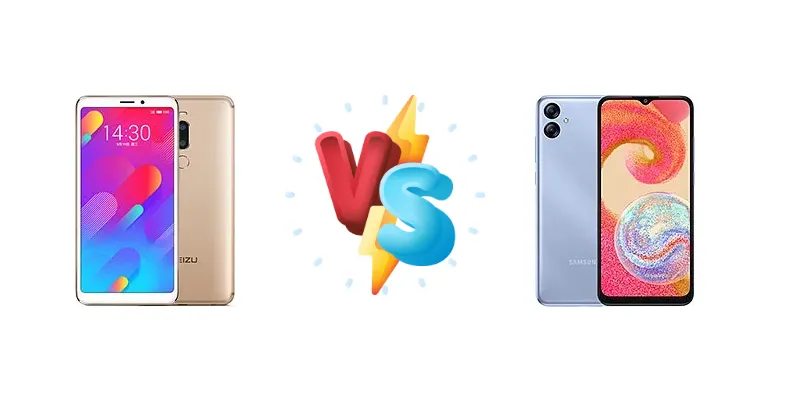
The Meizu V8 Pro and Samsung Galaxy A04e represent the extreme end of the budget smartphone spectrum. Both devices aim to deliver essential smartphone functionality at the lowest possible price point, but they achieve this with different Mediatek chipsets. This comparison dissects the performance differences between the Helio P22 in the V8 Pro and the Helio P35 in the A04e, helping you determine which offers the best value.
🏆 Quick Verdict
For the average user prioritizing responsiveness in everyday tasks, the Samsung Galaxy A04e emerges as the better choice. Its Helio P35 chipset, with its faster core clock speeds, provides a noticeable performance edge over the Meizu V8 Pro’s Helio P22, despite both being built on the same 12nm process.
| Network |
|---|
| 2G bands | GSM 850 / 900 / 1800 / 1900 | GSM 850 / 900 / 1800 / 1900 |
| 3G bands | HSDPA 850 / 900 / 2100 - China | HSDPA 850 / 900 / 2100 |
| 4G bands | 1, 3, 5, 8, 34, 38, 39, 40, 41 - China | 1, 3, 5, 7, 8, 20, 28, 38, 40, 41 |
| Speed | HSPA 42.2/11.5 Mbps, LTE (2CA) Cat6 300/50 Mbps | HSPA, LTE |
| Technology | GSM / CDMA / HSPA / LTE | GSM / HSPA / LTE |
| | CDMA 800 & TD-SCDMA - China | - |
| Launch |
|---|
| Announced | 2018, September. Released 2018, September | 2022, October 21 |
| Status | Discontinued | Available. Released 2022, November 07 |
| Body |
|---|
| Build | - | Glass front, plastic back, plastic frame |
| Dimensions | 147.5 x 72.7 x 8.1 mm (5.81 x 2.86 x 0.32 in) | 164.2 x 75.9 x 9.1 mm (6.46 x 2.99 x 0.36 in) |
| SIM | Nano-SIM + Nano-SIM | · Nano-SIM· Nano-SIM + Nano-SIM |
| Weight | 159 g (5.61 oz) | 188 g (6.63 oz) |
| Display |
|---|
| Resolution | 720 x 1440 pixels, 18:9 ratio (~282 ppi density) | 720 x 1600 pixels, 20:9 ratio (~270 ppi density) |
| Size | 5.7 inches, 83.8 cm2 (~78.2% screen-to-body ratio) | 6.5 inches, 102.0 cm2 (~81.8% screen-to-body ratio) |
| Type | IPS LCD | PLS LCD |
| Platform |
|---|
| CPU | Octa-core 2.0 GHz Cortex-A53 | Octa-core (4x2.3 GHz Cortex-A53 & 4x1.8 GHz Cortex-A53) |
| Chipset | Mediatek MT6762 Helio P22 (12 nm) | Mediatek MT6765 Helio P35 (12 nm) |
| GPU | PowerVR GE8320 | PowerVR GE8320 |
| OS | Android 8.0 (Oreo), Flyme UI | Android 12, One UI Core 4.1 |
| Memory |
|---|
| Card slot | microSDXC | microSDXC (dedicated slot) |
| Internal | 64GB 4GB RAM | 32GB 2GB RAM, 32GB 3GB RAM, 32GB 4GB RAM, 64GB 2GB RAM, 64GB 3GB RAM, 64GB 4GB RAM, 128GB 4GB RAM |
| | eMMC 5.1 | - |
| Main Camera |
|---|
| Dual | 12 MP, f/2.2, AF
5 MP, f/2.2 | 13 MP, f/2.2, (wide), AF
Auxiliary lens |
| Features | Dual-LED dual-tone flash, panorama | LED flash |
| Single | - | 5 MP, f/2.2 |
| Video | 1080p@30fps | 1080p@30fps |
| Selfie camera |
|---|
| Single | 5 MP, f/1.9 | 5 MP, f/2.2 |
| Video | - | Yes |
| Sound |
|---|
| 3.5mm jack | Yes | Yes |
| 35mm jack | Yes | Yes |
| Loudspeaker | Yes | Yes |
| Comms |
|---|
| Bluetooth | 5.0, A2DP, LE | 5.0, A2DP, LE |
| NFC | No | No |
| Positioning | GPS, GLONASS | GPS, GLONASS, GALILEO, BDS |
| Radio | No | Unspecified |
| USB | microUSB 2.0 | USB Type-C 2.0, OTG |
| WLAN | Wi-Fi 802.11 a/b/g/n, dual-band, Wi-Fi Direct | Wi-Fi 802.11 b/g/n, Wi-Fi Direct |
| Features |
|---|
| Sensors | Fingerprint (rear-mounted), accelerometer, proximity, compass | Accelerometer, proximity |
| Battery |
|---|
| Type | Li-Ion 3100 mAh, non-removable | Li-Po 5000 mAh |
| Misc |
|---|
| Colors | Black, Gold | Black, Copper, Light Blue |
| Models | - | SM-A042F, SM-A042F/DS, SM-A042M, SM-A042M/DS |
| Price | About 150 EUR | ₹ 7,999 |
| SAR EU | - | 0.29 W/kg (head) 1.11 W/kg (body) |
Meizu V8 Pro
- Potentially lower price point
- Reliable Mediatek Helio P22 chipset
- Functional for basic smartphone tasks
- Slower performance compared to the A04e
- Less responsive user interface
- May struggle with multitasking
Samsung Galaxy A04e
- Faster Mediatek Helio P35 chipset
- More responsive user experience
- Better multitasking capabilities
- May be slightly more expensive
- Similar camera performance to the V8 Pro
- Battery life gains are likely marginal
Display Comparison
Neither device is known for display prowess, and detailed display specs are unavailable. However, given their market positioning, both likely utilize LCD panels with 720p+ resolutions. The focus here is on the chipset's ability to drive the display smoothly, and the P35's GPU advantage will contribute to a slightly more fluid experience. Bezels are expected to be substantial on both devices, reflecting their budget nature.
Camera Comparison
Camera performance is likely to be similar on both devices, relying heavily on software processing. Both are expected to feature a primary camera alongside basic auxiliary lenses (likely 2MP depth or macro sensors, which offer limited utility). The image signal processor (ISP) within the Helio P35 is marginally more advanced, potentially leading to slightly better image quality in favorable lighting conditions. However, low-light performance will likely be a weakness on both devices. Focusing on the primary sensor's megapixel count is more important than the presence of low-resolution auxiliary cameras.
Performance
The core difference lies in the chipsets. The Meizu V8 Pro’s Mediatek MT6762 Helio P22 features an octa-core CPU clocked at 2.0 GHz, all Cortex-A53 cores. The Samsung Galaxy A04e’s Mediatek MT6765 Helio P35 utilizes a more sophisticated core configuration: four Cortex-A53 cores clocked at 2.3 GHz, paired with four slower cores at 1.8 GHz. This 'big.LITTLE' architecture allows the P35 to dynamically allocate tasks to the faster cores when needed, resulting in improved responsiveness. While both are 12nm chips, the higher clock speeds of the P35 translate to a tangible performance advantage in real-world usage. The P35 also has a slightly more capable GPU, further enhancing the user experience.
Battery Life
Battery capacity details are unavailable for both devices. However, given their price points, both are likely to feature batteries in the 3000-4000 mAh range. The Helio P35’s slightly improved efficiency, coupled with its ability to offload tasks to slower cores when possible, may result in marginally better battery life on the Samsung Galaxy A04e. Charging wattage is also unknown, but both are likely to support standard 5W or 10W charging, resulting in relatively slow charging times.
Buying Guide
Buy the Meizu V8 Pro if you prioritize a potentially lower price point and are willing to accept slightly slower performance for basic tasks. Buy the Samsung Galaxy A04e if you prefer a smoother user experience, particularly when multitasking or launching apps, and value the incremental performance boost offered by the Helio P35. Both are suitable for light users, but the A04e offers more headroom.
Frequently Asked Questions
❓ Will the Samsung Galaxy A04e handle popular social media apps like TikTok and Instagram smoothly?
Yes, the Helio P35 in the A04e provides sufficient processing power for smooth operation of most social media applications. The faster cores will ensure a more responsive experience when scrolling through feeds and recording videos compared to the V8 Pro.
❓ Is the difference in performance between the Helio P22 and Helio P35 noticeable for everyday tasks like browsing and messaging?
Yes, the difference is noticeable. While both chips can handle basic tasks, the A04e’s P35 will feel snappier when launching apps, switching between them, and general navigation. The P22 in the V8 Pro may exhibit slight lag in these scenarios.
❓ Can either of these phones run demanding games like PUBG Mobile or Call of Duty Mobile?
Both phones will struggle with demanding games. While PUBG Mobile might be playable at the lowest settings, expect significant frame rate drops and stuttering. The Helio P35 offers a slight advantage, but neither device is designed for serious gaming.
❓ Which phone is better for someone who primarily uses their phone for calls, texts, and light web browsing?
For this use case, either phone will suffice. However, the Samsung Galaxy A04e’s slightly better performance will provide a more pleasant overall experience, even for basic tasks. The added responsiveness is beneficial even for light users.