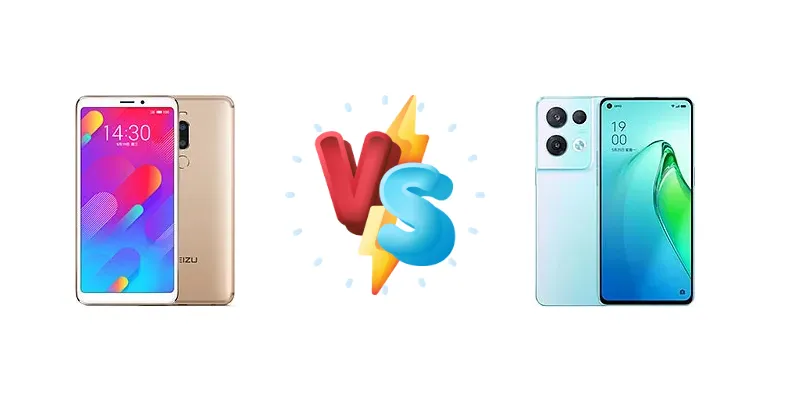
The Meizu V8 Pro represents a budget-conscious approach to smartphone ownership, while the Oppo Reno8 Pro (China) aims for a more refined mid-range experience. This comparison dissects the core differences between these two devices, focusing on the significant chipset disparity and its impact on daily use and long-term performance.
🏆 Quick Verdict
For the average user prioritizing responsiveness and future-proofing, the Oppo Reno8 Pro (China) is the clear winner. Its Snapdragon 7 Gen 1 chipset offers a substantial performance leap over the Meizu V8 Pro’s Helio P22, coupled with significantly faster 80W charging. However, the V8 Pro remains a viable option for basic tasks and users on a very tight budget.
| Network |
|---|
| 2G bands | GSM 850 / 900 / 1800 / 1900 | GSM 850 / 900 / 1800 / 1900 |
| 3G bands | HSDPA 850 / 900 / 2100 - China | HSDPA 800 / 850 / 900 / 1700(AWS) / 1900 / 2100 |
| 4G bands | 1, 3, 5, 8, 34, 38, 39, 40, 41 - China | 1, 3, 4, 5, 8, 28, 34, 38, 39, 40, 41 |
| 5G bands | - | 1, 3, 5, 8, 28, 41, 77, 78 SA/NSA |
| Speed | HSPA 42.2/11.5 Mbps, LTE (2CA) Cat6 300/50 Mbps | HSPA, LTE, 5G |
| Technology | GSM / CDMA / HSPA / LTE | GSM / CDMA / HSPA / EVDO / LTE / 5G |
| | CDMA 800 & TD-SCDMA - China | CDMA2000 1xEV-DO |
| Launch |
|---|
| Announced | 2018, September. Released 2018, September | 2022, May 23 |
| Status | Discontinued | Available. Released 2022, June 11 |
| Body |
|---|
| Build | - | Glass front (Gorilla Glass 5), aluminum frame |
| Dimensions | 147.5 x 72.7 x 8.1 mm (5.81 x 2.86 x 0.32 in) | 161 x 74.2 x 7.6 mm (6.34 x 2.92 x 0.30 in) |
| SIM | Nano-SIM + Nano-SIM | Nano-SIM + Nano-SIM |
| Weight | 159 g (5.61 oz) | 188 g (6.63 oz) |
| Display |
|---|
| Protection | - | Corning Gorilla Glass 5 |
| Resolution | 720 x 1440 pixels, 18:9 ratio (~282 ppi density) | 1080 x 2400 pixels, 20:9 ratio (~397 ppi density) |
| Size | 5.7 inches, 83.8 cm2 (~78.2% screen-to-body ratio) | 6.62 inches, 106.3 cm2 (~89.0% screen-to-body ratio) |
| Type | IPS LCD | AMOLED, 120Hz, HDR10+, 500 nits (typ), 800 nits (HBM), 1300 nits (peak) |
| Platform |
|---|
| CPU | Octa-core 2.0 GHz Cortex-A53 | Octa-core (1x2.4 GHz Cortex-A710 & 3x2.36 GHz Cortex-A710 & 4x1.8 GHz Cortex-A510) |
| Chipset | Mediatek MT6762 Helio P22 (12 nm) | Qualcomm SM7450-AB Snapdragon 7 Gen 1 (4 nm) |
| GPU | PowerVR GE8320 | Adreno 644 |
| OS | Android 8.0 (Oreo), Flyme UI | Android 12, upgradable to Android 14, ColorOS 14 |
| Memory |
|---|
| Card slot | microSDXC | No |
| Internal | 64GB 4GB RAM | 128GB 8GB RAM, 256GB 8GB RAM, 256GB 12GB RAM |
| | eMMC 5.1 | UFS 2.2 |
| Main Camera |
|---|
| Dual | 12 MP, f/2.2, AF
5 MP, f/2.2 | - |
| Features | Dual-LED dual-tone flash, panorama | Dual-LED flash, HDR, panorama |
| Single | - | 32 MP, f/2.4, 24mm (wide), 1/2.74", 0.8µm |
| Triple | - | 50 MP, f/1.8, 24mm (wide), 1/1.56", 1.0µm, PDAF
8 MP, f/2.2, 120˚ (ultrawide), 1/4.0", 1.12µm
2 MP (macro) |
| Video | 1080p@30fps | 4K@30fps, 1080p@30/60/120fps, gyro-EIS |
| Selfie camera |
|---|
| Features | - | Panorama, HDR |
| Single | 5 MP, f/1.9 | 32 MP, f/2.4, 24mm (wide), 1/2.74", 0.8µm |
| Video | - | 1080p@30fps, gyro-EIS |
| Sound |
|---|
| 3.5mm jack | Yes | No |
| 35mm jack | Yes | No |
| Loudspeaker | Yes | Yes |
| Comms |
|---|
| Bluetooth | 5.0, A2DP, LE | 5.2, A2DP, LE, aptX HD |
| NFC | No | Yes |
| Positioning | GPS, GLONASS | GPS, GLONASS, GALILEO, BDS, QZSS |
| Radio | No | No |
| USB | microUSB 2.0 | USB Type-C 2.0, OTG |
| WLAN | Wi-Fi 802.11 a/b/g/n, dual-band, Wi-Fi Direct | Wi-Fi 802.11 a/b/g/n/ac/6, dual-band, Wi-Fi Direct |
| Features |
|---|
| Sensors | Fingerprint (rear-mounted), accelerometer, proximity, compass | Fingerprint (under display, optical), accelerometer, gyro, proximity, compass |
| Battery |
|---|
| Charging | - | 80W wired, 45% in 10 min, 100% in 31 min
Reverse wired |
| Type | Li-Ion 3100 mAh, non-removable | Li-Po 4500 mAh |
| Misc |
|---|
| Colors | Black, Gold | Black, Blue, Gold |
| Models | - | PGAM10 |
| Price | About 150 EUR | About 420 EUR |
Meizu V8 Pro
- Significantly lower price point
- Functional for basic smartphone tasks
- Potentially longer software support due to simpler hardware
- Outdated and underpowered chipset
- Slow charging speeds
- Poor gaming performance
Oppo Reno8 Pro (China)
- Powerful Snapdragon 7 Gen 1 chipset
- Ultra-fast 80W charging
- Superior camera capabilities (likely)
- Reverse wired charging
- Higher price tag
- Potential for software bloat (typical of Oppo)
- May require more frequent charging with heavy use
Display Comparison
Context data lacks display specifics for both devices. However, given the Reno8 Pro’s positioning, it likely features a higher-quality AMOLED panel with a higher refresh rate than the V8 Pro, which may utilize an LCD. The Reno8 Pro’s more premium positioning suggests better color accuracy and peak brightness. Bezels are also likely slimmer on the Reno8 Pro, contributing to a more immersive viewing experience.
Camera Comparison
Without detailed camera specs, it’s difficult to make a precise comparison. However, the Reno8 Pro, being a more recent and higher-tier device, likely features a more sophisticated camera system with a larger main sensor and improved image processing algorithms. The Reno8 Pro likely benefits from features like Optical Image Stabilization (OIS), which the V8 Pro likely lacks. While both phones may include multiple lenses, the Reno8 Pro’s image quality will likely be superior in various lighting conditions.
Performance
The core difference lies in the chipsets. The Oppo Reno8 Pro’s Qualcomm Snapdragon 7 Gen 1 (4nm) is a generational leap ahead of the Meizu V8 Pro’s MediaTek Helio P22 (12nm). The Snapdragon 7 Gen 1 utilizes Cortex-A710 cores, offering significantly improved single-core and multi-core performance compared to the Cortex-A53 cores in the Helio P22. The 4nm process node of the Snapdragon 7 Gen 1 also translates to superior power efficiency and reduced thermal throttling during sustained workloads. This means the Reno8 Pro will handle demanding apps and games with greater ease and maintain performance for longer periods. The Reno8 Pro’s CPU configuration (1x2.4 GHz Cortex-A710 & 3x2.36 GHz Cortex-A710 & 4x1.8 GHz Cortex-A510) is far more capable than the Helio P22’s Octa-core 2.0 GHz Cortex-A53.
Battery Life
The Reno8 Pro’s 80W wired charging is a game-changer. The ability to charge from 0-100% in just 31 minutes significantly reduces downtime compared to the V8 Pro, which likely supports slower charging speeds. While the battery capacity isn’t specified for either device, the Snapdragon 7 Gen 1’s superior power efficiency means the Reno8 Pro can potentially offer comparable or even better battery life despite potentially having a similar or smaller battery capacity. The Reno8 Pro also offers reverse wired charging, a feature absent on the V8 Pro.
Buying Guide
Buy the Meizu V8 Pro if you need a functional smartphone for essential tasks like calls, messaging, and light social media browsing, and your budget is extremely limited. Buy the Oppo Reno8 Pro (China) if you prioritize smoother multitasking, gaming, faster charging speeds, and a more responsive user experience, even if it means a higher upfront cost.
Frequently Asked Questions
❓ Will the Oppo Reno8 Pro (China) run demanding games like Genshin Impact smoothly?
The Snapdragon 7 Gen 1 in the Reno8 Pro is capable of running Genshin Impact, but you'll likely need to adjust graphics settings to medium or low for a consistently smooth experience. The Helio P22 in the V8 Pro will struggle significantly with this title.
❓ Is the difference in charging speed between the two phones really that noticeable?
Absolutely. The Oppo Reno8 Pro’s 80W charging can take a phone from 0% to 45% in just 10 minutes and fully charge it in 31 minutes. The Meizu V8 Pro will likely take well over an hour to fully charge, making the Reno8 Pro much more convenient for users who need a quick power boost.
❓ Does the Meizu V8 Pro have enough processing power for everyday tasks like browsing and social media?
Yes, the Helio P22 is sufficient for basic tasks like web browsing, social media, and messaging. However, you may experience noticeable lag when multitasking or opening multiple apps simultaneously.
❓ Is the Oppo Reno8 Pro (China) a good choice for someone who frequently takes photos?
Likely, yes. While specific camera specs are unavailable, the Reno8 Pro’s more advanced chipset and likely larger sensor size suggest it will capture higher-quality photos and videos compared to the V8 Pro, especially in low-light conditions.