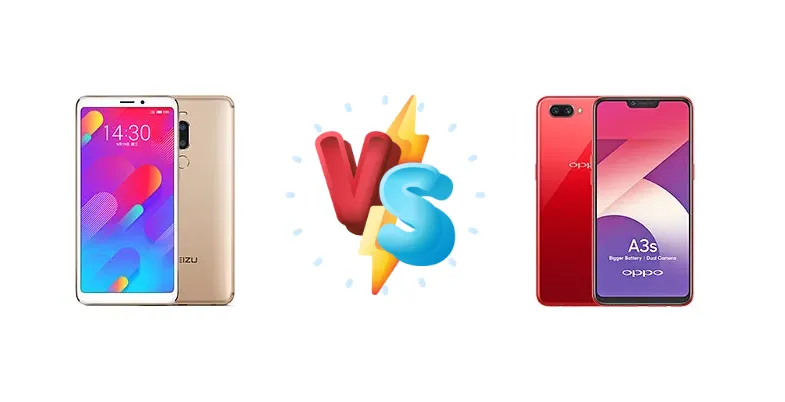
The Meizu V8 Pro and Oppo A3s represent a segment of the market focused on affordability. While both aim to deliver a smartphone experience without breaking the bank, they take different approaches to achieving this. The V8 Pro leverages Mediatek's power-efficient Helio P22, while the A3s opts for Qualcomm's Snapdragon 450. This comparison dissects these choices, revealing which device offers the best value for your money.
🏆 Quick Verdict
For the average user prioritizing sustained performance and faster charging, the Oppo A3s emerges as the better choice. While the Meizu V8 Pro benefits from a slightly newer process node, the Snapdragon 450's architecture and 20W charging provide a more responsive experience and quicker top-ups, outweighing the V8 Pro's marginal efficiency gains.
| Network |
|---|
| 2G bands | GSM 850 / 900 / 1800 / 1900 | GSM 850 / 900 / 1800 / 1900 |
| 3G bands | HSDPA 850 / 900 / 2100 - China | HSDPA 850 / 900 / 2100 |
| 4G bands | 1, 3, 5, 8, 34, 38, 39, 40, 41 - China | 1, 3, 5, 8, 38, 40, 41 |
| Speed | HSPA 42.2/11.5 Mbps, LTE (2CA) Cat6 300/50 Mbps | HSPA 42.2/5.76 Mbps, LTE (2CA) Cat6 300/50 Mbps |
| Technology | GSM / CDMA / HSPA / LTE | GSM / HSPA / LTE |
| | CDMA 800 & TD-SCDMA - China | - |
| Launch |
|---|
| Announced | 2018, September. Released 2018, September | 2018, July 13. Released 2018, July |
| Status | Discontinued | Discontinued |
| Body |
|---|
| Build | - | Glass front (Gorilla Glass 3), plastic back, plastic frame |
| Dimensions | 147.5 x 72.7 x 8.1 mm (5.81 x 2.86 x 0.32 in) | 156.2 x 75.6 x 8.2 mm (6.15 x 2.98 x 0.32 in) |
| SIM | Nano-SIM + Nano-SIM | Nano-SIM + Nano-SIM |
| Weight | 159 g (5.61 oz) | 168 g (5.93 oz) |
| Display |
|---|
| Protection | - | Corning Gorilla Glass 3 |
| Resolution | 720 x 1440 pixels, 18:9 ratio (~282 ppi density) | 720 x 1520 pixels, 19:9 ratio (~271 ppi density) |
| Size | 5.7 inches, 83.8 cm2 (~78.2% screen-to-body ratio) | 6.2 inches, 95.9 cm2 (~81.2% screen-to-body ratio) |
| Type | IPS LCD | IPS LCD |
| Platform |
|---|
| CPU | Octa-core 2.0 GHz Cortex-A53 | Octa-core 1.8 GHz Cortex-A53 |
| Chipset | Mediatek MT6762 Helio P22 (12 nm) | Qualcomm SDM450 Snapdragon 450 (14 nm) |
| GPU | PowerVR GE8320 | Adreno 506 |
| OS | Android 8.0 (Oreo), Flyme UI | Android 8.1 (Oreo), ColorOS 5.1 |
| Memory |
|---|
| Card slot | microSDXC | microSDXC (dedicated slot) |
| Internal | 64GB 4GB RAM | 16GB 2GB RAM, 32GB 3GB RAM, 64GB 4GB RAM |
| | eMMC 5.1 | eMMC 5.1 |
| Main Camera |
|---|
| Dual | 12 MP, f/2.2, AF
5 MP, f/2.2 | 13 MP, f/2.2, AF
Auxiliary lens |
| Features | Dual-LED dual-tone flash, panorama | LED flash, HDR, panorama |
| Video | 1080p@30fps | 1080p@30fps |
| Selfie camera |
|---|
| Single | 5 MP, f/1.9 | 8 MP, f/2.2 |
| Video | - | 1080p@30fps |
| Sound |
|---|
| 3.5mm jack | Yes | Yes |
| 35mm jack | Yes | Yes |
| Loudspeaker | Yes | Yes |
| Comms |
|---|
| Bluetooth | 5.0, A2DP, LE | 4.2, A2DP, LE |
| NFC | No | No |
| Positioning | GPS, GLONASS | GPS |
| Radio | No | FM radio |
| USB | microUSB 2.0 | microUSB 2.0, OTG |
| WLAN | Wi-Fi 802.11 a/b/g/n, dual-band, Wi-Fi Direct | Wi-Fi 802.11 b/g/n, Wi-Fi Direct |
| Features |
|---|
| Sensors | Fingerprint (rear-mounted), accelerometer, proximity, compass | Accelerometer, gyro, proximity, compass |
| Battery |
|---|
| Charging | - | 20W wired |
| Type | Li-Ion 3100 mAh, non-removable | Li-Ion 4230 mAh, non-removable |
| Misc |
|---|
| Colors | Black, Gold | Red, Dark Purple |
| Models | - | CPH1803, CPH1853, CPH1805 |
| Price | About 150 EUR | About 11000 INR |
Meizu V8 Pro
- Potentially better power efficiency with the 12nm Helio P22.
- May run cooler under sustained light loads.
- Likely a more affordable price point.
- Snapdragon 450 generally offers better sustained performance.
- Slower charging speeds compared to the Oppo A3s.
Oppo A3s
- Faster 20W wired charging.
- Snapdragon 450 provides a more responsive user experience.
- Qualcomm’s optimizations generally lead to better app compatibility.
- 14nm process may result in slightly higher power consumption.
- Potentially runs warmer under heavy load.
Display Comparison
Neither device boasts a standout display. Given the context data focuses on processing power, we can infer both likely utilize LCD panels common in this price bracket. The absence of specifications like resolution or refresh rate suggests a focus on cost reduction. Bezels are likely substantial on both, typical of phones in this segment. Color accuracy is expected to be standard, prioritizing visibility over fidelity.
Camera Comparison
Without detailed camera specifications, a direct comparison is difficult. Both phones likely feature basic camera setups geared towards casual photography. It's reasonable to assume both will include a primary sensor and potentially a depth sensor for portrait mode effects. The absence of OIS (Optical Image Stabilization) on either device suggests image stabilization will rely on software processing. Given the market segment, image quality will likely be adequate for social media sharing but won't compete with higher-end smartphones.
Performance
The core difference lies in the chipsets. The Meizu V8 Pro’s Mediatek MT6762 Helio P22 (12nm) and the Oppo A3s’ Qualcomm SDM450 Snapdragon 450 (14nm) both employ octa-core Cortex-A53 CPUs, but the manufacturing process and architectural nuances matter. The 12nm process of the Helio P22 *should* theoretically offer better power efficiency, potentially leading to longer battery life during less intensive tasks. However, the Snapdragon 450, despite being on a larger 14nm node, generally exhibits better sustained performance due to Qualcomm’s optimizations and a slightly higher clock speed (1.8GHz vs 2.0GHz). This translates to smoother app switching and a more responsive user interface on the Oppo A3s. The lack of information on RAM speed and capacity prevents a complete assessment, but the chipset difference is the dominant factor.
Battery Life
While the battery capacity isn't specified, the Oppo A3s’ 20W wired charging is a significant advantage. This allows for a much faster 0-100% charge compared to the likely slower charging speeds of the Meizu V8 Pro. The Helio P22’s efficiency *could* translate to slightly longer battery life during light use, but the faster charging of the A3s mitigates the impact of any capacity difference. Users who frequently need to top up their phones will greatly benefit from the A3s’ charging capabilities.
Buying Guide
Buy the Meizu V8 Pro if you prioritize maximizing battery life during light usage and appreciate a potentially cooler operating temperature. This phone suits users who primarily browse, use social media, and make occasional calls. Buy the Oppo A3s if you need a phone that feels more responsive during multitasking, benefits from faster charging, and can handle slightly more demanding applications without significant slowdowns. This is the better option for users who play casual games or frequently switch between apps.
Frequently Asked Questions
❓ Will the Snapdragon 450 in the Oppo A3s struggle with modern mobile games?
While the Snapdragon 450 isn't a gaming powerhouse, it can handle many popular casual games at medium settings. Demanding titles may require lower graphics settings and frame rates for a smooth experience. The Helio P22 in the Meizu V8 Pro will likely offer similar gaming performance, but the A3s' slightly better CPU and GPU provide a small edge.
❓ How much faster is the 20W charging on the Oppo A3s compared to a standard 10W charger?
20W charging on the Oppo A3s can significantly reduce charging times. While exact times depend on battery capacity, you can expect a full charge to be completed roughly 30-50% faster than with a standard 10W charger. This is a major convenience factor for users who frequently need to top up their phones throughout the day.
❓ Is the difference in CPU clock speed (2.0 GHz vs 1.8 GHz) noticeable in everyday use?
The 0.2 GHz difference in CPU clock speed is unlikely to be dramatically noticeable in most everyday tasks like browsing, social media, and messaging. However, the Snapdragon 450's architectural advantages and optimizations provide a more consistent and responsive experience, making the A3s feel snappier overall.