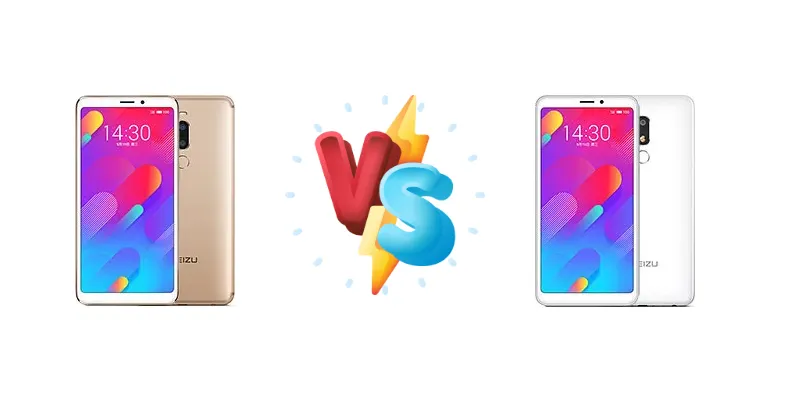
The Meizu V8 and V8 Pro represent a budget-focused approach from Meizu, but a significant internal difference separates them: the chipset. While both aim to provide an affordable smartphone experience, the V8 Pro’s newer Mediatek Helio P22 processor promises a noticeable performance uplift over the V8’s older MT6739. This comparison dissects these differences to determine which device offers the best value.
🏆 Quick Verdict
For most users, the Meizu V8 Pro is the clear winner. Its Helio P22 chipset, built on a 12nm process, delivers substantially improved performance and efficiency compared to the V8’s 28nm MT6739. While both phones target the budget segment, the V8 Pro offers a smoother, more responsive experience justifying the likely price premium.
| Network |
|---|
| 2G bands | GSM 850 / 900 / 1800 / 1900 | GSM 850 / 900 / 1800 / 1900 |
| 3G bands | HSDPA 850 / 900 / 2100 - China | HSDPA 850 / 900 / 2100 - China |
| 4G bands | 1, 3, 5, 8, 34, 38, 39, 40, 41 - China | 1, 3, 5, 7, 8, 38, 39, 40, 41 - China |
| Speed | HSPA 42.2/11.5 Mbps, LTE (2CA) Cat6 300/50 Mbps | HSPA 42.2/5.76 Mbps, LTE Cat4 150/50 Mbps |
| Technology | GSM / CDMA / HSPA / LTE | GSM / CDMA / HSPA / LTE |
| | CDMA 800 & TD-SCDMA - China | CDMA 800 & TD-SCDMA - China |
| Launch |
|---|
| Announced | 2018, September. Released 2018, September | 2018, September. Released 2018, September |
| Status | Discontinued | Discontinued |
| Body |
|---|
| Dimensions | 147.5 x 72.7 x 8.1 mm (5.81 x 2.86 x 0.32 in) | 148 x 73 x 8.4 mm (5.83 x 2.87 x 0.33 in) |
| SIM | Nano-SIM + Nano-SIM | Nano-SIM + Nano-SIM |
| Weight | 159 g (5.61 oz) | 145 g (5.11 oz) |
| Display |
|---|
| Resolution | 720 x 1440 pixels, 18:9 ratio (~282 ppi density) | 720 x 1440 pixels, 18:9 ratio (~282 ppi density) |
| Size | 5.7 inches, 83.8 cm2 (~78.2% screen-to-body ratio) | 5.7 inches, 83.8 cm2 (~77.6% screen-to-body ratio) |
| Type | IPS LCD | IPS LCD |
| Platform |
|---|
| CPU | Octa-core 2.0 GHz Cortex-A53 | Quad-core 1.5 GHz Cortex-A53 |
| Chipset | Mediatek MT6762 Helio P22 (12 nm) | Mediatek MT6739 (28 nm) |
| GPU | PowerVR GE8320 | PowerVR GE8100 |
| OS | Android 8.0 (Oreo), Flyme UI | Android 8.0 (Oreo), Flyme UI |
| Memory |
|---|
| Card slot | microSDXC | microSDXC |
| Internal | 64GB 4GB RAM | 32GB 3GB RAM |
| | eMMC 5.1 | eMMC 5.1 |
| Main Camera |
|---|
| Dual | 12 MP, f/2.2, AF
5 MP, f/2.2 | - |
| Features | Dual-LED dual-tone flash, panorama | Dual-LED dual-tone flash, panorama |
| Single | - | 13 MP, f/2.2, AF |
| Video | 1080p@30fps | 1080p@30fps |
| Selfie camera |
|---|
| Single | 5 MP, f/1.9 | 5 MP, f/1.9 |
| Sound |
|---|
| 3.5mm jack | Yes | Yes |
| 35mm jack | Yes | Yes |
| Loudspeaker | Yes | Yes |
| Comms |
|---|
| Bluetooth | 5.0, A2DP, LE | 4.2, A2DP, LE |
| NFC | No | No |
| Positioning | GPS, GLONASS | GPS, GLONASS |
| Radio | No | No |
| USB | microUSB 2.0 | microUSB 2.0 |
| WLAN | Wi-Fi 802.11 a/b/g/n, dual-band, Wi-Fi Direct | Wi-Fi 802.11 b/g/n, Wi-Fi Direct |
| Features |
|---|
| Sensors | Fingerprint (rear-mounted), accelerometer, proximity, compass | Fingerprint (rear-mounted), accelerometer, proximity, compass |
| Battery |
|---|
| Type | Li-Ion 3100 mAh, non-removable | Li-Ion 3200 mAh, non-removable |
| Misc |
|---|
| Colors | Black, Gold | Black, White |
| Price | About 150 EUR | About 100 EUR |
Meizu V8 Pro
- Significantly faster processor
- More efficient power consumption
- Improved multitasking capabilities
- Likely a slightly higher price point
- May not have a dramatically better camera without sensor upgrades
Meizu V8
- Lower price point
- Sufficient for basic smartphone tasks
- Potentially longer standby time (due to less powerful processor)
- Slow processor and noticeable lag
- Poor performance with demanding apps
- Less efficient power consumption
Display Comparison
Neither Meizu provides detailed display specifications in the provided data. However, given their market positioning, it’s reasonable to assume both utilize IPS LCD panels. The difference in chipset power will have a greater impact on perceived smoothness of UI elements than display quality. The V8 Pro’s more powerful GPU will likely contribute to better rendering of animations and transitions, even on a similar panel.
Camera Comparison
Without specific camera sensor details, a direct comparison is difficult. However, the V8 Pro’s more powerful ISP (Image Signal Processor) within the Helio P22 chipset will likely result in better image processing, including improved noise reduction and dynamic range. While both phones may feature similar megapixel counts, the V8 Pro will likely produce more detailed and visually appealing photos, especially in challenging lighting conditions. It's probable that both phones include low-resolution auxiliary cameras (e.g., 2MP depth sensors) which offer limited practical benefit.
Performance
The core difference lies in the chipsets. The Meizu V8 Pro’s Mediatek MT6762 Helio P22 (12nm) features an octa-core CPU clocked at 2.0 GHz, while the V8’s MT6739 (28nm) has a quad-core CPU at 1.5 GHz. The 12nm fabrication process of the Helio P22 is significantly more efficient, leading to lower power consumption and reduced heat generation. This translates to better sustained performance and potentially longer battery life. The octa-core configuration also provides a substantial advantage in multitasking and handling more complex applications. The V8’s MT6739, being older and built on a larger process node, will struggle with demanding tasks and exhibit noticeable lag.
Battery Life
Battery capacity isn’t specified, but the V8 Pro’s more efficient Helio P22 chipset will undoubtedly translate to longer battery life. The 12nm process consumes less power than the V8’s 28nm MT6739. Even with a similar battery capacity, the V8 Pro will likely offer several hours of additional usage. The V8 Pro’s chipset may also support more efficient power management features, further extending battery life. Charging wattage is also unknown, but the V8 Pro’s chipset may support faster charging protocols.
Buying Guide
Buy the Meizu V8 Pro if you prioritize a responsive user experience, smoother multitasking, and the ability to handle moderately demanding apps. This phone is ideal for users who frequently browse the web, use social media, or play casual games. Buy the Meizu V8 if your primary needs are basic communication – calls, texts, and light web browsing – and you are on a very tight budget where every dollar counts. It’s a functional device for minimal smartphone usage.
Frequently Asked Questions
❓ Will the Meizu V8 Pro handle popular games like PUBG Mobile or Call of Duty?
While the Helio P22 isn't a gaming powerhouse, the Meizu V8 Pro will offer a playable experience in PUBG Mobile and Call of Duty at lower graphics settings. The V8, with its MT6739, will likely struggle to maintain a stable framerate even at the lowest settings.
❓ How much of a difference will I notice in everyday tasks like browsing and social media?
The difference will be quite noticeable. The V8 Pro’s octa-core processor and more efficient architecture will result in significantly faster app loading times, smoother scrolling, and a more responsive overall experience when browsing the web or using social media apps. The V8 will feel sluggish in comparison.
❓ Is the difference in chipset worth paying extra for the V8 Pro?
For most users, yes. The improved performance and efficiency of the Helio P22 in the V8 Pro provide a much more enjoyable and future-proof experience. If you plan to use your phone for anything beyond basic communication, the V8 Pro is a worthwhile investment.