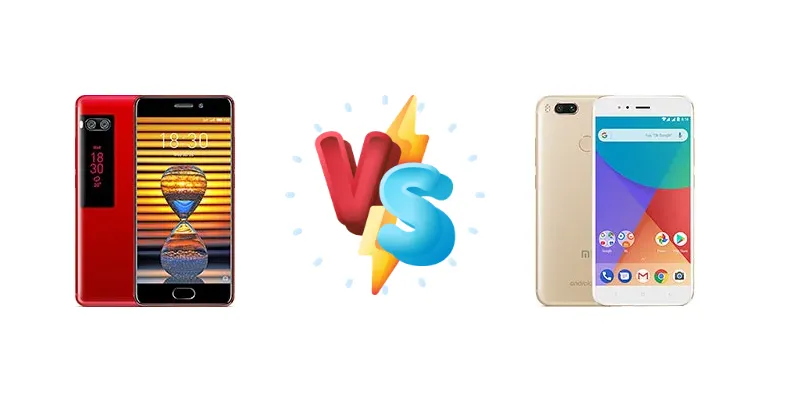
Released in 2017, the Meizu Pro 7 and Xiaomi Mi A1 (also known as the Mi 5X) represented distinct approaches to the mid-range smartphone market. The Pro 7 aimed for flagship-level performance with its Helio X30 variant, while the Mi A1 prioritized software experience and camera quality within a more conservative hardware package. This comparison revisits these devices to determine which holds up better today.
🏆 Quick Verdict
For the average user in 2024, the Xiaomi Mi A1 emerges as the more practical choice. While the Meizu Pro 7’s Helio X30 offers theoretical performance advantages, the Mi A1’s Snapdragon 625 provides a more consistently smooth experience, coupled with comparable battery life and a cleaner software experience. The Pro 7’s complexity and potential thermal issues outweigh its raw power.
| Network |
|---|
| 2G bands | GSM 850 / 900 / 1800 / 1900 - SIM 1 & SIM 2 | GSM 850 / 900 / 1800 / 1900 - SIM 1 & SIM 2 |
| 3G bands | HSDPA 850 / 900 / 1900 / 2100 | HSDPA 850 / 900 / 1900 / 2100 |
| 4G bands | 1, 3, 7, 38, 39, 40, 41 | 1, 3, 5, 7, 8, 20, 38, 40 |
| Speed | HSPA, LTE | HSPA 42.2/5.76 Mbps, LTE (2CA) Cat6 300/50 Mbps |
| Technology | GSM / HSPA / EVDO / LTE | GSM / HSPA / LTE |
| | CDMA2000 1xEV-DO & TD-SCDMA | - |
| Launch |
|---|
| Announced | 2017, July. Released 2017, August | 2017, September. Released 2017, September |
| Status | Discontinued | Discontinued |
| Body |
|---|
| Build | - | Glass front (Gorilla Glass 3), aluminum back, aluminum frame |
| Dimensions | 147.6 x 70.7 x 7.3 mm (5.81 x 2.78 x 0.29 in) | 155.4 x 75.8 x 7.3 mm (6.12 x 2.98 x 0.29 in) |
| SIM | Nano-SIM + Nano-SIM | Nano-SIM + Nano-SIM |
| Weight | 163 g (5.75 oz) | 165 g (5.82 oz) |
| Display |
|---|
| Protection | - | Corning Gorilla Glass 3 |
| Resolution | 1080 x 1920 pixels, 16:9 ratio (~423 ppi density) | 1080 x 1920 pixels, 16:9 ratio (~403 ppi density) |
| Size | 5.2 inches, 74.9 cm2 (~71.8% screen-to-body ratio) | 5.5 inches, 82.6 cm2 (~70.1% screen-to-body ratio) |
| Type | Super AMOLED | IPS LCD |
| | Secondary 2" AMOLED display, 240 x 536 pixels | - |
| Platform |
|---|
| CPU | Octa-core (4x2.4 GHz Cortex-A53 & 4x1.6 GHz Cortex-A53)Deca-core (2x2.6 GHz Cortex-A73, 4x1.9 GHz Cortex-A35, 4x2.2 GHz Cortex-A53) | Octa-core 2.0 GHz Cortex-A53 |
| Chipset | Mediatek MT6757T Helio P25 (16 nm) - standard editionMediatek MT6799 Helio X30 (10 nm) - high edition | Qualcomm MSM8953 Snapdragon 625 (14 nm) |
| GPU | Mali-T880MP2PowerVR 7XTP | Adreno 506 |
| OS | Android 7.0 (Nougat), Flyme 7.3 | Android 7.1.2 (Nougat), upgradable to Android 9.0 (Pie), Android One |
| Memory |
|---|
| Card slot | No | microSDXC (uses shared SIM slot) |
| Internal | 64GB 4GB RAM, 128GB 4GB RAM | 32GB 4GB RAM, 64GB 4GB RAM |
| | - | eMMC 5.1 |
| Main Camera |
|---|
| Dual | - | 12 MP, f/2.2, 26mm (wide), 1/2.9", 1.25µm, PDAF
12 MP, f/2.6, 50mm (telephoto), 1.0µm, AF, 2x optical zoom |
| Features | Dual-LED dual-tone flash, HDR, panorama | Dual-LED dual-tone flash, HDR, panorama |
| Single | 12 MP, f/2.0, 1/2.9", 1.25µm, PDAF | - |
| Video | 4K@30fps, 1080p@30fps | 4K@30fps, 1080p@30fps, 720p@120fps |
| Selfie camera |
|---|
| Single | 16 MP, f/2.0, 26mm (wide), 1/3.06", 1.0µm | 5 MP |
| Video | 1080p@30fps | 1080p@30fps |
| Sound |
|---|
| 3.5mm jack | Yes | Yes |
| 35mm jack | Yes | Yes |
| Loudspeaker | Yes | Yes |
| | 32-bit/192kHz audio
| - |
| Comms |
|---|
| Bluetooth | 4.2, A2DP, LE | 4.2, A2DP, LE |
| Infrared port | - | Yes |
| NFC | No | No |
| Positioning | GPS, GLONASS, BDS | GPS, GLONASS, BDS |
| Radio | No | FM radio |
| USB | USB Type-C | USB Type-C 2.0 |
| WLAN | Wi-Fi 802.11 a/b/g/n or a/b/g/n/ac, dual-band, Wi-Fi Direct | Wi-Fi 802.11 a/b/g/n/ac, dual-band, Wi-Fi Direct |
| Features |
|---|
| Sensors | Fingerprint (front-mounted), accelerometer, gyro, proximity, compass | Fingerprint (rear-mounted), accelerometer, gyro, proximity |
| Battery |
|---|
| Charging | 24W wired | 10W wired |
| Type | Li-Ion 3000 mAh, non-removable | Li-Po 3080 mAh, non-removable |
| Misc |
|---|
| Colors | Black, gold, red | Black, Gold, Rose Gold, Red |
| Models | PRO 7, MZ-PRO 7 | MDG2, MDI2 |
| Price | About 400 EUR | About 170 EUR |
| SAR | - | 1.75 W/kg (head) 0.76 W/kg (body) |
| Tests |
|---|
| Audio quality | - |
Noise -91.0dB / Crosstalk -82.5dB |
| Battery life | - | Endurance rating 87h |
| Camera | - |
Photo / Video |
| Display | - |
Contrast ratio: 1570:1 (nominal), 2.689 (sunlight) |
| Loudspeaker | - |
Voice 74dB / Noise 73dB / Ring 90dB |
| Performance | - |
GeekBench: 4292 (v4.4)
GFXBench: 3.5fps (ES 3.1 onscreen) |
Meizu Pro 7
- Potentially higher peak performance with Helio X30
- Faster 24W wired charging
- Unique dual-screen design (novelty factor)
- Helio X30 prone to thermal throttling
- Software complexity and potential bugs
- Limited information on display specs
Xiaomi Mi A1 (Mi 5X)
- Stable and clean Android experience
- Efficient Snapdragon 625 processor
- Reliable camera performance
- Slower 10W wired charging
- Less raw processing power than Pro 7 (Helio X30)
- Display isn't class-leading
Display Comparison
Both the Meizu Pro 7 and Xiaomi Mi A1 share a similar display contrast ratio of 1570:1 (nominal) and 2.689 (sunlight), suggesting comparable visibility in bright conditions. However, detailed display specs like resolution and panel type are missing for the Pro 7. The Mi A1’s display, while not exceptional, delivers accurate colors and good viewing angles. The Pro 7’s dual-screen design, while novel, doesn’t inherently translate to a superior viewing experience and adds complexity.
Camera Comparison
Both devices feature photo and video capabilities, but specifics are limited. The Mi A1 gained recognition for its camera quality, leveraging Qualcomm’s image signal processor. Without detailed sensor information for the Pro 7, it’s difficult to assess its camera performance definitively. The Mi A1’s consistent image processing and reliable performance make it a more predictable choice for photography. The Pro 7’s camera system, while potentially capable, lacks the established reputation of the Mi A1.
Performance
The core difference lies in the chipsets. The Meizu Pro 7 boasts either the MediaTek MT6757T Helio P25 or the more powerful MT6799 Helio X30 (10nm). The Helio X30, a deca-core processor, theoretically outperforms the Xiaomi Mi A1’s Qualcomm MSM8953 Snapdragon 625 (14nm) octa-core. However, the Snapdragon 625’s efficiency and optimized software integration often result in a smoother, more consistent user experience. The Helio X30’s complex architecture is prone to thermal throttling under sustained load, diminishing its performance advantage. The Mi A1’s Snapdragon 625, built on a 14nm process, offers a better balance of performance and power efficiency.
Battery Life
Interestingly, both phones achieved an endurance rating of 87 hours, suggesting similar real-world battery life despite the Pro 7’s more power-hungry chipset. The Meizu Pro 7 supports 24W wired charging, significantly faster than the Mi A1’s 10W charging. This means the Pro 7 can replenish its battery much quicker, mitigating the impact of its potentially higher power consumption. However, the Mi A1’s efficient Snapdragon 625 helps it maintain a respectable battery life throughout the day.
Buying Guide
Buy the Meizu Pro 7 if you prioritize raw processing power and are comfortable with potential software quirks and thermal throttling. Its Helio X30 variant offers a noticeable performance boost for demanding tasks. Buy the Xiaomi Mi A1 (Mi 5X) if you value a stable Android experience, reliable battery life, and a well-tuned camera system. It’s the better option for everyday use and photography.
Frequently Asked Questions
❓ Is the Meizu Pro 7’s dual-screen feature actually useful?
While innovative, the secondary e-ink display on the Pro 7 primarily served for notifications and basic information. It wasn’t a core functionality for most users and added complexity to the device. Its utility is limited compared to the Mi A1’s more conventional design.
❓ Does the Snapdragon 625 in the Mi A1 still hold up for basic tasks in 2024?
Absolutely. The Snapdragon 625 remains a capable processor for everyday tasks like browsing, social media, and messaging. Its efficiency ensures a smooth and responsive experience, even years after its release. It’s more than sufficient for users who don’t require demanding performance.
❓ Which phone is better for long-term software support?
The Xiaomi Mi A1, being part of the Android One program, received guaranteed software updates for a longer period than the Meizu Pro 7. Meizu’s software support track record is less consistent, making the Mi A1 the safer choice for long-term security and feature updates.