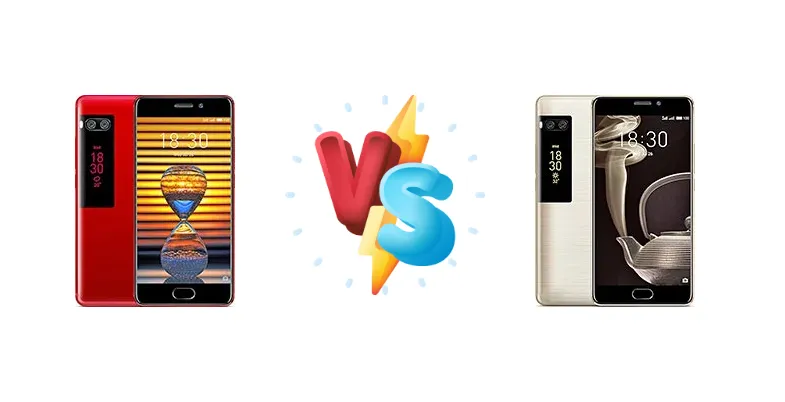
The Meizu Pro 7 and Pro 7 Plus represented a bold step for the Chinese manufacturer, introducing a secondary e-ink display alongside powerful (for their time) MediaTek processors. While visually similar, key internal differences – particularly in chipset and battery optimization – create distinct user experiences. This comparison dissects those differences to determine which Pro 7 variant offers the best value today.
🏆 Quick Verdict
For most users, the Meizu Pro 7 Plus is the superior choice. Its consistent use of the Helio X30 chipset and optimized battery endurance, offering 45% charge in 30 minutes, provide a smoother and more reliable experience than the base Pro 7, which can be found with either the Helio P25 or X30.
| Network |
|---|
| 2G bands | GSM 850 / 900 / 1800 / 1900 - SIM 1 & SIM 2 | GSM 850 / 900 / 1800 / 1900 - SIM 1 & SIM 2 |
| 3G bands | HSDPA 850 / 900 / 1900 / 2100 | HSDPA 850 / 900 / 1900 / 2100 |
| 4G bands | 1, 3, 7, 38, 39, 40, 41 | 1, 3, 7, 38, 39, 40, 41 |
| Speed | HSPA, LTE | HSPA, LTE |
| Technology | GSM / HSPA / EVDO / LTE | GSM / HSPA / EVDO / LTE |
| | CDMA2000 1xEV-DO & TD-SCDMA | CDMA2000 1xEV-DO & TD-SCDMA |
| Launch |
|---|
| Announced | 2017, July. Released 2017, August | 2017, July. Released 2017, August |
| Status | Discontinued | Discontinued |
| Body |
|---|
| Build | - | Glass front, aluminum back, aluminum frame |
| Dimensions | 147.6 x 70.7 x 7.3 mm (5.81 x 2.78 x 0.29 in) | 157.3 x 77.2 x 7.3 mm (6.19 x 3.04 x 0.29 in) |
| SIM | Nano-SIM + Nano-SIM | Nano-SIM + Nano-SIM |
| Weight | 163 g (5.75 oz) | 170 g (6.00 oz) |
| Display |
|---|
| Resolution | 1080 x 1920 pixels, 16:9 ratio (~423 ppi density) | 1440 x 2560 pixels, 16:9 ratio (~518 ppi density) |
| Size | 5.2 inches, 74.9 cm2 (~71.8% screen-to-body ratio) | 5.7 inches, 88.5 cm2 (~72.9% screen-to-body ratio) |
| Type | Super AMOLED | Super AMOLED |
| | Secondary 2" AMOLED display, 240 x 536 pixels | Secondary 2" AMOLED display, 240 x 536 pixels |
| Platform |
|---|
| CPU | Octa-core (4x2.4 GHz Cortex-A53 & 4x1.6 GHz Cortex-A53)Deca-core (2x2.6 GHz Cortex-A73, 4x1.9 GHz Cortex-A35, 4x2.2 GHz Cortex-A53) | Deca-core (2x2.6 GHz Cortex-A73, 4x1.9 GHz Cortex-A35, 4x2.2 GHz Cortex-A53) |
| Chipset | Mediatek MT6757T Helio P25 (16 nm) - standard editionMediatek MT6799 Helio X30 (10 nm) - high edition | Mediatek MT6799 Helio X30 (10 nm) |
| GPU | Mali-T880MP2PowerVR 7XTP | PowerVR 7XTP |
| OS | Android 7.0 (Nougat), Flyme 7.3 | Android 7.0 (Nougat), Flyme 7.3 |
| Memory |
|---|
| Card slot | No | No |
| Internal | 64GB 4GB RAM, 128GB 4GB RAM | 64GB 6GB RAM, 128GB 6GB RAM |
| Main Camera |
|---|
| Features | Dual-LED dual-tone flash, HDR, panorama | Dual-LED dual-tone flash, HDR, panorama |
| Single | 12 MP, f/2.0, 1/2.9", 1.25µm, PDAF | 12 MP, f/2.0, 1/2.9", 1.25µm, PDAF |
| Video | 4K@30fps, 1080p@30fps | 4K@30fps |
| Selfie camera |
|---|
| Single | 16 MP, f/2.0, 26mm (wide), 1/3.06", 1.0µm | 16 MP, f/2.0, 26mm (wide), 1/3.06", 1.0µm |
| Video | 1080p@30fps | - |
| Sound |
|---|
| 3.5mm jack | Yes | Yes |
| 35mm jack | Yes | Yes |
| Loudspeaker | Yes | Yes |
| | 32-bit/192kHz audio
| 32-bit/192kHz audio
|
| Comms |
|---|
| Bluetooth | 4.2, A2DP, LE | 4.2, A2DP, LE |
| NFC | No | No |
| Positioning | GPS, GLONASS, BDS | GPS, GLONASS, BDS |
| Radio | No | No |
| USB | USB Type-C | USB Type-C |
| WLAN | Wi-Fi 802.11 a/b/g/n or a/b/g/n/ac, dual-band, Wi-Fi Direct | Wi-Fi 802.11 a/b/g/n/ac, dual-band, Wi-Fi Direct |
| Features |
|---|
| Sensors | Fingerprint (front-mounted), accelerometer, gyro, proximity, compass | Fingerprint (front-mounted), accelerometer, gyro, proximity, compass |
| Battery |
|---|
| Charging | 24W wired | 24W wired, 45% in 30 min |
| Type | Li-Ion 3000 mAh, non-removable | Li-Ion 3500 mAh, non-removable |
| Misc |
|---|
| Colors | Black, gold, red | Black, gold, silver |
| Models | PRO 7, MZ-PRO 7 | PRO 7 Plus |
| Price | About 400 EUR | About 500 EUR |
| Tests |
|---|
| Audio quality | - |
Noise -92.1dB / Crosstalk -92.8dB |
| Battery life | - | Endurance rating 70h |
| Camera | - |
Photo / Video |
| Display | - |
Contrast ratio: Infinite (nominal), 4.147 (sunlight) |
| Loudspeaker | - |
Voice 87dB / Noise 72dB / Ring 90dB |
| Performance | - |
GFXBench: 4.8fps (ES 3.1 onscreen) |
Meizu Pro 7
- Potentially lower price (P25 variant)
- Unique dual-screen functionality
- 24W wired charging
- Inconsistent performance (P25 vs X30)
- Potentially shorter battery life (P25 variant)
- Helio P25 is less efficient
Meizu Pro 7 Plus
- Consistent performance with Helio X30
- Optimized battery endurance (70h rating)
- Faster charging (45% in 30 min)
- Generally higher price
- Dual-screen functionality may be niche
- Older chipset architecture
Display Comparison
Both the Pro 7 and Pro 7 Plus feature identical primary displays, boasting an infinite (nominal) contrast ratio and a 4.147 contrast ratio in sunlight. This suggests excellent visibility even in bright outdoor conditions. However, the secondary e-ink display is a defining feature of both, offering always-on information and reduced power consumption for notifications. The impact of the secondary display on overall battery life is significant, but identical across both models.
Camera Comparison
Both devices share the same 'Photo / Video' camera capabilities, but specific sensor details are missing. Given the era, it's likely both feature a similar primary sensor, potentially around 12-16MP. The image processing algorithms are also likely identical. Without detailed sensor specifications, a definitive camera comparison is impossible, but the X30’s superior ISP (Image Signal Processor) *could* contribute to slightly faster image processing and potentially better low-light performance on the Pro 7 Plus.
Performance
This is where the most significant divergence occurs. The standard Meizu Pro 7 is available with either the Mediatek Helio P25 or the Helio X30. The P25, with its Cortex-A53 based octa-core CPU, is demonstrably less powerful than the X30’s deca-core configuration (2x Cortex-A73, 4x Cortex-A35, 4x Cortex-A53). The X30, built on a 10nm process, offers superior efficiency and performance, particularly in multi-threaded tasks. The Pro 7 Plus exclusively features the Helio X30, guaranteeing a consistently faster and more responsive experience. While both phones share the same RAM configuration (assumed to be 6GB based on market positioning), the X30’s architectural advantages translate to smoother multitasking and gaming.
Battery Life
The Meizu Pro 7 Plus boasts an endurance rating of 70 hours, indicating excellent battery life. While the Pro 7’s endurance isn’t specified, the Pro 7 Plus’s optimized power management, coupled with the more efficient Helio X30, likely results in a noticeable advantage. Both support 24W wired charging, but the Pro 7 Plus adds the benefit of reaching 45% charge in just 30 minutes, a significant convenience for users on the go. This faster charging speed, combined with the longer endurance, makes the Pro 7 Plus the clear winner in battery performance.
Buying Guide
Buy the Meizu Pro 7 if you find a significantly discounted unit with the Helio X30 and prioritize the novelty of the dual-screen design at a budget price. Buy the Meizu Pro 7 Plus if you value consistent performance, longer battery life, and faster charging, making it ideal for power users and those who rely on their phone throughout the day.
Frequently Asked Questions
❓ Does the Helio X30 in the Pro 7 Plus suffer from significant thermal throttling under sustained load?
While the Helio X30 was a powerful chip for its time, it was known to run warm. However, Meizu likely implemented thermal management strategies to mitigate throttling. Real-world performance will depend on ambient temperature and the intensity of the task, but the Pro 7 Plus is generally better equipped to handle sustained loads than the P25 variant.
❓ Is the secondary e-ink display on both phones useful for more than just displaying notifications?
Yes, the e-ink display can be customized to show various information, including time, date, battery level, and even used as a dedicated reading mode. It's a niche feature, but offers a unique way to interact with your phone and conserve battery life.
❓ What kind of storage options were available for the Meizu Pro 7 and Pro 7 Plus?
Both phones were typically offered in 64GB and 128GB storage configurations. Neither model featured microSD card expansion, so choosing the appropriate storage capacity at purchase was crucial.
❓ How does the 24W charging compare to modern fast charging standards?
24W charging is relatively slow by today's standards. Modern smartphones often support 65W or even 120W charging. However, the Pro 7 Plus's 45% charge in 30 minutes is still a respectable charging speed for its era.