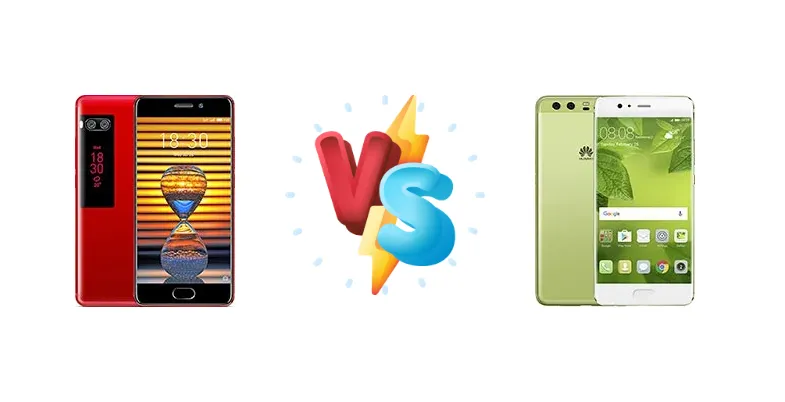
Released in 2017, both the Meizu Pro 7 and Huawei P10 represent a fascinating snapshot of flagship ambitions from a bygone era. Today, as these devices find a second life in the used market, the question isn't about beating the latest flagships, but about which offers the best balance of features and performance for budget-conscious users. This comparison dives deep into their core components to determine which phone provides the most compelling experience.
🏆 Quick Verdict
For the average user prioritizing consistent performance and a refined user experience, the Huawei P10 emerges as the better choice. While the Meizu Pro 7’s Helio X30 offers theoretical multi-core advantages, the Kirin 960’s optimized architecture and software integration deliver a smoother, more reliable day-to-day experience.
| Network |
|---|
| 2G bands | GSM 850 / 900 / 1800 / 1900 - SIM 1 & SIM 2 | GSM 850 / 900 / 1800 / 1900 - SIM 1 & SIM 2 (dual-SIM model only) |
| 3G bands | HSDPA 850 / 900 / 1900 / 2100 | HSDPA 800 / 850 / 900 / 1700(AWS) / 1900 / 2100 |
| 4G bands | 1, 3, 7, 38, 39, 40, 41 | 1, 2, 3, 4, 5, 7, 8, 9, 12, 17, 18, 19, 20, 26, 28, 29, 38, 39, 40 |
| Speed | HSPA, LTE | HSPA 42.2/5.76 Mbps, LTE (3CA) Cat12 600/150 Mbps |
| Technology | GSM / HSPA / EVDO / LTE | GSM / HSPA / LTE |
| | CDMA2000 1xEV-DO & TD-SCDMA | - |
| Launch |
|---|
| Announced | 2017, July. Released 2017, August | 2017, February. Released 2017, March |
| Status | Discontinued | Discontinued |
| Body |
|---|
| Build | - | Glass front (Gorilla Glass 5), aluminum back, aluminum frame |
| Dimensions | 147.6 x 70.7 x 7.3 mm (5.81 x 2.78 x 0.29 in) | 145.3 x 69.3 x 7 mm (5.72 x 2.73 x 0.28 in) |
| SIM | Nano-SIM + Nano-SIM | · Nano-SIM· Nano-SIM + Nano-SIM |
| Weight | 163 g (5.75 oz) | 145 g (5.11 oz) |
| Display |
|---|
| Protection | - | Corning Gorilla Glass 5 |
| Resolution | 1080 x 1920 pixels, 16:9 ratio (~423 ppi density) | 1080 x 1920 pixels, 16:9 ratio (~432 ppi density) |
| Size | 5.2 inches, 74.9 cm2 (~71.8% screen-to-body ratio) | 5.1 inches, 71.7 cm2 (~71.2% screen-to-body ratio) |
| Type | Super AMOLED | IPS-NEO LCD |
| | Secondary 2" AMOLED display, 240 x 536 pixels | - |
| Platform |
|---|
| CPU | Octa-core (4x2.4 GHz Cortex-A53 & 4x1.6 GHz Cortex-A53)Deca-core (2x2.6 GHz Cortex-A73, 4x1.9 GHz Cortex-A35, 4x2.2 GHz Cortex-A53) | Octa-core (4x2.4 GHz Cortex-A73 & 4x1.8 GHz Cortex-A53) |
| Chipset | Mediatek MT6757T Helio P25 (16 nm) - standard editionMediatek MT6799 Helio X30 (10 nm) - high edition | Kirin 960 (16 nm) |
| GPU | Mali-T880MP2PowerVR 7XTP | Mali-G71 MP8 |
| OS | Android 7.0 (Nougat), Flyme 7.3 | Android 7.0 (Nougat), upgradable to Android 9.0 (Pie), EMUI 9.1 |
| Memory |
|---|
| Card slot | No | microSDXC (uses shared SIM slot) |
| Internal | 64GB 4GB RAM, 128GB 4GB RAM | 32GB 4GB RAM, 64GB 4GB RAM |
| | - | eMMC 5.1, UFS 2.0, or UFS 2.1 |
| Main Camera |
|---|
| Dual | - | 12 MP, f/2.2, 28mm (wide), PDAF, OIS
20 MP B/W, f/1.8, 27mm (wide), 1/2.7" |
| Features | Dual-LED dual-tone flash, HDR, panorama | Laser AF, Leica optics, dual-LED dual-tone flash, HDR, panorama |
| Single | 12 MP, f/2.0, 1/2.9", 1.25µm, PDAF | - |
| Video | 4K@30fps, 1080p@30fps | 4K@30fps, 1080p@60fps |
| Selfie camera |
|---|
| Single | 16 MP, f/2.0, 26mm (wide), 1/3.06", 1.0µm | 8 MP, f/1.9 |
| Video | 1080p@30fps | 1080p@30fps |
| Sound |
|---|
| 3.5mm jack | Yes | Yes |
| 35mm jack | Yes | Yes |
| Loudspeaker | Yes | Yes |
| | 32-bit/192kHz audio
| 24-bit/192kHz audio
|
| Comms |
|---|
| Bluetooth | 4.2, A2DP, LE | 4.2, A2DP, LE, aptX |
| NFC | No | Yes |
| Positioning | GPS, GLONASS, BDS | GPS, GLONASS, BDS, GALILEO |
| Radio | No | No |
| USB | USB Type-C | USB Type-C 2.0 |
| WLAN | Wi-Fi 802.11 a/b/g/n or a/b/g/n/ac, dual-band, Wi-Fi Direct | Wi-Fi 802.11 a/b/g/n/ac, dual-band, DLNA, Wi-Fi Direct |
| Features |
|---|
| Sensors | Fingerprint (front-mounted), accelerometer, gyro, proximity, compass | Fingerprint (front-mounted), accelerometer, gyro, proximity, compass |
| Battery |
|---|
| Charging | 24W wired | 22.5W wired |
| Type | Li-Ion 3000 mAh, non-removable | Li-Ion 3200 mAh, non-removable |
| Misc |
|---|
| Colors | Black, gold, red | Mystic Silver, Rose Gold, Graphite Black, Dazzling Gold, Dazzling Blue, Greenery |
| Models | PRO 7, MZ-PRO 7 | VTR-L29, VTR-AL00, VTR-TL00, VTR-L09 |
| Price | About 400 EUR | About 280 EUR |
| Tests |
|---|
| Audio quality | - |
Noise -93.0dB / Crosstalk -93.5dB |
| Battery life | - |
Endurance rating 75h
|
| Camera | - |
Photo / Video |
| Display | - |
Contrast ratio: 1423:1 (nominal), 3.379 (sunlight) |
| Loudspeaker | - |
Voice 67dB / Noise 70dB / Ring 83dB
|
| Performance | - |
AnTuTu: 144458 (v7)
GFXBench: 16fps (ES 3.1 onscreen) |
Meizu Pro 7
- Potentially higher multi-core performance with Helio X30 variant
- Faster charging speed (24W)
- Unique dual-screen design (though usability is debatable)
- Software optimization may be less refined
- Helio P25 variant offers significantly lower performance
- Brand recognition and support are limited
Huawei P10
- More polished and reliable user experience
- Stronger brand reputation and potential for community support
- Likely superior camera image processing
- Slightly slower charging speed (22.5W)
- Potentially lower multi-core performance compared to Helio X30
- Older device, limited software updates
Display Comparison
Both the Meizu Pro 7 and Huawei P10 share a similar display contrast ratio of 1423:1 (nominal) and 3.379 (sunlight), suggesting comparable visibility in bright conditions. However, detailed panel specifications like peak brightness (nits) and color gamut coverage are unavailable. Given Huawei’s historical focus on display quality, it’s reasonable to assume the P10’s panel benefits from more accurate color calibration and potentially higher peak brightness, enhancing the viewing experience. The absence of information on PWM dimming rates makes it difficult to assess which phone is better for users sensitive to flicker.
Camera Comparison
Both phones are advertised with 'Photo / Video' capabilities, but specifics are lacking. Without detailed sensor size information, it’s difficult to definitively declare a winner. However, Huawei historically prioritized camera performance, and the P10 likely benefits from superior image processing algorithms and potentially better low-light performance. The absence of information regarding OIS (Optical Image Stabilization) on either device makes it difficult to assess video stability. The focus should be on real-world image samples, as software processing plays a crucial role in the final image quality.
Performance
The core difference lies in the chipsets: the Meizu Pro 7 offers two variants – the Helio P25 and the Helio X30 – while the Huawei P10 features the Kirin 960. The Helio X30, with its deca-core configuration (2x2.6 GHz Cortex-A73, 4x1.9 GHz Cortex-A35, 4x2.2 GHz Cortex-A53), theoretically outperforms the Kirin 960’s octa-core (4x2.4 GHz Cortex-A73 & 4x1.8 GHz Cortex-A53) in multi-threaded workloads. However, the Kirin 960, built on a 16nm process, benefits from Huawei’s optimization and a more efficient architecture. The P10’s CPU architecture, utilizing four high-performance Cortex-A73 cores, provides a more responsive experience for everyday tasks. The Meizu Pro 7’s Helio P25 variant is significantly less powerful than either the X30 or the Kirin 960, making it a less desirable option.
Battery Life
Both the Meizu Pro 7 and Huawei P10 boast an endurance rating of 75 hours, suggesting similar battery life under typical usage. However, this metric doesn’t account for charging speeds. The Meizu Pro 7 supports 24W wired charging, slightly faster than the Huawei P10’s 22.5W. This translates to marginally quicker 0-100% charging times for the Meizu Pro 7, but the difference is unlikely to be substantial. The overall battery experience will depend heavily on individual usage patterns and software optimization.
Buying Guide
Buy the Meizu Pro 7 if you prioritize raw processing power for demanding tasks and are comfortable with potential software quirks. The Helio X30’s deca-core configuration *could* offer an edge in heavily multi-threaded applications. Buy the Huawei P10 if you value a polished user experience, a consistently reliable camera, and a more established brand reputation for software updates and support, even if those updates are now limited.
Frequently Asked Questions
❓ Is the Meizu Pro 7's dual-screen useful for everyday tasks?
The Meizu Pro 7 features a secondary e-ink display, intended for notifications and basic information. However, its limited functionality and monochrome nature make it a niche feature unlikely to significantly enhance the daily user experience for most individuals. It's more of a novelty than a practical tool.
❓ Will I find software updates for either of these phones in 2024?
Official software updates for both the Meizu Pro 7 and Huawei P10 are highly unlikely. Both devices are several years old, and manufacturers typically cease support after a certain period. However, the Android community may offer custom ROMs, providing a potential avenue for extending the software lifespan, though this requires technical expertise.
❓ Which phone is better for playing demanding mobile games?
While the Meizu Pro 7's Helio X30 has a higher core count, the Kirin 960 in the Huawei P10 is likely to provide a more consistent gaming experience. The Kirin 960's architecture is better optimized for sustained performance, reducing the risk of thermal throttling during extended gaming sessions. The P10's software optimization also contributes to smoother frame rates.