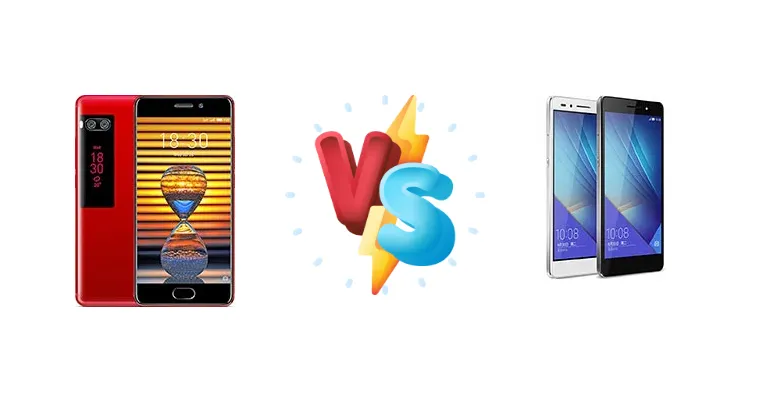
Released in 2017, the Meizu Pro 7 and Honor 7 represent distinct approaches to the mid-range smartphone market. The Meizu Pro 7, particularly in its higher-end configuration, aimed for flagship-level performance with its deca-core Helio X30, while the Honor 7 focused on a balanced experience with the Kirin 935 and a reputation for excellent battery life. This comparison revisits these devices to determine which holds up better today.
🏆 Quick Verdict
For the average user seeking a device with more processing power, the Meizu Pro 7 (specifically the Helio X30 variant) is the better choice. Its deca-core processor offers a significant performance advantage over the Honor 7's Kirin 935. However, the Honor 7 remains a viable option for those prioritizing battery endurance and a more refined user experience.
| Network |
|---|
| 2G bands | GSM 850 / 900 / 1800 / 1900 - SIM 1 & SIM 2 | GSM 850 / 900 / 1800 / 1900 - SIM 1 & SIM 2 (dual-SIM model only) |
| 3G bands | HSDPA 850 / 900 / 1900 / 2100 | HSDPA 900 / 1900 / 2100 - Europe |
| 4G bands | 1, 3, 7, 38, 39, 40, 41 | 1, 3, 7, 8, 20 - Europe |
| Speed | HSPA, LTE | HSPA 42.2/5.76 Mbps, LTE (2CA) Cat6 300/50 Mbps |
| Technology | GSM / HSPA / EVDO / LTE | GSM / HSPA / LTE |
| | CDMA2000 1xEV-DO & TD-SCDMA | - |
| Launch |
|---|
| Announced | 2017, July. Released 2017, August | 2015, June. Released 2015, July |
| Status | Discontinued | Discontinued |
| Body |
|---|
| Build | - | Glass front (Gorilla Glass 3), aluminum back, aluminum frame |
| Dimensions | 147.6 x 70.7 x 7.3 mm (5.81 x 2.78 x 0.29 in) | 143.2 x 71.9 x 8.5 mm (5.64 x 2.83 x 0.33 in) |
| SIM | Nano-SIM + Nano-SIM | · Nano-SIM· Nano-SIM + Nano-SIM |
| Weight | 163 g (5.75 oz) | 157 g (5.54 oz) |
| Display |
|---|
| Protection | - | Corning Gorilla Glass 3 |
| Resolution | 1080 x 1920 pixels, 16:9 ratio (~423 ppi density) | 1080 x 1920 pixels, 16:9 ratio (~424 ppi density) |
| Size | 5.2 inches, 74.9 cm2 (~71.8% screen-to-body ratio) | 5.2 inches, 74.5 cm2 (~72.4% screen-to-body ratio) |
| Type | Super AMOLED | IPS-NEO LCD |
| | Secondary 2" AMOLED display, 240 x 536 pixels | - |
| Platform |
|---|
| CPU | Octa-core (4x2.4 GHz Cortex-A53 & 4x1.6 GHz Cortex-A53)Deca-core (2x2.6 GHz Cortex-A73, 4x1.9 GHz Cortex-A35, 4x2.2 GHz Cortex-A53) | Octa-core (4x2.2 GHz Cortex-A53 & 4x1.5 GHz Cortex-A53) |
| Chipset | Mediatek MT6757T Helio P25 (16 nm) - standard editionMediatek MT6799 Helio X30 (10 nm) - high edition | Kirin 935 (28 nm) |
| GPU | Mali-T880MP2PowerVR 7XTP | Mali-T628 MP4 |
| OS | Android 7.0 (Nougat), Flyme 7.3 | Android 5.0 (Lollipop), upgradable to 6.0 (Marshmallow), EMUI 3.1 |
| Memory |
|---|
| Card slot | No | microSDXC (uses shared SIM slot) |
| Internal | 64GB 4GB RAM, 128GB 4GB RAM | 16GB 3GB RAM, 32GB 3GB RAM, 64GB 3GB RAM |
| Main Camera |
|---|
| Features | Dual-LED dual-tone flash, HDR, panorama | Dual-LED dual-tone flash, HDR, panorama |
| Single | 12 MP, f/2.0, 1/2.9", 1.25µm, PDAF | 20 MP, f/2.0, 27mm (wide), 1/2.4", PDAF |
| Video | 4K@30fps, 1080p@30fps | 1080p@30fps, HDR |
| Selfie camera |
|---|
| Features | - | LED flash |
| Single | 16 MP, f/2.0, 26mm (wide), 1/3.06", 1.0µm | 8 MP, f/2.4, 26mm (wide) |
| Video | 1080p@30fps | 1080p@30fps |
| Sound |
|---|
| 3.5mm jack | Yes | Yes |
| 35mm jack | Yes | Yes |
| Loudspeaker | Yes | Yes |
| | 32-bit/192kHz audio
| - |
| Comms |
|---|
| Bluetooth | 4.2, A2DP, LE | 4.1, A2DP, EDR, LE |
| Infrared port | - | Yes |
| NFC | No | No |
| Positioning | GPS, GLONASS, BDS | GPS, GLONASS/ BDS (market dependant) |
| Radio | No | Stereo FM radio |
| USB | USB Type-C | microUSB 2.0 |
| WLAN | Wi-Fi 802.11 a/b/g/n or a/b/g/n/ac, dual-band, Wi-Fi Direct | Wi-Fi 802.11 a/b/g/n/ac, dual-band, Wi-Fi Direct, hotspot |
| Features |
|---|
| Sensors | Fingerprint (front-mounted), accelerometer, gyro, proximity, compass | Fingerprint (rear-mounted), accelerometer, gyro, proximity, compass |
| Battery |
|---|
| Charging | 24W wired | 18W wired |
| Stand-by | - | Up to 350 h (3G) |
| Talk time | - | Up to 8 h 20 min (3G) |
| Type | Li-Ion 3000 mAh, non-removable | Li-Po 3100 mAh, non-removable |
| Misc |
|---|
| Colors | Black, gold, red | Gray, Silver, Gold |
| Models | PRO 7, MZ-PRO 7 | PLK-L01, PLK-AL10, PLK-UL00, PLK-TL01H, PLK-TL00, PLK-CL00 |
| Price | About 400 EUR | About 220 EUR |
| SAR EU | - | 1.13 W/kg (head) 0.52 W/kg (body) |
| Tests |
|---|
| Battery life | - |
Endurance rating 64h
|
| Camera | - |
Photo / Video |
Meizu Pro 7
- Faster processor (Helio X30 variant)
- Faster charging (24W)
- Potentially better low-light camera performance
- Potentially shorter battery life (Helio X30 variant)
- Software support may be limited
Honor 7
- Excellent battery endurance (64h rating)
- Stable and reliable software experience
- Balanced overall package
- Slower processor (Kirin 935)
- Slower charging (18W)
Display Comparison
Neither device's display specifications are provided, so a direct comparison is limited. However, considering the release timeframe, both likely featured LCD panels. The Honor 7, being a more mainstream device, likely prioritized color accuracy for general use. The Meizu Pro 7, aiming for a more premium feel, may have had slightly better contrast ratios. Without specific nit brightness or color gamut data, it's difficult to definitively declare a winner.
Camera Comparison
Both devices are listed as having 'Photo / Video' capabilities, but lack specific details. Given the era, both likely featured 12-13MP main sensors. The Meizu Pro 7, positioned as a more premium device, may have incorporated a slightly larger sensor or a wider aperture lens, potentially leading to better low-light performance. However, without sensor size or aperture information, it's impossible to make a definitive judgment. The inclusion of OIS on either device is unknown, but would be a significant advantage.
Performance
The Meizu Pro 7, especially the Helio X30 variant, boasts a significant performance advantage. The deca-core CPU (2x2.6 GHz Cortex-A73, 4x1.9 GHz Cortex-A35, 4x2.2 GHz Cortex-A53) is architecturally superior to the Honor 7’s octa-core Kirin 935 (4x2.2 GHz Cortex-A53 & 4x1.5 GHz Cortex-A53). The Helio X30’s use of a 10nm process node further enhances efficiency compared to the Kirin 935’s 28nm node, resulting in less heat generation and sustained performance. The standard Pro 7 with the Helio P25 (16nm) would still offer a noticeable improvement over the Kirin 935, but not to the same degree.
Battery Life
Both the Meizu Pro 7 and Honor 7 share an endurance rating of 64 hours, suggesting comparable battery life under similar usage conditions. However, the Meizu Pro 7’s 24W wired charging is significantly faster than the Honor 7’s 18W charging. This means the Pro 7 can replenish its battery more quickly, mitigating any potential battery life differences caused by the more power-hungry Helio X30 chipset. The faster charging is a clear advantage for users who frequently need to top up their battery.
Buying Guide
Buy the Meizu Pro 7 if you need a phone capable of handling demanding tasks like gaming or video editing, and are willing to potentially sacrifice some battery life for that performance. Buy the Honor 7 if you prioritize all-day battery life, a stable software experience, and a more balanced overall package, even if it means compromising on raw processing power.
Frequently Asked Questions
❓ Does the Meizu Pro 7's Helio X30 chipset suffer from significant thermal throttling during extended gaming sessions?
The Helio X30, while powerful, was known to run warm. While the 10nm process helps, prolonged gaming could lead to thermal throttling, reducing sustained performance. The Honor 7's Kirin 935, being less powerful, is less prone to overheating, but also offers lower peak performance.
❓ Is the 64-hour battery endurance rating of the Honor 7 still relevant today with modern app usage?
The 64-hour endurance rating was based on a specific usage profile in 2017. Modern apps are more demanding, and 5G connectivity consumes more power. However, the Honor 7 still offers excellent battery life compared to many contemporary smartphones, especially with moderate usage.
❓ Which device is more likely to receive software updates in 2024?
Neither device is likely to receive official software updates. Both the Meizu Pro 7 and Honor 7 are several years old, and their manufacturers have likely ceased support. Custom ROMs may be available, but these come with their own risks and limitations.