
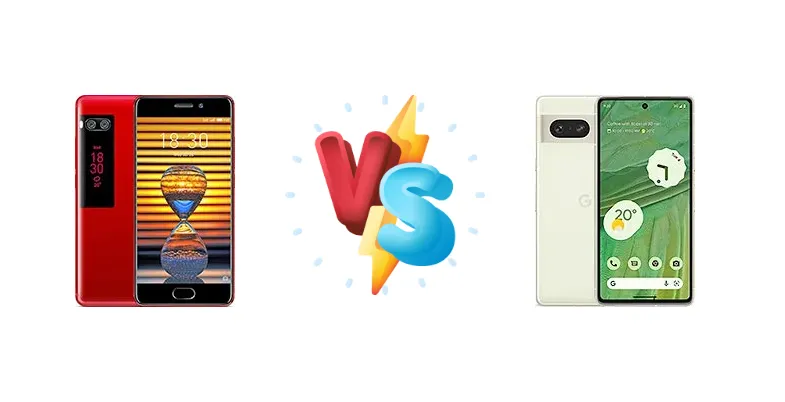
Google Pixel 7 vs. Meizu Pro 7: A Tale of Two Android Philosophies
| Phones Images | |||||
|---|---|---|---|---|---|
|
🏆 Quick Verdict
For the average user in 2024, the Google Pixel 7 is the clear winner. Its superior processing power thanks to the Tensor G2, exceptional camera capabilities, and continued software support outweigh the Meizu Pro 7’s unique dual-screen feature, which feels dated and less practical in modern usage. The Pixel 7 offers a more polished and reliable experience.
| PHONES | ||
|---|---|---|
| Phone Names | Meizu Pro 7 | Google Pixel 7 |
| Network | ||
|---|---|---|
| 2G bands | GSM 850 / 900 / 1800 / 1900 - SIM 1 & SIM 2 | GSM 850 / 900 / 1800 / 1900 |
| 3G bands | HSDPA 850 / 900 / 1900 / 2100 | HSDPA 800 / 850 / 900 / 1700(AWS) / 1900 / 2100 |
| 4G bands | 1, 3, 7, 38, 39, 40, 41 | 1, 2, 3, 4, 5, 7, 8, 12, 13, 14, 17, 18, 19, 20, 25, 26, 28, 29, 30, 38, 40, 41, 42, 46, 48, 66, 71 - GQML3 |
| 5G bands | - | 1, 2, 3, 4, 5, 7, 8, 12, 13, 14, 17, 18, 19, 20, 25, 26, 28, 29, 30, 38, 40, 41, 46, 48, 66, 71, 260, 261 SA/NSA/Sub6/mmWave - GQML3 |
| Speed | HSPA, LTE | HSPA, LTE, 5G |
| Technology | GSM / HSPA / EVDO / LTE | GSM / CDMA / HSPA / EVDO / LTE / 5G |
| CDMA2000 1xEV-DO & TD-SCDMA | 1, 2, 3, 5, 7, 8, 12, 14, 20, 25, 28, 30, 38, 40, 41, 48, 66, 71, 75, 76, 77, 78 SA/NSA/Sub6 - GVU6C | |
| Launch | ||
|---|---|---|
| Announced | 2017, July. Released 2017, August | 2022, October 06 |
| Status | Discontinued | Available. Released 2022, October 13 |
| Body | ||
|---|---|---|
| Build | - | Glass front (Gorilla Glass Victus), glass back (Gorilla Glass Victus), aluminum frame |
| Dimensions | 147.6 x 70.7 x 7.3 mm (5.81 x 2.78 x 0.29 in) | 155.6 x 73.2 x 8.7 mm (6.13 x 2.88 x 0.34 in) |
| SIM | Nano-SIM + Nano-SIM | Nano-SIM + eSIM |
| Weight | 163 g (5.75 oz) | 197 g (6.95 oz) |
| - | IP68 dust/water resistant (up to 1.5m for 30 min) | |
| Display | ||
|---|---|---|
| Protection | - | Corning Gorilla Glass Victus |
| Resolution | 1080 x 1920 pixels, 16:9 ratio (~423 ppi density) | 1080 x 2400 pixels, 20:9 ratio (~416 ppi density) |
| Size | 5.2 inches, 74.9 cm2 (~71.8% screen-to-body ratio) | 6.3 inches, 96.7 cm2 (~84.9% screen-to-body ratio) |
| Type | Super AMOLED | AMOLED, 90Hz, HDR10+, 1000 nits (HBM), 1400 nits (peak) |
| Secondary 2" AMOLED display, 240 x 536 pixels | Always-on display | |
| Platform | ||
|---|---|---|
| CPU | Octa-core (4x2.4 GHz Cortex-A53 & 4x1.6 GHz Cortex-A53)Deca-core (2x2.6 GHz Cortex-A73, 4x1.9 GHz Cortex-A35, 4x2.2 GHz Cortex-A53) | Octa-core (2x2.85 GHz Cortex-X1 & 2x2.35 GHz Cortex-A78 & 4x1.80 GHz Cortex-A55) |
| Chipset | Mediatek MT6757T Helio P25 (16 nm) - standard editionMediatek MT6799 Helio X30 (10 nm) - high edition | Google Tensor G2 (5 nm) |
| GPU | Mali-T880MP2PowerVR 7XTP | Mali-G710 MP7 |
| OS | Android 7.0 (Nougat), Flyme 7.3 | Android 13, upgradable to Android 15, up to 5 major Android upgrades |
| Memory | ||
|---|---|---|
| Card slot | No | No |
| Internal | 64GB 4GB RAM, 128GB 4GB RAM | 128GB 8GB RAM, 256GB 8GB RAM |
| - | UFS 3.1 | |
| Main Camera | ||
|---|---|---|
| Dual | - | 50 MP, f/1.9, 25mm (wide), 1/1.31", 1.2µm, dual pixel PDAF, OIS 12 MP, f/2.2, 114˚ (ultrawide), 1/2.9", 1.25µm |
| Features | Dual-LED dual-tone flash, HDR, panorama | Laser AF, Dual-LED flash, Pixel Shift, Auto-HDR, panorama |
| Single | 12 MP, f/2.0, 1/2.9", 1.25µm, PDAF | 10.8 MP, f/2.2, 21mm (ultrawide), 1/3.1", 1.22µm |
| Video | 4K@30fps, 1080p@30fps | 4K@30/60fps, 1080p@30/60/120/240fps; gyro-EIS, OIS, 10-bit HDR |
| Selfie camera | ||
|---|---|---|
| Features | - | HDR, panorama |
| Single | 16 MP, f/2.0, 26mm (wide), 1/3.06", 1.0µm | 10.8 MP, f/2.2, 21mm (ultrawide), 1/3.1", 1.22µm |
| Video | 1080p@30fps | 4K@30/60fps, 1080p@30/60fps |
| Sound | ||
|---|---|---|
| 3.5mm jack | Yes | No |
| 35mm jack | Yes | No |
| Loudspeaker | Yes | Yes, with stereo speakers |
| 32-bit/192kHz audio | - | |
| Comms | ||
|---|---|---|
| Bluetooth | 4.2, A2DP, LE | 5.2, A2DP, LE, aptX HD |
| NFC | No | Yes |
| Positioning | GPS, GLONASS, BDS | GPS (L1+L5), GLONASS (G1), BDS (B1I+B1c+B2a), GALILEO (E1+E5a), QZSS (L1+L5) |
| Radio | No | No |
| USB | USB Type-C | USB Type-C 3.2 |
| WLAN | Wi-Fi 802.11 a/b/g/n or a/b/g/n/ac, dual-band, Wi-Fi Direct | Wi-Fi 802.11 a/b/g/n/ac/6e, tri-band, Wi-Fi Direct |
| Features | ||
|---|---|---|
| Sensors | Fingerprint (front-mounted), accelerometer, gyro, proximity, compass | Fingerprint (under display, optical), accelerometer, gyro, proximity, compass, barometer |
| Battery | ||
|---|---|---|
| Charging | 24W wired | 20W wired, PD3.0, 50% in 30 min 20W wireless Reverse wireless |
| Type | Li-Ion 3000 mAh, non-removable | Li-Ion 4355 mAh |
| Misc | ||
|---|---|---|
| Colors | Black, gold, red | Obsidian, Lemongrass, Snow |
| Models | PRO 7, MZ-PRO 7 | GVU6C, GQML3, GO3Z5 |
| Price | About 400 EUR | € 199.00 / $ 179.26 / £ 189.99 / ₹ 28,499 |
| Tests | ||
|---|---|---|
| Battery life | - | Endurance rating 96h |
| Camera | - | Photo / Video |
| Display | - | Contrast ratio: Infinite (nominal) |
| Loudspeaker | - | -26.2 LUFS (Good) |
| Performance | - | AnTuTu: 813114 (v9) GeekBench: 3288 (v5.1) GFXBench: 59fps (ES 3.1 onscreen) |
Meizu Pro 7
- Unique dual-screen functionality
- Potentially powerful Helio X30 variant
- Customizable software (for its time)
- Outdated chipset (Helio P25)
- Limited software support
- Dual-screen adds complexity and potential battery drain
Google Pixel 7
- Powerful Google Tensor G2 chipset
- Excellent camera with computational photography
- Long-term software support and updates
- Fast and versatile charging options
- No dual-screen functionality
- May be more expensive than a used Meizu Pro 7
- Design may not appeal to all
Display Comparison
The Pixel 7 boasts a significantly brighter display, reaching a measured 974 nits, compared to the Meizu Pro 7’s unspecified peak brightness. While the Pro 7’s secondary e-ink display is a novelty, it’s limited in functionality. The Pixel 7’s infinite contrast ratio (nominal) provides a richer viewing experience. The Pixel 7’s display is also likely to have a higher refresh rate, contributing to smoother scrolling and animations, a feature absent in the Pro 7’s specifications. The Pro 7’s dual-screen approach, while innovative, adds complexity and potential battery drain.
Camera Comparison
The Pixel 7 excels in camera performance, leveraging Google’s renowned computational photography algorithms. While both devices offer photo and video capabilities, the Pixel 7’s sensor size and image processing are likely far superior. The Meizu Pro 7’s camera specifications are vague, and its image quality likely pales in comparison to the Pixel 7’s consistently excellent results, particularly in low-light conditions. The Pixel 7’s software features, such as Magic Eraser and Photo Unblur, provide significant editing capabilities not found on the Pro 7.
Performance
The Google Pixel 7’s Tensor G2, fabricated on a 5nm process, represents a substantial leap in efficiency and performance over the Meizu Pro 7’s MediaTek Helio P25 (16nm) or Helio X30 (10nm). The Tensor G2’s octa-core configuration, featuring Cortex-X1 and Cortex-A78 cores, delivers significantly faster processing speeds and improved AI capabilities. The Helio X30, while a deca-core processor, suffers from the inefficiencies of its 10nm node. The Pixel 7’s LPDDR5x RAM further enhances performance, while the Pro 7’s RAM specifications are unknown. This translates to faster app loading times, smoother multitasking, and a more responsive user experience on the Pixel 7.
Battery Life
Both the Pixel 7 and Meizu Pro 7 achieve an endurance rating of 96 hours, suggesting comparable battery life under similar usage scenarios. However, the Pixel 7’s 20W wired charging with PD3.0 and 50% charge in 30 minutes, along with 20W wireless and reverse wireless charging, offers significantly more convenient and versatile charging options than the Meizu Pro 7’s 24W wired charging. The Pixel 7’s more efficient chipset also contributes to better battery management.
Buying Guide
Buy the Meizu Pro 7 if you are a collector of unique hardware, fascinated by early dual-screen implementations, and willing to accept limited software support and potential performance bottlenecks. Buy the Google Pixel 7 if you prioritize a smooth, modern Android experience, a class-leading camera, and long-term software updates, making it ideal for everyday use and photography enthusiasts.