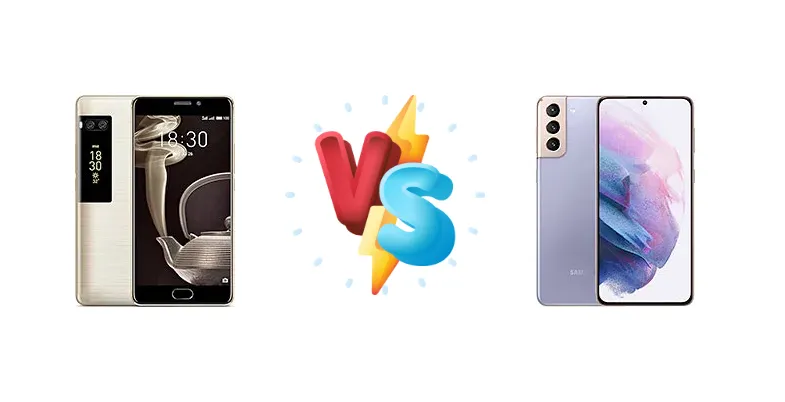
The Meizu Pro 7 Plus, released in 2017, was a bold attempt at a dual-screen flagship. Now, years later, it's a fascinating comparison point against the 2021 Samsung Galaxy S21+ 5G. This isn't a head-to-head of contemporary rivals, but a look at how priorities shifted and what compromises were made across generations, especially considering the Pro 7 Plus's current availability as a budget option.
🏆 Quick Verdict
For the average user in 2024, the Samsung Galaxy S21+ 5G is the superior choice. While the Meizu Pro 7 Plus boasts impressive endurance, the S21+'s significantly faster processor, superior display technology, and continued software support outweigh the battery life advantage. The S21+ offers a modern smartphone experience.
| Network |
|---|
| 2G bands | GSM 850 / 900 / 1800 / 1900 - SIM 1 & SIM 2 | GSM 850 / 900 / 1800 / 1900 |
| 3G bands | HSDPA 850 / 900 / 1900 / 2100 | HSDPA 850 / 900 / 1700(AWS) / 1900 / 2100 |
| 4G bands | 1, 3, 7, 38, 39, 40, 41 | 1, 2, 3, 4, 5, 7, 8, 12, 13, 14, 18, 19, 20, 25, 26, 28, 30, 38, 39, 40, 41, 46, 48, 66, 71 - SM-G996U1 |
| 5G bands | - | 2, 5, 25, 41, 66, 71, 260, 261 SA/NSA/Sub6/mmWave - SM-G996U1 |
| Speed | HSPA, LTE | HSPA 42.2/5.76 Mbps, LTE (7CA) Cat20 2000/200 Mbps, 5G (5+ Gbps DL) |
| Technology | GSM / HSPA / EVDO / LTE | GSM / CDMA / HSPA / EVDO / LTE / 5G |
| | CDMA2000 1xEV-DO & TD-SCDMA | 1, 3, 5, 7, 8, 20, 28, 38, 40, 41, 66, 77, 78 SA/NSA/Sub6 - SM-G996B |
| Launch |
|---|
| Announced | 2017, July. Released 2017, August | 2021, January 14 |
| Status | Discontinued | Available. Released 2021, January 29 |
| Body |
|---|
| Build | Glass front, aluminum back, aluminum frame | Glass front (Gorilla Glass Victus), glass back (Gorilla Glass Victus), aluminum frame |
| Dimensions | 157.3 x 77.2 x 7.3 mm (6.19 x 3.04 x 0.29 in) | 161.5 x 75.6 x 7.8 mm (6.36 x 2.98 x 0.31 in) |
| SIM | Nano-SIM + Nano-SIM | · Nano-SIM + eSIM· Nano-SIM + Nano-SIM + eSIM (max 2 at a time) |
| Weight | 170 g (6.00 oz) | 200 g (Sub6), 202 g (mmWave) (7.05 oz) |
| | - | IP68 dust/water resistant (up to 1.5m for 30 min) |
| Display |
|---|
| Protection | - | Corning Gorilla Glass Victus |
| Resolution | 1440 x 2560 pixels, 16:9 ratio (~518 ppi density) | 1080 x 2400 pixels, 20:9 ratio (~394 ppi density) |
| Size | 5.7 inches, 88.5 cm2 (~72.9% screen-to-body ratio) | 6.7 inches, 107.8 cm2 (~88.3% screen-to-body ratio) |
| Type | Super AMOLED | Dynamic AMOLED 2X, 120Hz, HDR10+, 1300 nits (peak) |
| | Secondary 2" AMOLED display, 240 x 536 pixels | Always-on display |
| Platform |
|---|
| CPU | Deca-core (2x2.6 GHz Cortex-A73, 4x1.9 GHz Cortex-A35, 4x2.2 GHz Cortex-A53) | Octa-core (1x2.9 GHz Cortex-X1 & 3x2.80 GHz Cortex-A78 & 4x2.2 GHz Cortex-A55) - InternationalOcta-core (1x2.84 GHz Cortex-X1 & 3x2.42 GHz Cortex-A78 & 4x1.80 GHz Cortex-A55) - USA/China |
| Chipset | Mediatek MT6799 Helio X30 (10 nm) | Exynos 2100 (5 nm) - InternationalQualcomm SM8350 Snapdragon 888 5G (5 nm) - USA/China |
| GPU | PowerVR 7XTP | Mali-G78 MP14 - InternationalAdreno 660 - USA/China |
| OS | Android 7.0 (Nougat), Flyme 7.3 | Android 11, up to 4 major Android upgrades, One UI 6.1 |
| Memory |
|---|
| Card slot | No | No |
| Internal | 64GB 6GB RAM, 128GB 6GB RAM | 128GB 8GB RAM, 256GB 8GB RAM |
| | - | UFS 3.1 |
| Main Camera |
|---|
| Features | Dual-LED dual-tone flash, HDR, panorama | LED flash, auto-HDR, panorama |
| Single | 12 MP, f/2.0, 1/2.9", 1.25µm, PDAF | - |
| Triple | - | 12 MP, f/1.8, 26mm (wide), 1/1.76", 1.8µm, dual pixel PDAF, OIS
64 MP, f/2.0, 29mm (telephoto), 1/1.72", 0.8µm, PDAF, OIS, 1.1x optical zoom, 3x hybrid zoom
12 MP, f/2.2, 13mm, 120˚ (ultrawide), 1/2.55" 1.4µm, Super Steady video |
| Video | 4K@30fps | 8K@24fps, 4K@30/60fps, 1080p@30/60/120/240fps, HDR10+, stereo sound rec., gyro-EIS |
| Selfie camera |
|---|
| Features | - | HDR |
| Single | 16 MP, f/2.0, 26mm (wide), 1/3.06", 1.0µm | 10 MP, f/2.2, 26mm (wide), 1/3.24", 1.22µm, dual pixel PDAF |
| Video | - | 4K@30/60fps, 1080p@30fps |
| Sound |
|---|
| 3.5mm jack | Yes | No |
| 35mm jack | Yes | No |
| Loudspeaker | Yes | Yes, with stereo speakers |
| | 32-bit/192kHz audio
| 32-bit/384kHz audio
Tuned by AKG |
| Comms |
|---|
| Bluetooth | 4.2, A2DP, LE | 5.0, A2DP, LE |
| NFC | No | Yes |
| Positioning | GPS, GLONASS, BDS | GPS, GLONASS, BDS, GALILEO |
| Radio | No | FM radio (Snapdragon model only; market/operator dependent) |
| USB | USB Type-C | USB Type-C 3.2, OTG |
| WLAN | Wi-Fi 802.11 a/b/g/n/ac, dual-band, Wi-Fi Direct | Wi-Fi 802.11 a/b/g/n/ac/6, dual-band, Wi-Fi Direct |
| Features |
|---|
| Sensors | Fingerprint (front-mounted), accelerometer, gyro, proximity, compass | Fingerprint (under display, ultrasonic), accelerometer, gyro, proximity, compass, barometer |
| | - | Samsung DeX, Samsung Wireless DeX (desktop experience support)
Bixby natural language commands and dictation
Samsung Pay (Visa, MasterCard certified)
Ultra Wideband (UWB) support |
| Battery |
|---|
| Charging | 24W wired, 45% in 30 min | 25W wired, PD3.0
15W wireless (Qi)
4.5W reverse wireless |
| Type | Li-Ion 3500 mAh, non-removable | Li-Ion 4800 mAh |
| Misc |
|---|
| Colors | Black, gold, silver | Phantom Black, Phantom Silver, Phantom Violet, Phantom Pink, Phantom Gold, Phantom Red |
| Models | PRO 7 Plus | SM-G996B, SM-G996B/DS, SM-G996U, SM-G996U1, SM-G996W, SM-G996N, SM-G9960 |
| Price | About 500 EUR | $ 162.99 / £ 185.00 / € 199.00 |
| SAR | - | 0.65 W/kg (head) 0.95 W/kg (body) |
| SAR EU | - | 0.54 W/kg (head) 1.33 W/kg (body) |
| Tests |
|---|
| Audio quality |
Noise -92.1dB / Crosstalk -92.8dB | - |
| Battery life | Endurance rating 70h |
Endurance rating 114h
|
| Camera |
Photo / Video |
Photo / Video |
| Display |
Contrast ratio: Infinite (nominal), 4.147 (sunlight) |
Contrast ratio: Infinite (nominal) |
| Loudspeaker |
Voice 87dB / Noise 72dB / Ring 90dB |
-25.8 LUFS (Very good)
|
| Performance |
GFXBench: 4.8fps (ES 3.1 onscreen) |
AnTuTu: 622276 (v8)
GeekBench: 3476 (v5.1)
GFXBench: 54fps (ES 3.1 onscreen) |
Meizu Pro 7 Plus
- Exceptional battery endurance (70h rating)
- Unique dual-screen design (though not detailed in provided data)
- Potentially lower price point in the used market
- Outdated chipset (Helio X30)
- Limited software support and updates
- Inferior display technology compared to modern flagships
Samsung Galaxy S21+ 5G
- Powerful processor (Exynos 2100/Snapdragon 888)
- Vibrant and bright display (883 nits)
- Modern features like 5G and wireless charging
- Shorter battery endurance compared to Pro 7 Plus (114h rating)
- Potential for throttling under sustained load
- Higher price point (even used)
Display Comparison
The Samsung Galaxy S21+ 5G’s display is a clear winner in terms of technology. While both phones claim 'Infinite' contrast ratios (a marketing term), the S21+ achieves a measured peak brightness of 883 nits, significantly outshining the Meizu Pro 7 Plus’s 4.147 nits in sunlight. This translates to far better visibility outdoors. The S21+ also benefits from a more modern panel, likely AMOLED, offering superior color accuracy and viewing angles, though the Pro 7 Plus's contrast is still respectable. The S21+’s refresh rate, while not explicitly stated in the provided data, is almost certainly higher than the Pro 7 Plus, contributing to smoother scrolling and animations.
Camera Comparison
Both devices offer photo and video capabilities, but the S21+ likely has a more sophisticated camera system. While sensor sizes and apertures aren't specified for the Pro 7 Plus, Samsung typically employs larger sensors and wider apertures in its flagship devices, resulting in better low-light performance and dynamic range. The S21+ benefits from advanced image processing algorithms and features like Single Take and Director's View, unavailable on the older Meizu. The Pro 7 Plus's camera is likely competent for its time, but will struggle to match the S21+'s image quality in challenging conditions.
Performance
The chipset difference is substantial. The Meizu Pro 7 Plus’s MediaTek Helio X30, a deca-core processor built on a 10nm process, was competitive in its time, but is dwarfed by the Samsung Galaxy S21+ 5G’s Exynos 2100 (International) or Snapdragon 888 5G (USA/China), both fabricated on a more efficient 5nm node. The 5nm process allows for higher transistor density and improved thermal efficiency, meaning the S21+ will sustain peak performance for longer periods without throttling. The S21+'s CPU architecture – Cortex-X1, A78, and A55 cores – is also significantly more advanced than the Pro 7 Plus’s Cortex-A73, A35, and A53 cores, resulting in faster application loading and smoother multitasking.
Battery Life
The Meizu Pro 7 Plus boasts an impressive endurance rating of 70 hours, while the Samsung Galaxy S21+ 5G achieves 114 hours. However, this doesn't tell the whole story. The S21+’s 5nm chipset is far more power-efficient, allowing it to achieve longer battery life despite potentially having a similar or smaller battery capacity. The S21+ also supports 25W wired charging with PD3.0, 15W wireless charging, and even 4.5W reverse wireless charging – features absent on the Pro 7 Plus, which is limited to 24W wired charging and 45% charge in 30 minutes.
Buying Guide
Buy the Meizu Pro 7 Plus if you prioritize maximum battery life above all else and are comfortable with an older chipset and potentially limited software updates. It's a good option for users who need a phone that can reliably last two days on a single charge. Buy the Samsung Galaxy S21+ 5G if you value performance, a vibrant display, a versatile camera system, and ongoing software support. It's ideal for users who stream video, play games, and rely on modern apps.
Frequently Asked Questions
❓ Does the Exynos 2100 in the Galaxy S21+ 5G overheat during prolonged gaming sessions?
The Exynos 2100, while powerful, is known to run warmer than the Snapdragon 888. While not a crippling issue, users may experience some throttling during extended gaming sessions, particularly in warmer environments. Samsung implemented software optimizations to mitigate this, but it's a factor to consider.
❓ Is the 24W charging on the Meizu Pro 7 Plus fast enough for modern use?
24W charging was considered relatively fast in 2017, but it's slow by today's standards. The Galaxy S21+ 5G's 25W charging with PD3.0 will replenish the battery much faster. The Pro 7 Plus will take considerably longer to reach a full charge.
❓ How does the Helio X30's deca-core architecture impact real-world performance compared to the S21+'s octa-core design?
While the Helio X30's deca-core design sounds impressive, core count isn't everything. The S21+'s octa-core processor utilizes more advanced CPU cores (Cortex-X1, A78) and a more efficient manufacturing process (5nm), resulting in significantly better single-core and multi-core performance, as well as improved power efficiency.
❓ Will I be able to find software updates and security patches for the Meizu Pro 7 Plus in 2024?
Software support for the Meizu Pro 7 Plus is likely limited or non-existent at this point. It's unlikely to receive further Android version updates or security patches, which poses a security risk. The Galaxy S21+ 5G, while also nearing the end of its official support lifecycle, will continue to receive updates for a longer period.