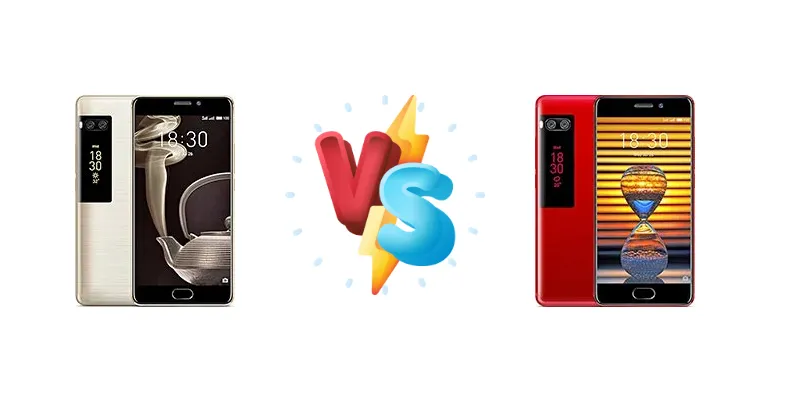
The Meizu Pro 7 and Pro 7 Plus represent an interesting period for the brand, experimenting with dual-screen technology and pushing the boundaries of mobile processing. While both share a similar aesthetic, the Pro 7 Plus distinguishes itself with a more powerful chipset. This comparison dissects the key differences to determine which device offers the best experience in 2024, considering both original price points and current availability.
🏆 Quick Verdict
For most users, the Meizu Pro 7 Plus is the superior choice. Its Helio X30 chipset delivers significantly better performance, making it more capable for demanding tasks and future-proofing it against software updates. While the Pro 7 offers a potentially more efficient experience with the P25, the performance gap is too large to ignore.
| Network |
|---|
| 2G bands | GSM 850 / 900 / 1800 / 1900 - SIM 1 & SIM 2 | GSM 850 / 900 / 1800 / 1900 - SIM 1 & SIM 2 |
| 3G bands | HSDPA 850 / 900 / 1900 / 2100 | HSDPA 850 / 900 / 1900 / 2100 |
| 4G bands | 1, 3, 7, 38, 39, 40, 41 | 1, 3, 7, 38, 39, 40, 41 |
| Speed | HSPA, LTE | HSPA, LTE |
| Technology | GSM / HSPA / EVDO / LTE | GSM / HSPA / EVDO / LTE |
| | CDMA2000 1xEV-DO & TD-SCDMA | CDMA2000 1xEV-DO & TD-SCDMA |
| Launch |
|---|
| Announced | 2017, July. Released 2017, August | 2017, July. Released 2017, August |
| Status | Discontinued | Discontinued |
| Body |
|---|
| Build | Glass front, aluminum back, aluminum frame | - |
| Dimensions | 157.3 x 77.2 x 7.3 mm (6.19 x 3.04 x 0.29 in) | 147.6 x 70.7 x 7.3 mm (5.81 x 2.78 x 0.29 in) |
| SIM | Nano-SIM + Nano-SIM | Nano-SIM + Nano-SIM |
| Weight | 170 g (6.00 oz) | 163 g (5.75 oz) |
| Display |
|---|
| Resolution | 1440 x 2560 pixels, 16:9 ratio (~518 ppi density) | 1080 x 1920 pixels, 16:9 ratio (~423 ppi density) |
| Size | 5.7 inches, 88.5 cm2 (~72.9% screen-to-body ratio) | 5.2 inches, 74.9 cm2 (~71.8% screen-to-body ratio) |
| Type | Super AMOLED | Super AMOLED |
| | Secondary 2" AMOLED display, 240 x 536 pixels | Secondary 2" AMOLED display, 240 x 536 pixels |
| Platform |
|---|
| CPU | Deca-core (2x2.6 GHz Cortex-A73, 4x1.9 GHz Cortex-A35, 4x2.2 GHz Cortex-A53) | Octa-core (4x2.4 GHz Cortex-A53 & 4x1.6 GHz Cortex-A53)Deca-core (2x2.6 GHz Cortex-A73, 4x1.9 GHz Cortex-A35, 4x2.2 GHz Cortex-A53) |
| Chipset | Mediatek MT6799 Helio X30 (10 nm) | Mediatek MT6757T Helio P25 (16 nm) - standard editionMediatek MT6799 Helio X30 (10 nm) - high edition |
| GPU | PowerVR 7XTP | Mali-T880MP2PowerVR 7XTP |
| OS | Android 7.0 (Nougat), Flyme 7.3 | Android 7.0 (Nougat), Flyme 7.3 |
| Memory |
|---|
| Card slot | No | No |
| Internal | 64GB 6GB RAM, 128GB 6GB RAM | 64GB 4GB RAM, 128GB 4GB RAM |
| Main Camera |
|---|
| Features | Dual-LED dual-tone flash, HDR, panorama | Dual-LED dual-tone flash, HDR, panorama |
| Single | 12 MP, f/2.0, 1/2.9", 1.25µm, PDAF | 12 MP, f/2.0, 1/2.9", 1.25µm, PDAF |
| Video | 4K@30fps | 4K@30fps, 1080p@30fps |
| Selfie camera |
|---|
| Single | 16 MP, f/2.0, 26mm (wide), 1/3.06", 1.0µm | 16 MP, f/2.0, 26mm (wide), 1/3.06", 1.0µm |
| Video | - | 1080p@30fps |
| Sound |
|---|
| 3.5mm jack | Yes | Yes |
| 35mm jack | Yes | Yes |
| Loudspeaker | Yes | Yes |
| | 32-bit/192kHz audio
| 32-bit/192kHz audio
|
| Comms |
|---|
| Bluetooth | 4.2, A2DP, LE | 4.2, A2DP, LE |
| NFC | No | No |
| Positioning | GPS, GLONASS, BDS | GPS, GLONASS, BDS |
| Radio | No | No |
| USB | USB Type-C | USB Type-C |
| WLAN | Wi-Fi 802.11 a/b/g/n/ac, dual-band, Wi-Fi Direct | Wi-Fi 802.11 a/b/g/n or a/b/g/n/ac, dual-band, Wi-Fi Direct |
| Features |
|---|
| Sensors | Fingerprint (front-mounted), accelerometer, gyro, proximity, compass | Fingerprint (front-mounted), accelerometer, gyro, proximity, compass |
| Battery |
|---|
| Charging | 24W wired, 45% in 30 min | 24W wired |
| Type | Li-Ion 3500 mAh, non-removable | Li-Ion 3000 mAh, non-removable |
| Misc |
|---|
| Colors | Black, gold, silver | Black, gold, red |
| Models | PRO 7 Plus | PRO 7, MZ-PRO 7 |
| Price | About 500 EUR | About 400 EUR |
| Tests |
|---|
| Audio quality |
Noise -92.1dB / Crosstalk -92.8dB | - |
| Battery life | Endurance rating 70h | - |
| Camera |
Photo / Video | - |
| Display |
Contrast ratio: Infinite (nominal), 4.147 (sunlight) | - |
| Loudspeaker |
Voice 87dB / Noise 72dB / Ring 90dB | - |
| Performance |
GFXBench: 4.8fps (ES 3.1 onscreen) | - |
Meizu Pro 7 Plus
- Significantly faster processor (Helio X30)
- More efficient 10nm manufacturing process
- Better suited for demanding tasks and gaming
- Potentially slightly lower battery life
- May run hotter under sustained load
Meizu Pro 7
- Potentially better battery efficiency (with P25)
- Lower price point (depending on edition)
- Sufficient for everyday tasks
- Noticeably slower processor (especially with P25)
- Less future-proof
- May struggle with demanding applications
Display Comparison
Both the Meizu Pro 7 and Pro 7 Plus feature displays with an 'Infinite' nominal contrast ratio, suggesting deep blacks. However, the 4.147 sunlight contrast ratio indicates similar performance in outdoor visibility. The key difference lies not in the display *quality* itself, but in the processing power needed to drive it smoothly – a task better suited to the Pro 7 Plus’s more capable chipset. The secondary display on both models is a unique feature, but its utility is limited to quick glances at notifications and basic controls.
Camera Comparison
Both devices are listed with 'Photo / Video' capabilities, lacking specific details. Given Meizu’s history, we can assume both phones offer a competent camera experience for their time. However, the Pro 7 Plus’s superior processing power could translate to faster image processing and potentially better video stabilization. Without detailed sensor specifications, it’s difficult to make a definitive judgment, but the X30’s ISP (Image Signal Processor) is likely more advanced.
Performance
The core difference between these two phones is the chipset. The Pro 7 Plus boasts the MediaTek MT6799 Helio X30, a deca-core processor built on a 10nm process. This contrasts with the Pro 7, which utilizes either the MT6757T Helio P25 (16nm) in the standard edition or the Helio X30 in the high edition. The X30’s architecture – 2x2.6 GHz Cortex-A73, 4x1.9 GHz Cortex-A35, and 4x2.2 GHz Cortex-A53 – provides a substantial performance advantage over the P25’s octa-core Cortex-A53 configuration. The 10nm process also contributes to better thermal efficiency, potentially mitigating throttling during sustained workloads. Users engaging in graphically intensive gaming or video editing will see a noticeable benefit from the Pro 7 Plus.
Battery Life
Both phones share a 24W wired charging capability, offering a 45% charge in 30 minutes. The Pro 7 Plus achieves an endurance rating of 70 hours, while the Pro 7’s endurance is not specified. While the Pro 7 Plus’s more powerful processor will consume more power, the 10nm process may partially offset this. The difference in endurance is likely marginal, and real-world usage will depend heavily on individual habits. The faster processing of the Pro 7 Plus could also lead to quicker task completion, indirectly contributing to battery savings.
Buying Guide
Buy the Meizu Pro 7 Plus if you prioritize performance for gaming, multitasking, or demanding applications and are willing to accept potentially slightly lower battery endurance. Buy the Meizu Pro 7 if you value a potentially more efficient chipset and are primarily focused on everyday tasks like browsing, social media, and light media consumption, and can find a significantly lower price.
Frequently Asked Questions
❓ Will the Helio X30 in the Pro 7 Plus overheat during prolonged gaming sessions?
The Helio X30 is known to generate heat under sustained load. However, the 10nm process helps mitigate this compared to older 16nm chips. While some throttling is possible, the Pro 7 Plus is better equipped to handle demanding games than the Pro 7.
❓ Is the secondary display on either phone actually useful in everyday scenarios?
The secondary display is primarily a novelty. It's useful for quickly checking notifications, controlling music playback, and displaying the time, but its limited functionality doesn't make it essential.
❓ Does the Pro 7 support the same 24W charging speed as the Pro 7 Plus, regardless of the chipset?
Yes, both the Pro 7 and Pro 7 Plus support 24W wired charging, achieving a 45% charge in 30 minutes. The charging speed is consistent across both models.
❓ If I find a Pro 7 with the Helio X30 chipset, is it a comparable alternative to the Pro 7 Plus?
Yes, a Pro 7 equipped with the Helio X30 is a much closer competitor to the Pro 7 Plus. The performance difference will be minimal, making it a viable option if available at a significantly lower price.