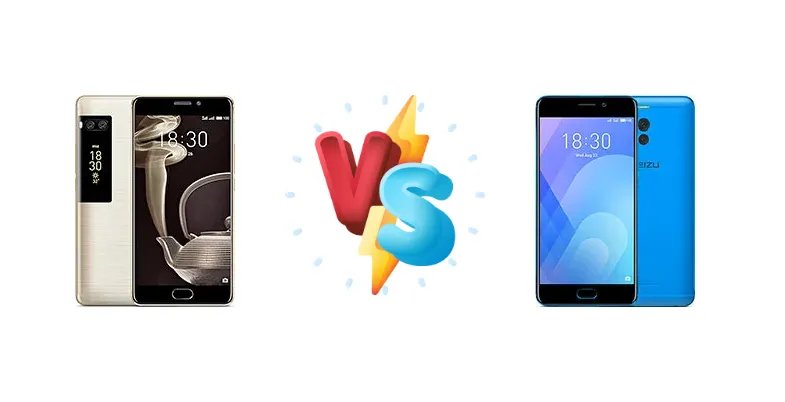
The Meizu Pro 7 Plus and M6 Note represent distinct approaches within Meizu’s lineup. The Pro 7 Plus aimed for a near-flagship experience with its deca-core Helio X30 processor, while the M6 Note focused on delivering solid performance and battery life at a more accessible price point. This comparison dissects the key differences to determine which device best suits your needs.
🏆 Quick Verdict
For users prioritizing raw processing power and a potentially brighter display, the Meizu Pro 7 Plus is the better choice. However, the M6 Note offers a more efficient Snapdragon 625 chipset and a comparable 24W charging experience, making it a strong contender for everyday use and budget-conscious buyers.
| Network |
|---|
| 2G bands | GSM 850 / 900 / 1800 / 1900 - SIM 1 & SIM 2 | GSM 850 / 900 / 1800 / 1900 - SIM 1 & SIM 2 |
| 3G bands | HSDPA 850 / 900 / 1900 / 2100 | HSDPA 850 / 900 / 1900 / 2100 |
| 4G bands | 1, 3, 7, 38, 39, 40, 41 | 1, 3, 5, 7, 8, 20, 38, 40 |
| Speed | HSPA, LTE | HSPA, LTE |
| Technology | GSM / HSPA / EVDO / LTE | GSM / CDMA / HSPA / LTE |
| | CDMA2000 1xEV-DO & TD-SCDMA | CDMA 800 |
| Launch |
|---|
| Announced | 2017, July. Released 2017, August | 2017, August. Released 2017, September |
| Status | Discontinued | Discontinued |
| Body |
|---|
| Build | Glass front, aluminum back, aluminum frame | Glass front, aluminum back, aluminum frame |
| Dimensions | 157.3 x 77.2 x 7.3 mm (6.19 x 3.04 x 0.29 in) | 154.6 x 75.2 x 8.4 mm (6.09 x 2.96 x 0.33 in) |
| SIM | Nano-SIM + Nano-SIM | Nano-SIM + Nano-SIM |
| Weight | 170 g (6.00 oz) | 173 g (6.10 oz) |
| Display |
|---|
| Resolution | 1440 x 2560 pixels, 16:9 ratio (~518 ppi density) | 1080 x 1920 pixels, 16:9 ratio (~403 ppi density) |
| Size | 5.7 inches, 88.5 cm2 (~72.9% screen-to-body ratio) | 5.5 inches, 82.6 cm2 (~71.0% screen-to-body ratio) |
| Type | Super AMOLED | IPS LCD |
| | Secondary 2" AMOLED display, 240 x 536 pixels | - |
| Platform |
|---|
| CPU | Deca-core (2x2.6 GHz Cortex-A73, 4x1.9 GHz Cortex-A35, 4x2.2 GHz Cortex-A53) | Octa-core 2.0 GHz Cortex-A53 |
| Chipset | Mediatek MT6799 Helio X30 (10 nm) | Qualcomm MSM8953 Snapdragon 625 (14 nm) |
| GPU | PowerVR 7XTP | Adreno 506 |
| OS | Android 7.0 (Nougat), Flyme 7.3 | Android 7.1.2 (Nougat), Flyme 7.3 |
| Memory |
|---|
| Card slot | No | microSDXC |
| Internal | 64GB 6GB RAM, 128GB 6GB RAM | 16GB 4GB RAM, 32GB 3GB RAM, 64GB 4GB RAM |
| | - | eMMC 5.1 |
| Main Camera |
|---|
| Dual | - | 12 MP, f/1.9, 1/2.55", 1.4µm, dual pixel PDAF
5 MP, f/2.0, AF |
| Features | Dual-LED dual-tone flash, HDR, panorama | quad-LED dual-tone flash, HDR, panorama |
| Single | 12 MP, f/2.0, 1/2.9", 1.25µm, PDAF | - |
| Video | 4K@30fps | 1080p@30fps |
| Selfie camera |
|---|
| Single | 16 MP, f/2.0, 26mm (wide), 1/3.06", 1.0µm | 16 MP, f/2.0, 26mm (wide), 1/3.06", 1.0µm |
| Video | - | 1080p@30fps |
| Sound |
|---|
| 3.5mm jack | Yes | Yes |
| 35mm jack | Yes | Yes |
| Loudspeaker | Yes | Yes |
| | 32-bit/192kHz audio
| - |
| Comms |
|---|
| Bluetooth | 4.2, A2DP, LE | 4.2, A2DP, LE |
| NFC | No | No |
| Positioning | GPS, GLONASS, BDS | GPS, GLONASS |
| Radio | No | No |
| USB | USB Type-C | microUSB 2.0 |
| WLAN | Wi-Fi 802.11 a/b/g/n/ac, dual-band, Wi-Fi Direct | Wi-Fi 802.11 a/b/g/n, dual-band |
| Features |
|---|
| Sensors | Fingerprint (front-mounted), accelerometer, gyro, proximity, compass | Fingerprint (front-mounted), accelerometer, gyro, proximity, compass |
| Battery |
|---|
| Charging | 24W wired, 45% in 30 min | 24W wired |
| Type | Li-Ion 3500 mAh, non-removable | Li-Ion 4000 mAh, non-removable |
| Misc |
|---|
| Colors | Black, gold, silver | Black, Blue, Gold |
| Models | PRO 7 Plus | M6 Note, MZ-M6 Note |
| Price | About 500 EUR | About 170 EUR |
| Tests |
|---|
| Audio quality |
Noise -92.1dB / Crosstalk -92.8dB | - |
| Battery life | Endurance rating 70h | - |
| Camera |
Photo / Video | - |
| Display |
Contrast ratio: Infinite (nominal), 4.147 (sunlight) | - |
| Loudspeaker |
Voice 87dB / Noise 72dB / Ring 90dB | - |
| Performance |
GFXBench: 4.8fps (ES 3.1 onscreen) | - |
Meizu Pro 7 Plus
- Potentially brighter and more vibrant display with higher contrast.
- More powerful deca-core processor for demanding tasks.
- Faster charging speed (45% in 30 minutes).
- Less power-efficient processor potentially leading to shorter battery life.
- Higher price point compared to the M6 Note.
- Potential for thermal throttling under sustained load.
Meizu M6 Note
- More power-efficient Snapdragon 625 processor.
- Potentially longer battery life due to efficient chipset.
- More affordable price point.
- Less powerful processor compared to the Helio X30.
- Likely a less vibrant display.
- May struggle with graphically intensive games or applications.
Display Comparison
Both devices feature 24W wired charging, but diverge significantly in display technology. The Pro 7 Plus boasts an 'Infinite' (nominal) contrast ratio and a 4.147 contrast ratio in sunlight, suggesting a potentially brighter and more vibrant display experience. While the M6 Note’s display specifications are not provided, the Pro 7 Plus’s higher contrast ratios indicate superior visual clarity, particularly outdoors. This difference is crucial for media consumption and gaming.
Camera Comparison
Both phones are listed as having 'Photo / Video' capabilities, but detailed camera specifications are absent. Given the Pro 7 Plus’s positioning as a higher-end device, it likely features a more sophisticated camera system with potentially larger sensors and advanced image processing. However, without specific details like sensor size, aperture, or OIS, it’s difficult to definitively assess the camera performance difference. The M6 Note likely offers a capable camera for everyday photography, but may lack the advanced features found in the Pro 7 Plus.
Performance
The core difference lies in the chipsets. The Meizu Pro 7 Plus utilizes the Mediatek MT6799 Helio X30, a deca-core processor built on a 10nm process. This configuration – 2x2.6 GHz Cortex-A73, 4x1.9 GHz Cortex-A35, and 4x2.2 GHz Cortex-A53 – aims for high performance across a range of tasks. Conversely, the M6 Note employs the Qualcomm MSM8953 Snapdragon 625, an octa-core 2.0 GHz Cortex-A53 processor fabricated on a more efficient 14nm node. While the Helio X30 offers more cores and higher clock speeds, the Snapdragon 625’s 14nm process generally translates to better power efficiency and sustained performance under load, reducing the likelihood of thermal throttling. The Pro 7 Plus targets power users, while the M6 Note prioritizes efficiency.
Battery Life
The Meizu Pro 7 Plus achieves an endurance rating of 70 hours, indicating respectable battery life. While the M6 Note’s battery life isn’t specified, the Snapdragon 625’s power efficiency suggests it could offer comparable or even superior endurance in real-world usage. Both devices support 24W wired charging, with the Pro 7 Plus claiming a 45% charge in 30 minutes. This fast charging capability is a commonality, but the Pro 7 Plus’s larger battery capacity means it will take longer to fully charge from 0-100%.
Buying Guide
Buy the Meizu Pro 7 Plus if you need a device capable of handling demanding tasks, potentially benefit from the higher contrast display, and are willing to accept potentially shorter battery life. Buy the Meizu M6 Note if you prioritize efficient power consumption, a stable and reliable processor for everyday tasks, and a more affordable price point. The M6 Note is ideal for users who value longevity and practicality over peak performance.
Frequently Asked Questions
❓ Will the Helio X30 in the Pro 7 Plus overheat during extended gaming sessions?
The Helio X30, while powerful, is known to generate more heat than the Snapdragon 625. While the 10nm process helps, prolonged gaming or demanding tasks could lead to thermal throttling, reducing performance to manage temperatures. The M6 Note’s Snapdragon 625 is less prone to overheating.
❓ Is the difference in processor performance between the Helio X30 and Snapdragon 625 noticeable for everyday tasks?
For typical daily use – browsing, social media, messaging – the difference will be minimal. The Snapdragon 625 is more than capable of handling these tasks smoothly. The Helio X30’s advantage becomes apparent in more demanding applications like video editing, 3D gaming, or multitasking with numerous apps open.
❓ Does the Meizu Pro 7 Plus support fast charging for other devices?
The context data doesn't specify if the 24W charging is a proprietary standard or supports common protocols like USB Power Delivery. It's likely limited to charging the Pro 7 Plus itself at its maximum speed, but compatibility with other devices is uncertain.