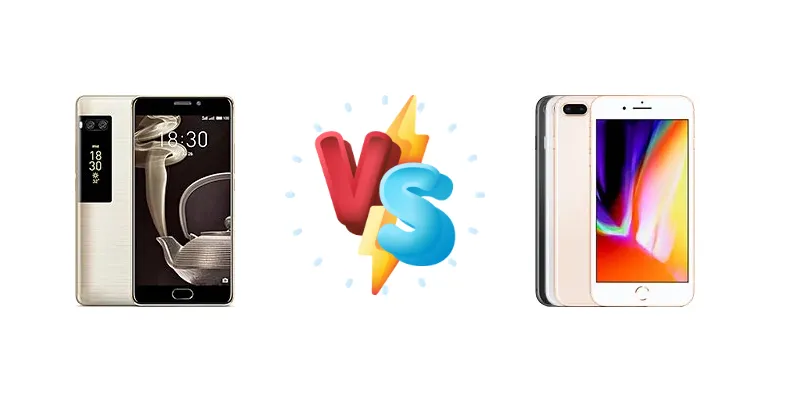
The Meizu Pro 7 Plus and Apple iPhone 8 Plus represent distinct approaches to the flagship smartphone experience from 2017. While both have aged, they remain relevant for budget-conscious buyers. This comparison dissects their key differences, from processor architecture to battery endurance, to determine which offers the best value today.
🏆 Quick Verdict
For the average user prioritizing longevity and a polished software experience, the Apple iPhone 8 Plus emerges as the better choice. Its A11 Bionic chip, coupled with superior battery endurance (81h vs 70h), provides a smoother and more reliable experience despite the Meizu's faster wired charging.
| Network |
|---|
| 2G bands | GSM 850 / 900 / 1800 / 1900 - SIM 1 & SIM 2 | GSM 850 / 900 / 1800 / 1900 |
| 3G bands | HSDPA 850 / 900 / 1900 / 2100 | HSDPA 850 / 900 / 1700(AWS) / 1900 / 2100 |
| 4G bands | 1, 3, 7, 38, 39, 40, 41 | 1, 2, 3, 4, 5, 7, 8, 12, 13, 17, 18, 19, 20, 25, 26, 28, 29, 30, 34, 38, 39, 40, 41, 66 |
| Speed | HSPA, LTE | HSPA 42.2/5.76 Mbps, LTE (3CA) Cat12 600/150 Mbps, EV-DO Rev.A 3.1 Mbps |
| Technology | GSM / HSPA / EVDO / LTE | GSM / HSPA / LTE |
| | CDMA2000 1xEV-DO & TD-SCDMA | - |
| Launch |
|---|
| Announced | 2017, July. Released 2017, August | 2017, September 12. Released 2017, September 22 |
| Status | Discontinued | Discontinued |
| Body |
|---|
| Build | Glass front, aluminum back, aluminum frame | Glass front (Corning-made glass), glass back (Corning-made glass), aluminum frame |
| Dimensions | 157.3 x 77.2 x 7.3 mm (6.19 x 3.04 x 0.29 in) | 158.4 x 78.1 x 7.5 mm (6.24 x 3.07 x 0.30 in) |
| SIM | Nano-SIM + Nano-SIM | Nano-SIM |
| Weight | 170 g (6.00 oz) | 202 g (7.13 oz) |
| | - | IP67 dust/water resistant (up to 1m for 30 mins)
Apple Pay (Visa, MasterCard, AMEX certified) |
| Display |
|---|
| Protection | - | Ion-strengthened glass |
| Resolution | 1440 x 2560 pixels, 16:9 ratio (~518 ppi density) | 1080 x 1920 pixels, 16:9 ratio (~401 ppi density) |
| Size | 5.7 inches, 88.5 cm2 (~72.9% screen-to-body ratio) | 5.5 inches, 83.4 cm2 (~67.4% screen-to-body ratio) |
| Type | Super AMOLED | Retina IPS LCD, 625 nits (typ) |
| | Secondary 2" AMOLED display, 240 x 536 pixels | 3D Touch display & home button |
| Platform |
|---|
| CPU | Deca-core (2x2.6 GHz Cortex-A73, 4x1.9 GHz Cortex-A35, 4x2.2 GHz Cortex-A53) | Hexa-core (2x Monsoon + 4x Mistral) |
| Chipset | Mediatek MT6799 Helio X30 (10 nm) | Apple A11 Bionic (10 nm) |
| GPU | PowerVR 7XTP | Apple GPU (three-core graphics) |
| OS | Android 7.0 (Nougat), Flyme 7.3 | iOS 11, up to iOS 16.7.12 |
| Memory |
|---|
| Card slot | No | No |
| Internal | 64GB 6GB RAM, 128GB 6GB RAM | 64GB 3GB RAM, 128GB 3GB RAM, 256GB 3GB RAM |
| | - | NVMe |
| Main Camera |
|---|
| Dual | - | 12 MP, f/1.8, 28mm (wide), PDAF, OIS
12 MP, f/2.8, 57mm (telephoto), PDAF, 2x optical zoom |
| Features | Dual-LED dual-tone flash, HDR, panorama | Quad-LED dual-tone flash, HDR |
| Single | 12 MP, f/2.0, 1/2.9", 1.25µm, PDAF | - |
| Video | 4K@30fps | 4K@24/30/60fps, 1080p@30/60/120/240fps |
| Selfie camera |
|---|
| Features | - | Face detection, HDR |
| Single | 16 MP, f/2.0, 26mm (wide), 1/3.06", 1.0µm | 7 MP, f/2.2, 32mm (standard) |
| Video | - | 1080p@30fps |
| Sound |
|---|
| 3.5mm jack | Yes | No |
| 35mm jack | Yes | No |
| Loudspeaker | Yes | Yes, with stereo speakers |
| | 32-bit/192kHz audio
| - |
| Comms |
|---|
| Bluetooth | 4.2, A2DP, LE | 5.0, A2DP, LE |
| NFC | No | Yes |
| Positioning | GPS, GLONASS, BDS | GPS, GLONASS, GALILEO, QZSS |
| Radio | No | No |
| USB | USB Type-C | Lightning, USB 2.0 |
| WLAN | Wi-Fi 802.11 a/b/g/n/ac, dual-band, Wi-Fi Direct | Wi-Fi 802.11 a/b/g/n/ac, dual-band, hotspot |
| Features |
|---|
| Sensors | Fingerprint (front-mounted), accelerometer, gyro, proximity, compass | Fingerprint (front-mounted), accelerometer, gyro, proximity, compass, barometer |
| Battery |
|---|
| Charging | 24W wired, 45% in 30 min | 15W wired, PD2.0, 50% in 30 min
Wireless (Qi) |
| Talk time | - | Up to 21 h (3G) |
| Type | Li-Ion 3500 mAh, non-removable | Li-Ion 2691 mAh, non-removable (10.28 Wh) |
| Misc |
|---|
| Colors | Black, gold, silver | Gold, Space Gray, Silver, Red |
| Models | PRO 7 Plus | A1864, A1897, A1898, , A1899, iPhone10,2, iPhone10,5 |
| Price | About 500 EUR | About 340 EUR |
| SAR | - | 1.19 W/kg (head) 1.19 W/kg (body) |
| SAR EU | - | 0.99 W/kg (head) 0.99 W/kg (body) |
| Tests |
|---|
| Audio quality |
Noise -92.1dB / Crosstalk -92.8dB |
Noise -93.5dB / Crosstalk -80.2dB |
| Battery life | Endurance rating 70h | Endurance rating 81h |
| Camera |
Photo / Video |
Photo / Video |
| Display |
Contrast ratio: Infinite (nominal), 4.147 (sunlight) |
Contrast ratio: 1395:1 (nominal), 3.957 (sunlight) |
| Loudspeaker |
Voice 87dB / Noise 72dB / Ring 90dB |
Voice 76dB / Noise 74dB / Ring 79dB |
| Performance |
GFXBench: 4.8fps (ES 3.1 onscreen) |
GeekBench: 10037 (v4.4) |
Meizu Pro 7 Plus
- Faster 24W wired charging
- Potentially higher display contrast (OLED)
- Deca-core processor offers theoretical multitasking benefits
- Lower battery endurance (70h)
- Less refined software experience
- Uncertain camera performance
Apple iPhone 8 Plus
- Superior battery life (81h)
- More efficient processor (A11 Bionic)
- Qi wireless charging support
- Slower 15W wired charging
- LCD display with lower nominal contrast
- Older iOS version (limited software updates)
Display Comparison
Both phones feature similar sunlight readability with contrast ratios around 4.0, but diverge significantly in nominal contrast. The Meizu Pro 7 Plus boasts an 'Infinite' nominal contrast ratio, suggesting a true OLED panel, while the iPhone 8 Plus’s 1395:1 ratio indicates an LCD. This means deeper blacks and potentially more vibrant colors on the Meizu, though color accuracy isn't specified. The lack of refresh rate data for either phone means neither offers the smoothness of modern displays.
Camera Comparison
Both devices are listed as having 'Photo / Video' capabilities, but detailed sensor information is absent. Given Apple’s historical strength in image processing, the iPhone 8 Plus likely delivers more consistent and pleasing results, particularly in challenging lighting conditions. The Meizu’s camera performance is harder to assess without specifics, but the lack of detail suggests it doesn’t represent a significant advantage. The absence of information on OIS or aperture sizes further complicates a direct comparison.
Performance
The Meizu Pro 7 Plus’s Mediatek Helio X30 is a deca-core processor utilizing a tri-cluster design (2x Cortex-A73, 4x Cortex-A35, 4x Cortex-A53) built on a 10nm process. This contrasts with the Apple A11 Bionic’s hexa-core architecture (2x Monsoon + 4x Mistral) also on a 10nm node. While the Meizu boasts more cores, Apple’s custom CPU design and tight software integration generally deliver superior single-core and sustained performance. The A11 Bionic’s efficiency also contributes to the iPhone 8 Plus’s better battery life.
Battery Life
The iPhone 8 Plus edges out the Meizu Pro 7 Plus in battery endurance, achieving 81 hours versus 70 hours. While the Meizu offers faster 24W wired charging (45% in 30 minutes), the iPhone 8 Plus supports 15W wired charging with PD2.0 and adds the convenience of Qi wireless charging. The iPhone’s superior efficiency, thanks to the A11 Bionic, allows it to extract more usage from a similar battery capacity.
Buying Guide
Buy the Meizu Pro 7 Plus if you prioritize fast charging (24W) and a potentially higher contrast display, and are comfortable with a less refined software experience. Buy the Apple iPhone 8 Plus if you value long-term software support, a more efficient processor, and a consistently reliable user experience, even if it means slightly slower charging.
Frequently Asked Questions
❓ Is the Mediatek Helio X30 prone to overheating under sustained load?
The Helio X30's deca-core architecture, while powerful, can generate significant heat. While the 10nm process helps, it's likely to throttle under prolonged gaming or demanding tasks, potentially leading to performance dips. The A11 Bionic in the iPhone 8 Plus is generally more efficient and manages heat better.
❓ Does the Meizu Pro 7 Plus receive regular software updates?
Meizu's software update track record is less consistent than Apple's. The Pro 7 Plus is unlikely to receive significant software updates at this point, meaning it may lack the latest security patches and features. The iPhone 8 Plus, while also nearing the end of its software support lifecycle, will likely receive updates for a longer period.
❓ How does the iPhone 8 Plus's battery health hold up over time?
Like all lithium-ion batteries, the iPhone 8 Plus's battery capacity degrades over time. Apple provides battery health information in settings, and users can replace the battery if capacity falls below acceptable levels. The iPhone 8 Plus's efficient processor helps mitigate battery degradation compared to devices with less optimized chips.