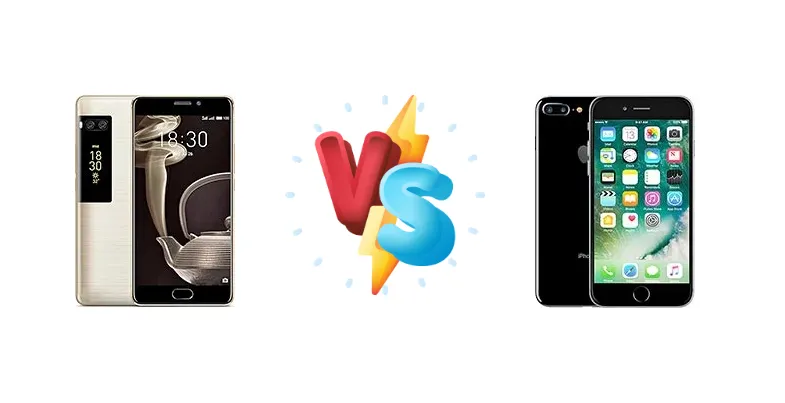
Released in different ecosystems and at different price points, the Meizu Pro 7 Plus and Apple iPhone 7 Plus represent interesting points in smartphone history. Today, both are available at significantly reduced prices, making a direct comparison relevant for budget-conscious consumers seeking a capable device. This analysis dives deep into their specifications to determine which offers the best experience in 2024.
🏆 Quick Verdict
For the average user prioritizing long-term software support and a refined user experience, the iPhone 7 Plus remains the better choice. While the Meizu Pro 7 Plus boasts a more modern deca-core processor and theoretically superior display contrast, Apple’s A10 Fusion chip delivers consistently smoother performance and the iOS ecosystem provides a more polished experience.
| Network |
|---|
| 2G bands | GSM 850 / 900 / 1800 / 1900 - SIM 1 & SIM 2 | GSM 850 / 900 / 1800 / 1900 - A1661, A1784 |
| 3G bands | HSDPA 850 / 900 / 1900 / 2100 | HSDPA 850 / 900 / 1700(AWS) / 1900 / 2100 - A1661, A1784 |
| 4G bands | 1, 3, 7, 38, 39, 40, 41 | 1, 2, 3, 4, 5, 7, 8, 12, 13, 17, 18, 19, 20, 25, 26, 27, 28, 29, 30, 38, 39, 40, 41 - A1661, A1784 |
| Speed | HSPA, LTE | HSPA 42.2/5.76 Mbps, LTE (3CA) Cat9 450/50 Mbps, EV-DO Rev.A 3.1 Mbps |
| Technology | GSM / HSPA / EVDO / LTE | GSM / CDMA / HSPA / EVDO / LTE |
| | CDMA2000 1xEV-DO & TD-SCDMA | CDMA2000 1xEV-DO & TD-SCDMA - A1661 |
| Launch |
|---|
| Announced | 2017, July. Released 2017, August | 2016, September 07. Released 2016, September 16 |
| Status | Discontinued | Discontinued |
| Body |
|---|
| Build | Glass front, aluminum back, aluminum frame | Glass front (Corning-made glass), aluminum back, aluminum frame |
| Dimensions | 157.3 x 77.2 x 7.3 mm (6.19 x 3.04 x 0.29 in) | 158.2 x 77.9 x 7.3 mm (6.23 x 3.07 x 0.29 in) |
| SIM | Nano-SIM + Nano-SIM | Nano-SIM |
| Weight | 170 g (6.00 oz) | 188 g (6.63 oz) |
| | - | IP67 dust/water resistant (up to 1m for 30 min)
Apple Pay (Visa, MasterCard, AMEX certified) |
| Display |
|---|
| Protection | - | Ion-strengthened glass |
| Resolution | 1440 x 2560 pixels, 16:9 ratio (~518 ppi density) | 1080 x 1920 pixels, 16:9 ratio (~401 ppi density) |
| Size | 5.7 inches, 88.5 cm2 (~72.9% screen-to-body ratio) | 5.5 inches, 83.4 cm2 (~67.7% screen-to-body ratio) |
| Type | Super AMOLED | Retina IPS LCD, 625 nits (typ) |
| | Secondary 2" AMOLED display, 240 x 536 pixels | 3D Touch display & home button |
| Platform |
|---|
| CPU | Deca-core (2x2.6 GHz Cortex-A73, 4x1.9 GHz Cortex-A35, 4x2.2 GHz Cortex-A53) | Quad-core 2.34 GHz (2x Hurricane + 2x Zephyr) |
| Chipset | Mediatek MT6799 Helio X30 (10 nm) | Apple A10 Fusion (16 nm) |
| GPU | PowerVR 7XTP | PowerVR Series7XT Plus (six-core graphics) |
| OS | Android 7.0 (Nougat), Flyme 7.3 | iOS 10.0.1, upgradable to iOS 15.8.5 |
| Memory |
|---|
| Card slot | No | No |
| Internal | 64GB 6GB RAM, 128GB 6GB RAM | 32GB 3GB RAM, 128GB 3GB RAM, 256GB 3GB RAM |
| | - | NVMe |
| Main Camera |
|---|
| Dual | - | 12 MP, f/1.8, 28mm (wide), 1/3.0", PDAF, OIS
12 MP, f/2.8, 56mm (telephoto), 1/3.6", AF, 2x optical zoom |
| Features | Dual-LED dual-tone flash, HDR, panorama | Quad-LED dual-tone flash, HDR |
| Single | 12 MP, f/2.0, 1/2.9", 1.25µm, PDAF | - |
| Video | 4K@30fps | 4K@30fps, 1080p@30/60/120fps, 720p@240fps |
| Selfie camera |
|---|
| Features | - | Face detection, HDR |
| Single | 16 MP, f/2.0, 26mm (wide), 1/3.06", 1.0µm | 7 MP, f/2.2, 32mm (standard) |
| Video | - | 1080p@30fps |
| Sound |
|---|
| 3.5mm jack | Yes | No |
| 35mm jack | Yes | No |
| Loudspeaker | Yes | Yes, with stereo speakers |
| | 32-bit/192kHz audio
| - |
| Comms |
|---|
| Bluetooth | 4.2, A2DP, LE | 4.2, A2DP, LE |
| NFC | No | Yes |
| Positioning | GPS, GLONASS, BDS | GPS, GLONASS, GALILEO, QZSS |
| Radio | No | No |
| USB | USB Type-C | Lightning, USB 2.0 |
| WLAN | Wi-Fi 802.11 a/b/g/n/ac, dual-band, Wi-Fi Direct | Wi-Fi 802.11 a/b/g/n/ac, dual-band, hotspot |
| Features |
|---|
| Sensors | Fingerprint (front-mounted), accelerometer, gyro, proximity, compass | Fingerprint (front-mounted), accelerometer, gyro, proximity, compass, barometer |
| Battery |
|---|
| Charging | 24W wired, 45% in 30 min | - |
| Stand-by | - | Up to 384 h (3G) |
| Talk time | - | Up to 21 h (3G) |
| Type | Li-Ion 3500 mAh, non-removable | Li-Ion 2900 mAh, non-removable (11.1 Wh) |
| Misc |
|---|
| Colors | Black, gold, silver | Jet Black, Black, Silver, Gold, Rose Gold, Red |
| Models | PRO 7 Plus | A1661, A1784, A1785, A1786, iPhone9,4, iPhone9,2 |
| Price | About 500 EUR | About 320 EUR |
| SAR | - | 1.19 W/kg (head) 1.19 W/kg (body) |
| SAR EU | - | 1.24 W/kg (head) 1.00 W/kg (body) |
| Tests |
|---|
| Audio quality |
Noise -92.1dB / Crosstalk -92.8dB |
Noise -93.1dB / Crosstalk -80.5dB |
| Battery life | Endurance rating 70h |
Endurance rating 75h
|
| Camera |
Photo / Video |
Photo / Video |
| Display |
Contrast ratio: Infinite (nominal), 4.147 (sunlight) |
Contrast ratio: 1398:1 (nominal), 3.588 (sunlight) |
| Loudspeaker |
Voice 87dB / Noise 72dB / Ring 90dB |
Voice 68dB / Noise 72dB / Ring 72dB
|
| Performance |
GFXBench: 4.8fps (ES 3.1 onscreen) |
Basemark OS II 2.0: 3796 |
Meizu Pro 7 Plus
- Potentially higher peak performance with deca-core processor
- Faster charging speed (24W)
- Higher contrast ratio (on paper)
- Less optimized software and potential for throttling
- Uncertain long-term software support
- Likely inferior camera performance
Apple iPhone 7 Plus
- Smooth and consistent performance with A10 Fusion
- Excellent camera quality and image stabilization
- Long-term software support and iOS ecosystem
- Slower charging speed
- Lower contrast ratio (on paper)
- Older design
Display Comparison
The Meizu Pro 7 Plus claims an 'Infinite' contrast ratio (nominal) and 4.147 in sunlight, suggesting a potentially striking visual experience. However, 'Infinite' contrast is a marketing term, and the 4.147 sunlight readability figure is more meaningful. The iPhone 7 Plus, with a 1398:1 nominal contrast ratio and 3.588 sunlight readability, falls behind on paper. In real-world use, the iPhone 7 Plus’s color accuracy and calibration are likely superior, a common strength of Apple displays. Both phones lack modern features like high refresh rates, but the Meizu’s higher contrast *could* translate to deeper blacks, though this is dependent on panel quality and calibration.
Camera Comparison
Both phones offer photo and video capabilities, but detailed sensor information is lacking. The iPhone 7 Plus is known for its dual-camera system, offering optical image stabilization (OIS) and portrait mode, features likely absent on the Meizu Pro 7 Plus. Apple’s image processing consistently delivers natural-looking photos with excellent dynamic range. Without specific sensor details for the Meizu, it’s difficult to assess its camera performance, but it’s unlikely to match the iPhone 7 Plus’s consistently high image quality and video stabilization.
Performance
The Meizu Pro 7 Plus’s Mediatek Helio X30 is a deca-core processor built on a 10nm process, theoretically offering significant multi-core performance. However, the A10 Fusion in the iPhone 7 Plus, despite having only four cores, is built on a 16nm process and benefits from Apple’s tight hardware-software integration. The A10 Fusion consistently outperforms the Helio X30 in single-core tasks and sustained performance, meaning smoother app launches and less throttling during extended gaming sessions. The architectural difference – Apple’s custom cores versus Mediatek’s Cortex-A series – is crucial here. While the Helio X30 has more cores, they aren’t as efficient or powerful individually.
Battery Life
Both phones boast similar endurance ratings, with the iPhone 7 Plus edging out the Meizu Pro 7 Plus at 75 hours versus 70 hours. The Meizu Pro 7 Plus supports 24W wired charging, achieving 45% charge in 30 minutes, a faster charging speed than the iPhone 7 Plus. However, the iPhone 7 Plus’s optimized power management and efficient A10 Fusion chip contribute to its slightly longer battery life despite a potentially smaller battery capacity. The faster charging on the Meizu is beneficial for quick top-ups, but the iPhone offers more consistent endurance.
Buying Guide
Buy the Meizu Pro 7 Plus if you need a phone with a potentially higher peak performance ceiling for demanding tasks and appreciate a high contrast display, and are comfortable with the Android ecosystem and potential software limitations. Buy the Apple iPhone 7 Plus if you prioritize a seamless user experience, long-term software updates, a well-established app ecosystem, and consistent performance across all tasks.
Frequently Asked Questions
❓ Is the Mediatek Helio X30 prone to overheating under sustained load?
The Helio X30, while powerful, is known to generate significant heat under prolonged stress. The 10nm process helps, but the deca-core design and less efficient architecture compared to Apple’s A10 Fusion mean it’s more likely to throttle performance during extended gaming or video recording sessions.
❓ How does the software support compare between the Meizu Pro 7 Plus and the iPhone 7 Plus?
Apple provides significantly longer software support for its devices. The iPhone 7 Plus has received updates for years after its release and continues to receive security patches. The Meizu Pro 7 Plus, running an older version of Android, is unlikely to receive further updates, potentially leaving it vulnerable to security risks and lacking new features.
❓ Will I be able to find accessories easily for the Meizu Pro 7 Plus?
Finding accessories for the Meizu Pro 7 Plus will be considerably more difficult than for the iPhone 7 Plus. Apple’s widespread popularity ensures a vast availability of cases, screen protectors, and other accessories. The Meizu Pro 7 Plus, being a less common device, will have limited accessory options.