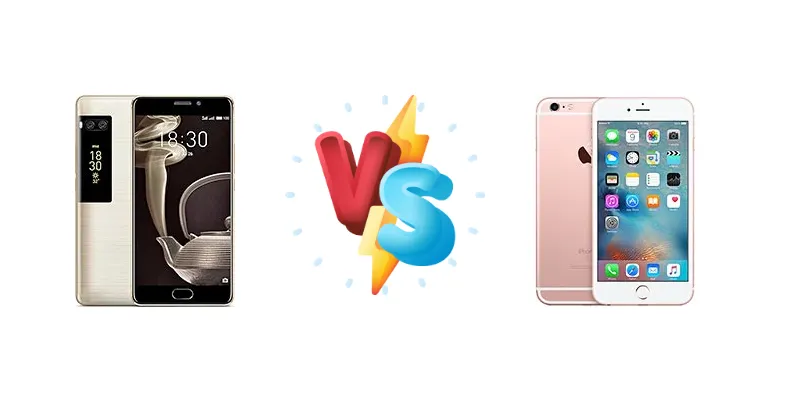
Released in 2017, the Meizu Pro 7 Plus and Apple iPhone 6s Plus represent divergent approaches to smartphone design. The Meizu aimed for cutting-edge specs, including a deca-core processor, while Apple focused on optimizing a dual-core chip within its ecosystem. This comparison revisits these devices, analyzing their strengths and weaknesses in a modern context, particularly for users considering a budget-friendly or vintage smartphone.
🏆 Quick Verdict
For the average user in 2024, the Apple iPhone 6s Plus emerges as the more practical choice. While the Meizu Pro 7 Plus boasts impressive on-paper specifications, the iPhone 6s Plus’s superior battery endurance and optimized software experience provide a smoother, more reliable daily experience. The iPhone’s continued software support and established ecosystem are significant advantages.
| Network |
|---|
| 2G bands | GSM 850 / 900 / 1800 / 1900 - SIM 1 & SIM 2 | GSM 850 / 900 / 1800 / 1900 |
| 3G bands | HSDPA 850 / 900 / 1900 / 2100 | HSDPA 850 / 900 / 1700 / 1900 / 2100 |
| 4G bands | 1, 3, 7, 38, 39, 40, 41 | 1, 2, 3, 4, 5, 7, 8, 12, 13, 17, 18, 19, 20, 25, 26, 28, 29, 30 - A1633 |
| Speed | HSPA, LTE | HSPA 42.2/5.76 Mbps, LTE (2CA) Cat6 300/50 Mbps, EV-DO Rev.A 3.1 Mbps |
| Technology | GSM / HSPA / EVDO / LTE | GSM / CDMA / HSPA / EVDO / LTE |
| | CDMA2000 1xEV-DO & TD-SCDMA | 1, 2, 3, 4, 5, 7, 8, 12, 13, 17, 18, 19, 20, 25, 26, 28, 29, 30, 38, 39, 40, 41 - A1634 |
| Launch |
|---|
| Announced | 2017, July. Released 2017, August | 2015, September 09. Released 2015, September 25 |
| Status | Discontinued | Discontinued |
| Body |
|---|
| Build | Glass front, aluminum back, aluminum frame | Glass front (Corning-made glass), aluminum back, aluminum frame |
| Dimensions | 157.3 x 77.2 x 7.3 mm (6.19 x 3.04 x 0.29 in) | 158.2 x 77.9 x 7.3 mm (6.23 x 3.07 x 0.29 in) |
| SIM | Nano-SIM + Nano-SIM | Nano-SIM |
| Weight | 170 g (6.00 oz) | 192 g (6.77 oz) |
| | - | Apple Pay (Visa, MasterCard, AMEX certified) |
| Display |
|---|
| Protection | - | Ion-strengthened glass, oleophobic coating |
| Resolution | 1440 x 2560 pixels, 16:9 ratio (~518 ppi density) | 1080 x 1920 pixels, 16:9 ratio (~401 ppi density) |
| Size | 5.7 inches, 88.5 cm2 (~72.9% screen-to-body ratio) | 5.5 inches, 83.4 cm2 (~67.7% screen-to-body ratio) |
| Type | Super AMOLED | IPS LCD |
| | Secondary 2" AMOLED display, 240 x 536 pixels | 3D Touch display |
| Platform |
|---|
| CPU | Deca-core (2x2.6 GHz Cortex-A73, 4x1.9 GHz Cortex-A35, 4x2.2 GHz Cortex-A53) | Dual-core 1.84 GHz Twister |
| Chipset | Mediatek MT6799 Helio X30 (10 nm) | Apple A9 (14/16 nm - maker dependant) |
| GPU | PowerVR 7XTP | PowerVR GT7600 (six-core graphics) |
| OS | Android 7.0 (Nougat), Flyme 7.3 | iOS 9, upgradable to iOS 15.8.5 |
| Memory |
|---|
| Card slot | No | No |
| Internal | 64GB 6GB RAM, 128GB 6GB RAM | 16GB 2GB RAM, 32GB 2GB RAM, 64GB 2GB RAM, 128GB 2GB RAM |
| | - | NVMe |
| Main Camera |
|---|
| Features | Dual-LED dual-tone flash, HDR, panorama | Dual-LED dual-tone flash, HDR |
| Single | 12 MP, f/2.0, 1/2.9", 1.25µm, PDAF | 12 MP, f/2.2, 29mm (standard), 1/3.0", 1.22µm, PDAF, OIS |
| Video | 4K@30fps | 4K@30fps, 1080p@60fps, 1080p@120fps, 720p@240fps |
| Selfie camera |
|---|
| Features | - | Face detection, HDR, panorama |
| Single | 16 MP, f/2.0, 26mm (wide), 1/3.06", 1.0µm | 5 MP, f/2.2, 31mm (standard) |
| Video | - | 720p@30fps |
| Sound |
|---|
| 3.5mm jack | Yes | Yes |
| 35mm jack | Yes | Yes |
| Loudspeaker | Yes | Yes |
| | 32-bit/192kHz audio
| 16-bit/44.1kHz audio
|
| Comms |
|---|
| Bluetooth | 4.2, A2DP, LE | 4.2, A2DP, LE |
| NFC | No | Yes (Apple Pay only) |
| Positioning | GPS, GLONASS, BDS | GPS, GLONASS, GALILEO, QZSS |
| Radio | No | No |
| USB | USB Type-C | Lightning, USB 2.0 |
| WLAN | Wi-Fi 802.11 a/b/g/n/ac, dual-band, Wi-Fi Direct | Wi-Fi 802.11 a/b/g/n/ac, dual-band, hotspot |
| Features |
|---|
| Sensors | Fingerprint (front-mounted), accelerometer, gyro, proximity, compass | Fingerprint (front-mounted), accelerometer, gyro, proximity, compass, barometer |
| Battery |
|---|
| Charging | 24W wired, 45% in 30 min | - |
| Stand-by | - | Up to 384 h (3G) |
| Talk time | - | Up to 24 h (3G) |
| Type | Li-Ion 3500 mAh, non-removable | Li-Ion 2750 mAh, non-removable (10.45 Wh) |
| Misc |
|---|
| Colors | Black, gold, silver | Space Gray, Silver, Gold, Rose Gold |
| Models | PRO 7 Plus | A1634, A1687, A1690, A1699, iPhone8,2 |
| Price | About 500 EUR | About 240 EUR |
| SAR | - | 1.12 W/kg (head) 1.14 W/kg (body) |
| SAR EU | - | 0.93 W/kg (head) 0.98 W/kg (body) |
| Tests |
|---|
| Audio quality |
Noise -92.1dB / Crosstalk -92.8dB |
Noise -93.4dB / Crosstalk -71.1dB |
| Battery life | Endurance rating 70h |
Endurance rating 85h
|
| Camera |
Photo / Video |
Photo / Video |
| Display |
Contrast ratio: Infinite (nominal), 4.147 (sunlight) |
Contrast ratio: 1382:1 (nominal), 3.530 (sunlight) |
| Loudspeaker |
Voice 87dB / Noise 72dB / Ring 90dB |
Voice 65dB / Noise 65dB / Ring 64dB
|
| Performance |
GFXBench: 4.8fps (ES 3.1 onscreen) |
Basemark OS II 2.0: 2261 |
Meizu Pro 7 Plus
- Higher display contrast ratio for potentially more vibrant visuals.
- Deca-core processor offers theoretical performance advantages.
- Faster charging speed (24W).
- More modern chipset architecture (10nm).
- Lower battery endurance rating.
- Potential for thermal throttling due to the complex CPU.
- Software optimization may be less refined.
- Limited long-term software support.
Apple iPhone 6s Plus
- Superior battery life and power efficiency.
- Optimized software and ecosystem integration.
- Reliable performance and responsiveness.
- Continued software support (though limited).
- Lower display contrast ratio.
- Dual-core processor may struggle with demanding tasks.
- Slower charging speed.
- Older chipset architecture (14/16nm).
Display Comparison
The Meizu Pro 7 Plus boasts an 'infinite' nominal contrast ratio, and a more usable 4.147 contrast ratio in sunlight, significantly exceeding the iPhone 6s Plus’s 1382:1 nominal and 3.530 sunlight contrast. This suggests deeper blacks and potentially more vibrant colors on the Meizu. However, contrast isn't everything; the iPhone 6s Plus’s display is known for its color accuracy, a metric not provided for the Meizu. The lack of information on the Meizu’s panel type (IPS, AMOLED) makes a definitive judgment difficult, but the higher contrast ratios suggest a more visually striking display in certain conditions.
Camera Comparison
Both devices offer photo and video capabilities, but detailed camera specifications are lacking. Without sensor size, aperture, or image processing details, a direct comparison is challenging. However, Apple’s image processing algorithms were, and remain, highly regarded for their natural-looking results. The Meizu Pro 7 Plus likely relied on software enhancements to compensate for potentially less advanced hardware. The absence of information regarding OIS (Optical Image Stabilization) on either device further complicates the assessment.
Performance
The Meizu Pro 7 Plus’s Mediatek Helio X30 deca-core CPU (2x2.6 GHz Cortex-A73, 4x1.9 GHz Cortex-A35, 4x2.2 GHz Cortex-A53) appears vastly more powerful on paper than the iPhone 6s Plus’s dual-core 1.84 GHz Apple A9. However, architectural differences are crucial. Apple’s A9, built on a 14nm or 16nm process (depending on the manufacturer), is renowned for its efficiency and single-core performance. The Helio X30, while offering more cores, is built on a 10nm process, which doesn’t necessarily translate to superior real-world performance due to potential thermal throttling and software optimization challenges. The A9’s optimized software integration gives it an edge in responsiveness and sustained performance.
Battery Life
Despite having a potentially larger battery (mAh not specified), the Meizu Pro 7 Plus achieves an endurance rating of 70 hours, while the iPhone 6s Plus manages 85 hours. This indicates that Apple’s A9 chip and iOS optimization deliver significantly better power efficiency. The Meizu Pro 7 Plus offers 24W wired charging, reaching 45% in 30 minutes, a faster charging speed than the iPhone 6s Plus, but the iPhone’s longer overall battery life mitigates the need for frequent charging.
Buying Guide
Buy the Meizu Pro 7 Plus if you prioritize raw processing power for specific tasks and are comfortable with potential software quirks and a less refined user experience. It's a good option for tech enthusiasts who enjoy tinkering. Buy the Apple iPhone 6s Plus if you value long-term reliability, a polished user interface, and access to a mature app ecosystem. It’s ideal for users who need a dependable smartphone for everyday tasks and appreciate Apple’s ecosystem integration.
Frequently Asked Questions
❓ Is the Mediatek Helio X30 prone to overheating under sustained load?
The Helio X30's deca-core architecture, while powerful, is known to generate significant heat. Without advanced cooling solutions, prolonged gaming or video recording could lead to thermal throttling, reducing performance to prevent damage. The iPhone 6s Plus’s A9 chip, being more efficient, is less susceptible to overheating.
❓ How does the software experience differ between the Meizu Pro 7 Plus and the iPhone 6s Plus?
The iPhone 6s Plus runs iOS, known for its user-friendliness, stability, and extensive app ecosystem. The Meizu Pro 7 Plus runs Flyme OS, a heavily customized Android skin. While Flyme OS offers unique features, it may lack the polish and optimization of iOS, potentially leading to occasional bugs or performance inconsistencies.
❓ Can the Meizu Pro 7 Plus still receive security updates in 2024?
It is highly unlikely that the Meizu Pro 7 Plus is receiving regular security updates in 2024. Meizu’s software support for older devices is limited, leaving it vulnerable to security threats. The iPhone 6s Plus, while also no longer receiving major iOS updates, still receives occasional security patches, offering a degree of protection.