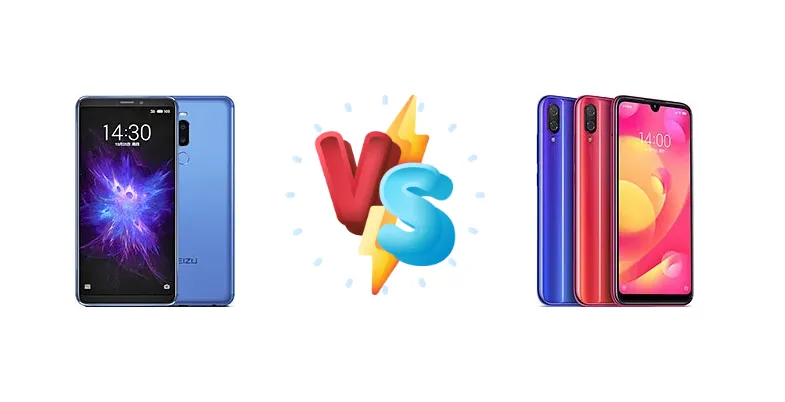
The Meizu Note 8 and Xiaomi Mi Play represent compelling options in the crowded budget smartphone market. While both aim to deliver a solid experience without breaking the bank, they take different approaches to achieving this goal. The Note 8 leverages Qualcomm’s Snapdragon 632, while the Mi Play opts for MediaTek’s Helio P35. This comparison dissects these key differences to determine which device offers the best value for your money.
🏆 Quick Verdict
For the average user prioritizing sustained performance and faster charging, the Meizu Note 8 is the better choice. Its Snapdragon 632 chipset, built on a smaller 14nm process, provides a noticeable advantage in multitasking and gaming compared to the Mi Play’s Helio P35, despite the latter’s slightly higher clock speeds. The 24W charging also significantly reduces downtime.
| Network |
|---|
| 2G bands | GSM 850 / 900 / 1800 / 1900 | GSM 850 / 900 / 1800 / 1900 |
| 3G bands | HSDPA 850 / 900 / 2100 - China | HSDPA 850 / 900 / 1900 / 2100 |
| 4G bands | 1, 3, 5, 38, 39, 40, 41 - China | 1, 3, 5, 7, 8, 34, 38, 39, 40, 41 |
| Speed | HSPA 42.2/5.76 Mbps, LTE Cat4 150/50 Mbps | HSPA, LTE |
| Technology | GSM / CDMA / HSPA / LTE | GSM / CDMA / HSPA / LTE |
| | CDMA 800 & TD-SCDMA - China | CDMA 800 & TD-SCDMA |
| Launch |
|---|
| Announced | 2018, October. Released 2018, November | 2018, December. Released 2018, December |
| Status | Discontinued | Discontinued |
| Body |
|---|
| Dimensions | 153.6 x 75.5 x 7.9 mm (6.05 x 2.97 x 0.31 in) | 147.8 x 71.9 x 7.8 mm (5.82 x 2.83 x 0.31 in) |
| SIM | Nano-SIM + Nano-SIM | Nano-SIM + Nano-SIM |
| Weight | 168 g (5.93 oz) | 150 g (5.29 oz) |
| Display |
|---|
| Resolution | 1080 x 2160 pixels, 18:9 ratio (~402 ppi density) | 1080 x 2280 pixels, 19:9 ratio (~432 ppi density) |
| Size | 6.0 inches, 92.9 cm2 (~80.1% screen-to-body ratio) | 5.84 inches, 85.1 cm2 (~80.1% screen-to-body ratio) |
| Type | IPS LCD | IPS LCD |
| Platform |
|---|
| CPU | Octa-core (4x1.8 GHz Kryo 250 Gold & 4x1.8 GHz Kryo 250 Silver) | Octa-core (4x2.3 GHz Cortex-A53 & 4x1.8 GHz Cortex-A53) |
| Chipset | Qualcomm SDM632 Snapdragon 632 (14 nm) | Mediatek MT6765 Helio P35 (12 nm) |
| GPU | Adreno 506 | PowerVR GE8320 |
| OS | Android 8.0 (Oreo), Flyme 7.3 | Android 9.0 (Pie) |
| Memory |
|---|
| Card slot | No | microSDXC (uses shared SIM slot) |
| Internal | 64GB 4GB RAM | 64GB 4GB RAM, 128GB 6GB RAM |
| | eMMC 5.1 | eMMC 5.1 |
| Main Camera |
|---|
| Dual | 12 MP, f/1.9, 1/2.55", 1.4µm, dual pixel PDAF
Auxiliary lens | 12 MP, f/2.2, 1.25 μm, PDAF
Auxiliary lens |
| Features | Dual-LED dual-tone flash, panorama | LED flash, HDR, panorama |
| Video | 1080p@30fps | 1080p@30fps |
| Selfie camera |
|---|
| Features | - | HDR |
| Single | 8 MP, f/2.0 | 8 MP |
| Video | - | 1080p@30fps |
| Sound |
|---|
| 3.5mm jack | Yes | Yes |
| 35mm jack | Yes | Yes |
| Loudspeaker | Yes | Yes |
| Comms |
|---|
| Bluetooth | 4.2, A2DP, LE | 4.2, A2DP, LE |
| NFC | No | No |
| Positioning | GPS, GLONASS, BDS | GPS, GLONASS, BDS |
| Radio | No | FM radio |
| USB | microUSB 2.0 | microUSB 2.0, OTG |
| WLAN | Wi-Fi 802.11 а/b/g/n, dual-band, Wi-Fi Direct | Wi-Fi 802.11 a/b/g/n/ac, dual-band, Wi-Fi Direct |
| Features |
|---|
| Sensors | Fingerprint (rear-mounted), accelerometer, gyro, proximity, compass | Fingerprint (rear-mounted), accelerometer, gyro, proximity, compass |
| Battery |
|---|
| Charging | 24W wired | 10W wired |
| Type | Li-Ion 3600 mAh, non-removable | Li-Ion 3000 mAh, non-removable |
| Misc |
|---|
| Colors | Black, Blue, Red, Pink | Dream Blue, Twilight Gold, Black |
| Models | - | M1901F9E |
| Price | About 200 EUR | About 170 EUR |
| SAR | - | 0.67 W/kg (head) 1.51 W/kg (body) |
Meizu Note 8
- Faster 24W charging for quicker top-ups.
- More efficient Snapdragon 632 chipset for sustained performance.
- Potentially better thermal management due to 14nm process.
- May have a slightly higher initial cost.
- Detailed camera specs are unknown.
Xiaomi Mi Play
- Potentially lower initial purchase price.
- Higher clock speeds on performance cores (on paper).
- May offer a slightly larger battery capacity (unconfirmed).
- Slower 10W charging.
- Less efficient Helio P35 chipset may throttle under sustained load.
- Likely inferior sustained performance compared to the Snapdragon 632.
Display Comparison
Neither device boasts a standout display. Both likely feature LCD panels, common in this price bracket. However, detailed specs like resolution and brightness are missing. The focus here is on the internal hardware. The difference in chipsets will have a greater impact on perceived smoothness of the UI than any minor display variations.
Camera Comparison
Without detailed camera sensor information, a direct comparison is difficult. Both phones likely feature a multi-camera setup geared towards social media sharing. However, the absence of information regarding sensor size and aperture suggests neither device will excel in low-light photography. The inclusion of a 2MP macro lens on either device is likely a marketing gimmick, offering minimal practical benefit. Image processing will be a key differentiator, but without sample images, it's impossible to assess.
Performance
The core difference lies in the chipsets. The Meizu Note 8’s Qualcomm Snapdragon 632 (14nm) utilizes a Kryo CPU architecture, offering a balance of performance and efficiency. Its octa-core configuration (4x1.8 GHz Kryo 250 Gold & 4x1.8 GHz Kryo 250 Silver) is designed for optimized task allocation. The Xiaomi Mi Play’s MediaTek Helio P35 (12nm) features an octa-core setup (4x2.3 GHz Cortex-A53 & 4x1.8 GHz Cortex-A53). While the P35’s higher clock speeds on the performance cores *suggest* faster single-core performance, the Snapdragon 632’s more efficient architecture and process node (14nm vs 12nm) generally translate to better sustained performance and thermal management. The 12nm process of the Helio P35, while newer, doesn't necessarily guarantee superior efficiency in real-world usage.
Battery Life
Battery capacity is not specified, but the charging wattage reveals a significant difference. The Meizu Note 8 supports 24W wired charging, enabling significantly faster top-ups compared to the Xiaomi Mi Play’s 10W charging. This means less time tethered to a wall outlet. Even if the Mi Play has a slightly larger battery capacity, the Note 8’s faster charging will likely result in a more convenient user experience, especially for users who frequently use their phones throughout the day.
Buying Guide
Buy the Meizu Note 8 if you need a phone capable of handling moderate gaming and multitasking without significant slowdowns, and if you value quicker charging speeds. Buy the Xiaomi Mi Play if your primary use case revolves around basic tasks like calling, texting, and light social media browsing, and you prioritize a potentially lower initial cost, accepting a trade-off in processing power and charging efficiency.
Frequently Asked Questions
❓ Will the Helio P35 in the Xiaomi Mi Play struggle with demanding games like PUBG Mobile?
The Helio P35 can run PUBG Mobile, but likely at lower graphics settings and frame rates to avoid stuttering. The Snapdragon 632 in the Meizu Note 8 offers a more consistent gaming experience, allowing for higher settings and potentially more stable frame rates, especially during prolonged gaming sessions.
❓ How long will it take to fully charge each phone from 0%?
With 24W charging, the Meizu Note 8 should fully charge in approximately 1.5 to 2 hours, depending on battery capacity. The Xiaomi Mi Play, with its 10W charging, will likely take 3 to 4 hours for a full charge, making it less convenient for users who need a quick power boost.
❓ Is the difference in chipset noticeable for everyday tasks like browsing and social media?
For basic tasks, the difference will be minimal. However, when multitasking or switching between apps, the Snapdragon 632 in the Meizu Note 8 will provide a smoother and more responsive experience due to its more efficient architecture.