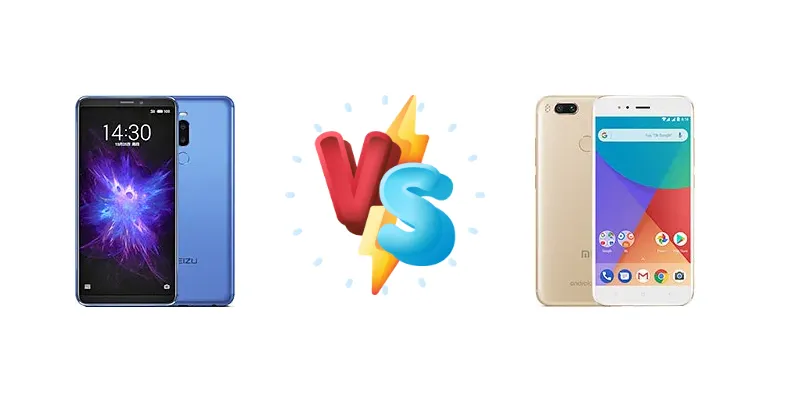
Released several years apart, the Meizu Note 8 and Xiaomi Mi A1 (also known as the Mi 5X) represent different eras of budget smartphone design. The Mi A1, part of the Android One initiative, prioritized software purity and a clean experience, while the Meizu Note 8 focused on delivering more raw performance for the price. This comparison revisits these devices to determine which holds up better in 2024, considering their core specifications and real-world usability.
🏆 Quick Verdict
For the average user in 2024, the Meizu Note 8 emerges as the better choice. While both phones boast similar battery endurance ratings, the Note 8’s Snapdragon 632 offers a noticeable performance uplift over the Mi A1’s Snapdragon 625, translating to a smoother user experience and better app responsiveness. The faster 24W charging is also a significant advantage.
| Network |
|---|
| 2G bands | GSM 850 / 900 / 1800 / 1900 | GSM 850 / 900 / 1800 / 1900 - SIM 1 & SIM 2 |
| 3G bands | HSDPA 850 / 900 / 2100 - China | HSDPA 850 / 900 / 1900 / 2100 |
| 4G bands | 1, 3, 5, 38, 39, 40, 41 - China | 1, 3, 5, 7, 8, 20, 38, 40 |
| Speed | HSPA 42.2/5.76 Mbps, LTE Cat4 150/50 Mbps | HSPA 42.2/5.76 Mbps, LTE (2CA) Cat6 300/50 Mbps |
| Technology | GSM / CDMA / HSPA / LTE | GSM / HSPA / LTE |
| | CDMA 800 & TD-SCDMA - China | - |
| Launch |
|---|
| Announced | 2018, October. Released 2018, November | 2017, September. Released 2017, September |
| Status | Discontinued | Discontinued |
| Body |
|---|
| Build | - | Glass front (Gorilla Glass 3), aluminum back, aluminum frame |
| Dimensions | 153.6 x 75.5 x 7.9 mm (6.05 x 2.97 x 0.31 in) | 155.4 x 75.8 x 7.3 mm (6.12 x 2.98 x 0.29 in) |
| SIM | Nano-SIM + Nano-SIM | Nano-SIM + Nano-SIM |
| Weight | 168 g (5.93 oz) | 165 g (5.82 oz) |
| Display |
|---|
| Protection | - | Corning Gorilla Glass 3 |
| Resolution | 1080 x 2160 pixels, 18:9 ratio (~402 ppi density) | 1080 x 1920 pixels, 16:9 ratio (~403 ppi density) |
| Size | 6.0 inches, 92.9 cm2 (~80.1% screen-to-body ratio) | 5.5 inches, 82.6 cm2 (~70.1% screen-to-body ratio) |
| Type | IPS LCD | IPS LCD |
| Platform |
|---|
| CPU | Octa-core (4x1.8 GHz Kryo 250 Gold & 4x1.8 GHz Kryo 250 Silver) | Octa-core 2.0 GHz Cortex-A53 |
| Chipset | Qualcomm SDM632 Snapdragon 632 (14 nm) | Qualcomm MSM8953 Snapdragon 625 (14 nm) |
| GPU | Adreno 506 | Adreno 506 |
| OS | Android 8.0 (Oreo), Flyme 7.3 | Android 7.1.2 (Nougat), upgradable to Android 9.0 (Pie), Android One |
| Memory |
|---|
| Card slot | No | microSDXC (uses shared SIM slot) |
| Internal | 64GB 4GB RAM | 32GB 4GB RAM, 64GB 4GB RAM |
| | eMMC 5.1 | eMMC 5.1 |
| Main Camera |
|---|
| Dual | 12 MP, f/1.9, 1/2.55", 1.4µm, dual pixel PDAF
Auxiliary lens | 12 MP, f/2.2, 26mm (wide), 1/2.9", 1.25µm, PDAF
12 MP, f/2.6, 50mm (telephoto), 1.0µm, AF, 2x optical zoom |
| Features | Dual-LED dual-tone flash, panorama | Dual-LED dual-tone flash, HDR, panorama |
| Video | 1080p@30fps | 4K@30fps, 1080p@30fps, 720p@120fps |
| Selfie camera |
|---|
| Single | 8 MP, f/2.0 | 5 MP |
| Video | - | 1080p@30fps |
| Sound |
|---|
| 3.5mm jack | Yes | Yes |
| 35mm jack | Yes | Yes |
| Loudspeaker | Yes | Yes |
| Comms |
|---|
| Bluetooth | 4.2, A2DP, LE | 4.2, A2DP, LE |
| Infrared port | - | Yes |
| NFC | No | No |
| Positioning | GPS, GLONASS, BDS | GPS, GLONASS, BDS |
| Radio | No | FM radio |
| USB | microUSB 2.0 | USB Type-C 2.0 |
| WLAN | Wi-Fi 802.11 а/b/g/n, dual-band, Wi-Fi Direct | Wi-Fi 802.11 a/b/g/n/ac, dual-band, Wi-Fi Direct |
| Features |
|---|
| Sensors | Fingerprint (rear-mounted), accelerometer, gyro, proximity, compass | Fingerprint (rear-mounted), accelerometer, gyro, proximity |
| Battery |
|---|
| Charging | 24W wired | 10W wired |
| Type | Li-Ion 3600 mAh, non-removable | Li-Po 3080 mAh, non-removable |
| Misc |
|---|
| Colors | Black, Blue, Red, Pink | Black, Gold, Rose Gold, Red |
| Models | - | MDG2, MDI2 |
| Price | About 200 EUR | About 170 EUR |
| SAR | - | 1.75 W/kg (head) 0.76 W/kg (body) |
| Tests |
|---|
| Audio quality | - |
Noise -91.0dB / Crosstalk -82.5dB |
| Battery life | - | Endurance rating 87h |
| Camera | - |
Photo / Video |
| Display | - |
Contrast ratio: 1570:1 (nominal), 2.689 (sunlight) |
| Loudspeaker | - |
Voice 74dB / Noise 73dB / Ring 90dB |
| Performance | - |
GeekBench: 4292 (v4.4)
GFXBench: 3.5fps (ES 3.1 onscreen) |
Meizu Note 8
- Faster processor (Snapdragon 632)
- Faster charging (24W)
- Potentially improved camera technology (due to later release)
- Software experience may be less polished than Android One
- Detailed display specs are unknown
Xiaomi Mi A1 (Mi 5X)
- Clean Android One software experience
- Good display contrast ratio
- Solid battery life
- Slower processor (Snapdragon 625)
- Slower charging (10W)
- Software support likely ended
Display Comparison
Both the Meizu Note 8 and Xiaomi Mi A1 share a similar display contrast ratio of 1570:1 (nominal) and 2.689 (sunlight), suggesting comparable visibility in bright conditions. However, detailed display specs like resolution and panel type are missing for the Note 8. Given the Mi A1’s focus on visual clarity, its display likely offered a pleasant viewing experience. The Note 8’s display quality is an unknown, but its later release date suggests potential improvements in color accuracy and brightness, though this is speculative without further data.
Camera Comparison
Both devices feature photo and video capabilities, but specific details regarding sensor size, aperture, and image processing are absent. The Mi A1 gained recognition for its dual-camera setup, offering a portrait mode and improved low-light performance for its time. Without detailed specs for the Note 8, it’s difficult to assess its camera capabilities accurately. However, given the Note 8’s later release, it likely benefited from advancements in image processing algorithms and potentially a larger sensor, though this remains unconfirmed.
Performance
The core difference lies in the chipsets. The Meizu Note 8’s Snapdragon 632, built on a 14nm process, features an octa-core CPU with a Kryo 250 architecture (4x1.8 GHz Gold & 4x1.8 GHz Silver). This is a significant upgrade over the Xiaomi Mi A1’s Snapdragon 625, which utilizes an octa-core 2.0 GHz Cortex-A53 CPU, also on a 14nm process. The Kryo cores in the 632 offer improved performance and efficiency compared to the Cortex-A53, resulting in faster app loading times and smoother multitasking on the Note 8. While both are 14nm, the architectural improvements in the 632 are key.
Battery Life
Interestingly, both phones achieve an endurance rating of 87 hours, suggesting similar real-world battery life despite the Note 8’s more powerful processor. This indicates efficient power management on both devices. However, the Meizu Note 8 boasts 24W wired charging, a substantial improvement over the Mi A1’s 10W charging. This faster charging speed significantly reduces the time required to replenish the battery, offering a more convenient user experience.
Buying Guide
Buy the Meizu Note 8 if you prioritize a more responsive user experience, faster charging speeds, and don't mind a potentially less polished software experience. Buy the Xiaomi Mi A1 (Mi 5X) if you value a clean, stock Android experience through the Android One program, and are willing to trade some processing power for software simplicity and potentially better long-term software support (though support has likely ended for both).
Frequently Asked Questions
❓ Is the Snapdragon 632 in the Meizu Note 8 powerful enough for modern apps?
While not a flagship processor, the Snapdragon 632 is capable of handling most everyday tasks and moderately demanding apps. It offers a noticeable performance improvement over the Snapdragon 625 in the Mi A1, providing a smoother experience for social media, browsing, and casual gaming. However, it may struggle with very graphically intensive games at high settings.
❓ Does the faster charging on the Meizu Note 8 significantly reduce charging time?
Yes, the 24W charging on the Note 8 is a substantial upgrade over the Mi A1’s 10W charging. This translates to a significantly faster 0-100% charge time, potentially cutting charging time in half. This is a major convenience factor for users who frequently need to top up their battery.
❓ Will I still receive software updates on either of these phones?
It's highly unlikely that either the Meizu Note 8 or the Xiaomi Mi A1 will receive further official software updates. Both devices are several years old, and manufacturers typically cease support after a certain period. The Mi A1, being part of the Android One program, *may* have received updates for a slightly longer period, but support has almost certainly ended for both.