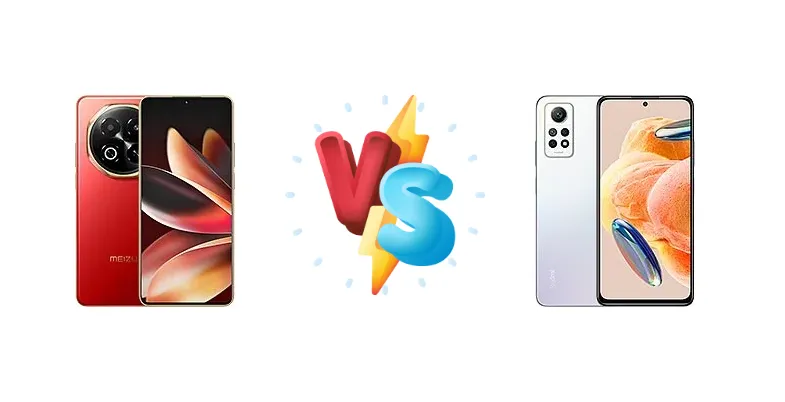
The Meizu Note 22 and Xiaomi Redmi Note 12 Pro 4G represent compelling options in the increasingly competitive mid-range 4G smartphone market. While both aim to deliver a balanced experience, they diverge significantly in their core components – specifically, their chipsets and charging capabilities. This comparison dissects these differences to determine which device offers the best value for your money.
🏆 Quick Verdict
For the average user prioritizing fast charging and a slightly more mature software ecosystem, the Xiaomi Redmi Note 12 Pro 4G is the better choice. Its 67W charging significantly reduces downtime, and the Snapdragon 732G offers a well-established balance of performance and efficiency. However, the Meizu Note 22 presents a viable alternative for those intrigued by Unisoc's newer architecture.
| Network |
|---|
| 2G bands | GSM 850 / 900 / 1800 / 1900 | GSM 850 / 900 / 1800 / 1900 |
| 3G bands | HSDPA 850 / 900 / 2100 | HSDPA 850 / 900 / 1700(AWS) / 1900 / 2100 |
| 4G bands | 1, 3, 5, 8, 34, 38, 39, 40, 41 | 1, 2, 3, 4, 5, 7, 8, 20, 28, 38, 40, 41, 66 |
| 5G bands | 1, 3, 5, 8, 28, 41, 78 SA/NSA | - |
| Speed | HSPA, LTE, 5G | HSPA, LTE |
| Technology | GSM / HSPA / LTE / 5G | GSM / HSPA / LTE |
| Launch |
|---|
| Announced | 2025, May 20 | 2023, March 03 |
| Status | Available. Released 2025, May 20 | Available. Released 2023, April 11 |
| Body |
|---|
| Dimensions | 167.6 x 75.8 x 9.2 mm (6.60 x 2.98 x 0.36 in) | 164.2 x 76.1 x 8.1 mm (6.46 x 3.00 x 0.32 in) |
| SIM | Nano-SIM + Nano-SIM | Nano-SIM + Nano-SIM |
| Weight | 217 g (7.65 oz) | 201.8 g (7.13 oz) |
| Display |
|---|
| Resolution | 1080 x 2460 pixels (~396 ppi density) | 1080 x 2400 pixels, 20:9 ratio (~395 ppi density) |
| Size | 6.78 inches, 109.2 cm2 (~85.9% screen-to-body ratio) | 6.67 inches, 107.4 cm2 (~86.0% screen-to-body ratio) |
| Type | IPS LCD, 120Hz, 1050 nits (HBM), 5000 nits (peak) | AMOLED, 120Hz, Dolby Vision, 700 nits (HBM), 1100 nits (peak) |
| Platform |
|---|
| CPU | Octa-core (2x2.3 GHz Cortex-A76 & 6x2.1 GHz Cortex-A55) | Octa-core (2x2.2 GHz Kryo 470 Gold & 6x1.8 GHz Kryo 470 Silver) |
| Chipset | Unisoc T8200 (6 nm) | Qualcomm SM7150 Snapdragon 732G (8 nm) |
| GPU | Mali-G57 MC2 | Adreno 618 |
| OS | Flyme AIOS 2 | Android 11, MIUI 13 |
| Memory |
|---|
| Card slot | No | microSDXC (uses shared SIM slot) |
| Internal | 128GB 8GB RAM, 256GB 8GB RAM, 256GB 12GB RAM | 128GB 6GB RAM, 128GB 8GB RAM, 256GB 8GB RAM |
| | - | UFS 2.2 |
| Main Camera |
|---|
| Dual | 50 MP, f/1.8, 26mm (wide), PDAF
Auxiliary lens | - |
| Features | LED flash, panorama, HDR | LED flash, HDR, panorama |
| Quad | - | 108 MP, f/1.9, (wide), 1/1.52", 0.7µm, PDAF
8 MP, 120˚, (ultrawide)
2 MP (macro)
Auxiliary lens |
| Video | Yes | 4K@30fps, 1080p@30/60fps |
| Selfie camera |
|---|
| Features | HDR | - |
| Single | 8 MP, f/2.0 | 16 MP, f/2.4, (wide) |
| Video | Yes | 1080p@30fps |
| Sound |
|---|
| 3.5mm jack | - | Yes |
| 35mm jack | Yes | Yes |
| Loudspeaker | Yes, with stereo speakers | Yes, with stereo speakers |
| Comms |
|---|
| Bluetooth | 5.0, A2DP, LE, aptX HD | 5.0, A2DP, LE |
| Infrared port | - | Yes |
| NFC | Unspecified | Yes (market/region dependent) |
| Positioning | GPS, GALILEO, BDS | GPS, GLONASS, GALILEO, BDS |
| Radio | Unspecified | Unspecified |
| USB | USB Type-C 2.0 | USB Type-C 2.0, OTG |
| WLAN | Wi-Fi 802.11 a/b/g/n/ac, dual-band | Wi-Fi 802.11 a/b/g/n/ac, dual-band |
| Features |
|---|
| Sensors | Fingerprint (side-mounted), accelerometer, proximity, compass | Fingerprint (side-mounted), accelerometer, gyro, compass |
| Battery |
|---|
| Charging | 40W wired, QC3+ | 67W wired |
| Type | 6600 mAh | Li-Po 5000 mAh |
| Misc |
|---|
| Colors | Pure Flame, Stonehold Black, Snow White | Star Blue, Graphite Gray, Polar White, Ice blue |
| Models | - | 2209116AG, 2209116AG |
| Price | About 210 EUR | About 150 EUR |
Meizu Note 22
- Potentially more efficient 6nm Unisoc T8200 chipset.
- May offer a cleaner software experience (depending on Meizu's Flyme OS).
- Intriguing alternative to Qualcomm's dominance.
- Slower 40W charging compared to the Redmi Note 12 Pro 4G.
- Unisoc chipset performance is less proven than Snapdragon.
- Potentially limited software support and updates.
Xiaomi Redmi Note 12 Pro 4G
- Significantly faster 67W wired charging.
- Proven Snapdragon 732G chipset with good performance.
- Wider availability of accessories and community support.
- 8nm process may result in slightly higher thermal output.
- Xiaomi’s MIUI software can be bloated with pre-installed apps.
- May prioritize camera megapixel count over sensor quality.
Display Comparison
Neither device boasts a standout display. Both are likely to feature standard IPS LCD panels, common in this price bracket. However, without specific display specs (resolution, refresh rate, peak brightness), a direct comparison is difficult. The Redmi Note 12 Pro 4G, given Xiaomi’s typical approach, may offer a slightly higher peak brightness for better outdoor visibility. The absence of LTPO technology on either device suggests standard refresh rate options (likely 60Hz or 90Hz).
Camera Comparison
Without detailed camera specifications, a comprehensive comparison is limited. However, it’s reasonable to assume both phones will feature multi-camera setups. The Redmi Note 12 Pro 4G, based on Xiaomi’s history, is likely to prioritize a higher megapixel count for its main sensor. Image processing will likely differ, with Xiaomi leaning towards more saturated and vibrant colors, while Meizu may aim for a more natural look. The presence of Optical Image Stabilization (OIS) on either device would be a significant advantage, but this information is currently unavailable. The inclusion of low-resolution macro and depth sensors on both phones is likely, but these contribute little to overall image quality.
Performance
The core difference lies in the chipsets. The Xiaomi Redmi Note 12 Pro 4G utilizes the Qualcomm Snapdragon 732G, fabricated on an 8nm process. This chipset features a Kryo 470 Gold/Silver core configuration, offering a balance of performance and power efficiency. Conversely, the Meizu Note 22 is powered by the Unisoc T8200, built on a 6nm node. While the Unisoc T8200’s Cortex-A76 cores boast a slightly higher clock speed (2.3 GHz vs 2.2 GHz), the Snapdragon 732G benefits from Qualcomm’s optimized software and GPU. The 8nm process of the Snapdragon 732G generally translates to better thermal management under sustained loads, potentially leading to less throttling during extended gaming sessions. The Meizu Note 22’s Unisoc chip is newer, and its real-world performance will depend heavily on software optimization.
Battery Life
The Xiaomi Redmi Note 12 Pro 4G’s 67W wired charging is a clear advantage. This allows for significantly faster top-ups compared to the Meizu Note 22’s 40W charging. While battery capacity isn’t specified, the faster charging speed mitigates the impact of a potentially smaller battery on the Redmi Note 12 Pro 4G. A full charge on the Redmi Note 12 Pro 4G is likely to take under 45 minutes, while the Meizu Note 22 will likely require over an hour. This difference is crucial for users who frequently find themselves needing to quickly replenish their battery.
Buying Guide
Buy the Meizu Note 22 if you're an early adopter interested in exploring Unisoc's processor technology and prefer a potentially cleaner software experience. Buy the Xiaomi Redmi Note 12 Pro 4G if you prioritize rapid charging, a proven chipset with good gaming performance, and a wider range of readily available accessories and community support.
Frequently Asked Questions
❓ Will the Unisoc T8200 in the Meizu Note 22 struggle with graphically demanding games like PUBG or Genshin Impact?
The Unisoc T8200 is a capable chipset, but its performance in demanding games will likely be lower than the Snapdragon 732G. While it can likely run these games, you may need to lower graphics settings to achieve a smooth frame rate. The Snapdragon 732G’s optimized GPU and software support give it an edge in gaming performance.
❓ How much faster is the 67W charging on the Redmi Note 12 Pro 4G compared to the 40W charging on the Meizu Note 22 in real-world usage?
The 67W charging on the Redmi Note 12 Pro 4G can realistically charge the phone from 0% to 100% in around 40-45 minutes, while the Meizu Note 22’s 40W charging will likely take over an hour and 15 minutes. This translates to a significant time saving, especially for users who frequently need to top up their battery throughout the day.
❓ Is the software experience on the Meizu Note 22 significantly different from Xiaomi's MIUI?
Yes, the Meizu Note 22 runs on Meizu’s Flyme OS, which historically has offered a cleaner and less cluttered user interface compared to Xiaomi’s MIUI. However, Flyme OS has a smaller user base and may receive fewer updates and less community support than MIUI.