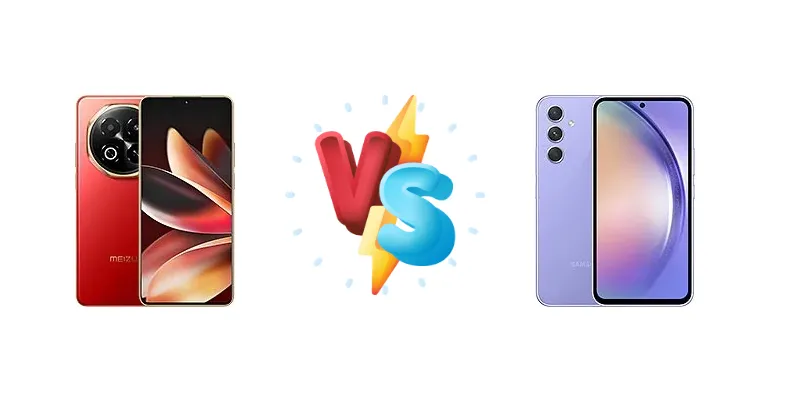
The mid-range smartphone market is fiercely competitive, and the Meizu Note 22 and Samsung Galaxy A54 represent compelling options for budget-conscious buyers. While both aim to deliver a well-rounded experience, they take different approaches to achieving it. This comparison dives deep into their specifications and performance to determine which device reigns supreme.
🏆 Quick Verdict
For the average user prioritizing a consistently smooth experience and a brighter, more vibrant display, the Samsung Galaxy A54 is the better choice. Its Exynos 1380 chipset, while not a performance leader, offers a more refined experience than the Unisoc T8200 in the Meizu Note 22, and the A54's display is significantly brighter.
| Network |
|---|
| 2G bands | GSM 850 / 900 / 1800 / 1900 | GSM 850 / 900 / 1800 / 1900 |
| 3G bands | HSDPA 850 / 900 / 2100 | HSDPA 850 / 900 / 1700(AWS) / 1900 / 2100 |
| 4G bands | 1, 3, 5, 8, 34, 38, 39, 40, 41 | 1, 2, 3, 4, 5, 7, 8, 12, 17, 20, 26, 28, 32, 38, 40, 41, 66 - International |
| 5G bands | 1, 3, 5, 8, 28, 41, 78 SA/NSA | 1, 3, 7, 8, 20, 28, 38, 40, 41, 77, 78 SA/NSA/Sub6 - International |
| Speed | HSPA, LTE, 5G | HSPA, LTE, 5G |
| Technology | GSM / HSPA / LTE / 5G | GSM / HSPA / LTE / 5G |
| | - | 25, 41, 66, 71 SA/NSA/Sub6/mmWave - USA |
| Launch |
|---|
| Announced | 2025, May 20 | 2023, March 15 |
| Status | Available. Released 2025, May 20 | Available. Released 2023, March 24 |
| Body |
|---|
| Build | - | Glass front (Gorilla Glass 5), glass back (Gorilla Glass 5), plastic frame |
| Dimensions | 167.6 x 75.8 x 9.2 mm (6.60 x 2.98 x 0.36 in) | 158.2 x 76.7 x 8.2 mm (6.23 x 3.02 x 0.32 in) |
| SIM | Nano-SIM + Nano-SIM | · Nano-SIM + eSIM· Nano-SIM + Nano-SIM |
| Weight | 217 g (7.65 oz) | 202 g (7.13 oz) |
| | - | IP67 dust/water resistant (up to 1m for 30 min) |
| Display |
|---|
| Protection | - | Corning Gorilla Glass 5 |
| Resolution | 1080 x 2460 pixels (~396 ppi density) | 1080 x 2340 pixels, 19.5:9 ratio (~403 ppi density) |
| Size | 6.78 inches, 109.2 cm2 (~85.9% screen-to-body ratio) | 6.4 inches, 100.5 cm2 (~82.9% screen-to-body ratio) |
| Type | IPS LCD, 120Hz, 1050 nits (HBM), 5000 nits (peak) | Super AMOLED, 120Hz, HDR10+, 1000 nits (HBM) |
| Platform |
|---|
| CPU | Octa-core (2x2.3 GHz Cortex-A76 & 6x2.1 GHz Cortex-A55) | Octa-core (4x2.4 GHz Cortex-A78 & 4x2.0 GHz Cortex-A55) |
| Chipset | Unisoc T8200 (6 nm) | Exynos 1380 (5 nm) |
| GPU | Mali-G57 MC2 | Mali-G68 MP5 |
| OS | Flyme AIOS 2 | Android 13, up to 4 major Android upgrades, One UI 7 |
| Memory |
|---|
| Card slot | No | microSDXC (uses shared SIM slot) |
| Internal | 128GB 8GB RAM, 256GB 8GB RAM, 256GB 12GB RAM | 128GB 4GB RAM, 128GB 6GB RAM, 128GB 8GB RAM, 256GB 6GB RAM, 256GB 8GB RAM |
| Main Camera |
|---|
| Dual | 50 MP, f/1.8, 26mm (wide), PDAF
Auxiliary lens | - |
| Features | LED flash, panorama, HDR | LED flash, panorama, HDR |
| Single | - | 32 MP, f/2.2, 26mm (wide), 1/2.8", 0.8µm |
| Triple | - | 50 MP, f/1.8, 23mm (wide), 1/1.56", 1.0µm, PDAF, OIS
12 MP, f/2.2, 13mm, 123˚ (ultrawide), 1/3.X", 1.12µm
5 MP (macro) |
| Video | Yes | 4K@30fps, 1080p@30/60fps, 720p@480fps, gyro-EIS |
| Selfie camera |
|---|
| Features | HDR | - |
| Single | 8 MP, f/2.0 | 32 MP, f/2.2, 26mm (wide), 1/2.8", 0.8µm |
| Video | Yes | 4K@30fps, 1080p@30/60fps |
| Sound |
|---|
| 3.5mm jack | - | No |
| 35mm jack | Yes | No |
| Loudspeaker | Yes, with stereo speakers | Yes, with stereo speakers |
| Comms |
|---|
| Bluetooth | 5.0, A2DP, LE, aptX HD | 5.3, A2DP, LE |
| NFC | Unspecified | Yes (market/region dependent) |
| Positioning | GPS, GALILEO, BDS | GPS, GLONASS, GALILEO, BDS |
| Radio | Unspecified | No |
| USB | USB Type-C 2.0 | USB Type-C 2.0, OTG |
| WLAN | Wi-Fi 802.11 a/b/g/n/ac, dual-band | Wi-Fi 802.11 a/b/g/n/ac/6, dual-band, Wi-Fi Direct |
| Features |
|---|
| Sensors | Fingerprint (side-mounted), accelerometer, proximity, compass | Fingerprint (under display, optical), accelerometer, gyro, compass, barometer (USA only) |
| | - | Virtual proximity sensing |
| Battery |
|---|
| Charging | 40W wired, QC3+ | 25W wired |
| Type | 6600 mAh | 5000 mAh |
| Misc |
|---|
| Colors | Pure Flame, Stonehold Black, Snow White | Lime, Graphite, Violet, White |
| Models | - | SM-A546V, SM-A546U, SM-A546U1, SM-A546B, SM-A546B/DS, SM-A546E, SM-A546E/DS, SM-A5460, SM-A546M, SM-A546M/DS, SM-A546W |
| Price | About 210 EUR | € 210.00 / $ 119.11 / £ 169.95 / ₹ 28,999 |
| SAR | - | 0.81 W/kg (head) 0.67 W/kg (body) |
| SAR EU | - | 0.69 W/kg (head) 1.34 W/kg (body) |
| Tests |
|---|
| Battery life | - |
Endurance rating 119h
|
| Camera | - |
Photo / Video |
| Display | - |
Contrast ratio: Infinite (nominal) |
| Loudspeaker | - |
-26.6 LUFS (Good)
|
| Performance | - |
AnTuTu: 506678 (v9)
GeekBench: 2703 (v5.1), 2797 (v6)
GFXBench: 25fps (ES 3.1 onscreen) |
Meizu Note 22
- Faster 40W charging
- Potentially more affordable price point
- Unique brand identity
- Less powerful chipset
- Limited display information
- Software experience may be less refined
Samsung Galaxy A54
- Brighter and more color-accurate display
- More powerful Exynos 1380 chipset
- Established brand reputation and software support
- Slower 25W charging
- Potentially higher price
- May include bloatware
Display Comparison
The Samsung Galaxy A54 boasts a significantly brighter display, reaching a measured 980 nits, compared to an unstated peak brightness for the Meizu Note 22. This difference is crucial for outdoor visibility. While both likely utilize AMOLED panels (implied by the 'Infinite' contrast ratio on the A54), Samsung's display technology generally offers superior color accuracy and viewing angles. The A54's panel is also likely to benefit from Samsung's display calibration expertise. The Meizu Note 22's display specs are currently limited, making a detailed comparison difficult, but it's unlikely to match the A54's brightness.
Camera Comparison
Both devices feature 'Photo / Video' capabilities, but detailed camera specifications are lacking for the Meizu Note 22. The Samsung Galaxy A54 likely benefits from Samsung's well-regarded image processing algorithms and potentially features Optical Image Stabilization (OIS) on its main sensor (a common feature in this price range). Without knowing the sensor size or aperture of the Meizu Note 22's camera, it's difficult to assess its image quality. The presence of a 2MP macro camera on either device is largely irrelevant, as these sensors typically produce low-quality images. The A54's camera system is likely to offer more consistent and reliable results across various lighting conditions.
Performance
The Samsung Galaxy A54's Exynos 1380 (5nm) chipset offers a clear architectural advantage over the Meizu Note 22's Unisoc T8200 (6nm). The Exynos 1380 utilizes Cortex-A78 cores, which are more powerful than the Cortex-A76 cores found in the Unisoc chip. This translates to better multi-core performance and improved responsiveness in demanding applications. While both are octa-core CPUs, the A54's configuration (4x2.4 GHz Cortex-A78 & 4x2.0 GHz Cortex-A55) is optimized for sustained performance. The Unisoc T8200's 6nm process, while newer, doesn't fully compensate for the architectural difference. Users engaging in gaming or heavy multitasking will likely experience smoother performance on the Galaxy A54.
Battery Life
The Samsung Galaxy A54 boasts an endurance rating of 119 hours, translating to 11:15 hours of active use. While the Meizu Note 22's battery capacity is unknown, its 40W wired charging significantly surpasses the A54's 25W charging. This means the Note 22 can replenish its battery much faster, potentially mitigating any capacity disadvantage. However, the A54's efficient Exynos 1380 chipset and optimized software contribute to its impressive battery life. The faster charging on the Meizu Note 22 is a boon for users who prefer quick top-ups, while the A54 excels in sustained usage.
Buying Guide
Buy the Meizu Note 22 if you prioritize fast charging and are comfortable with a potentially less polished software experience. It's a good option for users who frequently top up their phones and appreciate a more unique brand identity. Buy the Samsung Galaxy A54 if you value a brighter, more color-accurate display, a more established brand reputation, and a generally smoother, more refined user experience, even if it means slightly slower charging.
Frequently Asked Questions
❓ Does the Exynos 1380 in the Galaxy A54 tend to overheat during prolonged gaming sessions?
The Exynos 1380 is generally well-managed in terms of thermal performance. While it can get warm during extended gaming, it's unlikely to experience significant throttling due to Samsung's thermal management solutions. The 5nm process contributes to better efficiency compared to the Meizu Note 22's 6nm Unisoc chip.
❓ Is the 40W charging on the Meizu Note 22 significantly faster in real-world use compared to the A54's 25W?
Yes, 40W charging will noticeably reduce charging times. Expect a 0-100% charge on the Meizu Note 22 to take approximately 60-75 minutes, while the Galaxy A54 will likely take around 90-120 minutes. This difference is particularly beneficial for users who frequently need to quickly top up their battery.
❓ How does the software experience differ between Meizu's Flyme OS and Samsung's One UI?
Samsung's One UI is a more mature and widely adopted software experience, offering a broader range of features and a larger community for support. Meizu's Flyme OS is known for its customization options but may have a steeper learning curve and potentially less frequent updates.