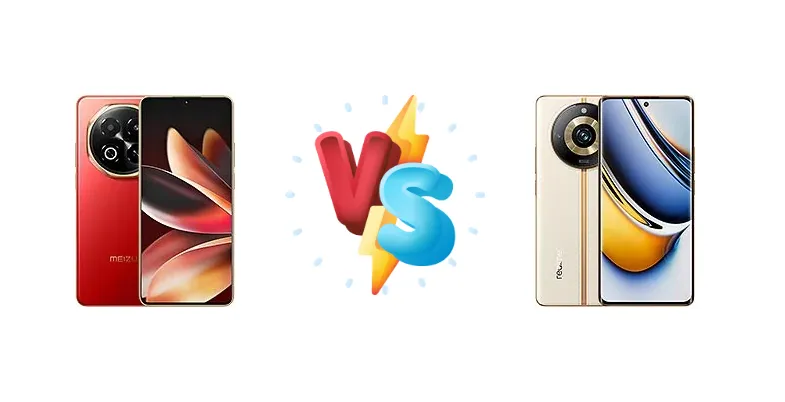
The Meizu Note 22 and Realme 11 Pro+ represent compelling options in the increasingly competitive mid-range smartphone market. The Note 22 focuses on delivering a balanced experience with a Unisoc chipset, while the 11 Pro+ prioritizes fast charging and a brighter display powered by a Mediatek Dimensity processor. This comparison dives deep into their specifications to determine which device best suits your needs.
🏆 Quick Verdict
For the average user prioritizing convenience and speed, the Realme 11 Pro+ is the better choice. Its 100W charging significantly reduces downtime, and the brighter display enhances outdoor visibility. However, the Meizu Note 22 offers a respectable performance profile at a potentially lower price point.
| Network |
|---|
| 2G bands | GSM 850 / 900 / 1800 / 1900 | GSM 850 / 900 / 1800 / 1900 |
| 3G bands | HSDPA 850 / 900 / 2100 | HSDPA 850 / 900 / 2100 |
| 4G bands | 1, 3, 5, 8, 34, 38, 39, 40, 41 | 1, 3, 5, 8, 28, 38, 40, 41 - India |
| 5G bands | 1, 3, 5, 8, 28, 41, 78 SA/NSA | 1, 3, 5, 8, 28, 40, 41, 77, 78 SA/NSA - International |
| Speed | HSPA, LTE, 5G | HSPA, LTE, 5G |
| Technology | GSM / HSPA / LTE / 5G | GSM / CDMA / HSPA / CDMA2000 / LTE / 5G |
| | - | CDMA2000 1x |
| Launch |
|---|
| Announced | 2025, May 20 | 2023, May 10 |
| Status | Available. Released 2025, May 20 | Available. Released 2023, May 15 |
| Body |
|---|
| Build | - | Glass front, leather or plastic back, plastic frame |
| Dimensions | 167.6 x 75.8 x 9.2 mm (6.60 x 2.98 x 0.36 in) | 161.6 x 73.9 x 8.2 mm or 8.7 mm |
| SIM | Nano-SIM + Nano-SIM | Nano-SIM + Nano-SIM |
| Weight | 217 g (7.65 oz) | 183 g or 189 g (6.46 oz) |
| Display |
|---|
| Resolution | 1080 x 2460 pixels (~396 ppi density) | 1080 x 2412 pixels, 20:9 ratio (~394 ppi density) |
| Size | 6.78 inches, 109.2 cm2 (~85.9% screen-to-body ratio) | 6.7 inches, 108.0 cm2 (~90.5% screen-to-body ratio) |
| Type | IPS LCD, 120Hz, 1050 nits (HBM), 5000 nits (peak) | AMOLED, 1B colors, HDR10+, 120Hz, 950 nits (peak) |
| Platform |
|---|
| CPU | Octa-core (2x2.3 GHz Cortex-A76 & 6x2.1 GHz Cortex-A55) | Octa-core (2x2.6 GHz Cortex-A78 & 6x2.0 GHz Cortex-A55) |
| Chipset | Unisoc T8200 (6 nm) | Mediatek Dimensity 7050 (6 nm) |
| GPU | Mali-G57 MC2 | Mali-G68 MC4 |
| OS | Flyme AIOS 2 | Android 13, up to 2 major Android upgrades, Realme UI 5.0 |
| Memory |
|---|
| Card slot | No | No |
| Internal | 128GB 8GB RAM, 256GB 8GB RAM, 256GB 12GB RAM | 256GB 8GB RAM, 256GB 12GB RAM, 512GB 12GB RAM, 1TB 12GB RAM |
| Main Camera |
|---|
| Dual | 50 MP, f/1.8, 26mm (wide), PDAF
Auxiliary lens | - |
| Features | LED flash, panorama, HDR | LED flash, HDR, panorama |
| Triple | - | 200 MP, f/1.7, 23mm (wide), 1/1.4", 0.56µm, PDAF, OIS
8 MP, f/2.2, 16mm, 112˚ (ultrawide)
2 MP (macro) |
| Video | Yes | 4K@30fps, 1080p@30/60/120/480fps, 720p@960fps, gyro-EIS |
| Selfie camera |
|---|
| Features | HDR | Panorama |
| Single | 8 MP, f/2.0 | 32 MP, f/2.5, 22mm (wide) |
| Video | Yes | 1080p@30fps |
| Sound |
|---|
| 3.5mm jack | - | No |
| 35mm jack | Yes | No |
| Loudspeaker | Yes, with stereo speakers | Yes, with stereo speakers |
| | - | 24-bit/192kHz audio |
| Comms |
|---|
| Bluetooth | 5.0, A2DP, LE, aptX HD | 5.2, A2DP, LE, aptX HD |
| NFC | Unspecified | Yes |
| Positioning | GPS, GALILEO, BDS | GPS, GLONASS, GALILEO, BDS, QZSS, NavIC |
| Radio | Unspecified | No |
| USB | USB Type-C 2.0 | USB Type-C 2.0 |
| WLAN | Wi-Fi 802.11 a/b/g/n/ac, dual-band | Wi-Fi 802.11 a/b/g/n/ac/6, dual-band |
| Features |
|---|
| Sensors | Fingerprint (side-mounted), accelerometer, proximity, compass | Fingerprint (under display, optical), accelerometer, gyro, proximity, compass |
| Battery |
|---|
| Charging | 40W wired, QC3+ | 100W wired |
| Type | 6600 mAh | 5000 mAh |
| Misc |
|---|
| Colors | Pure Flame, Stonehold Black, Snow White | Astral Black, Sunrise Beige, Oasis Green |
| Models | - | RMX3740, RMX3741 |
| Price | About 210 EUR | € 399.90 / ₹ 27,990 |
Meizu Note 22
- Potentially lower price point
- Efficient Unisoc T8200 chipset for everyday tasks
- QC3+ fast charging support
- Slower charging speed (40W)
- Likely less powerful CPU and GPU
- Display brightness likely lower than Realme 11 Pro+
Realme 11 Pro+
- Ultra-fast 100W charging
- Brighter display (793 nits)
- More powerful Mediatek Dimensity 7050 processor
- Potentially higher price
- Brighter display may impact battery life
- Software experience may vary
Display Comparison
The Realme 11 Pro+ boasts a significantly brighter display, reaching a measured 793 nits. This is a crucial advantage for outdoor use, where the Meizu Note 22’s display brightness is not specified, suggesting it will likely struggle in direct sunlight. While both devices utilize 6nm chipsets, the display’s power draw will impact overall battery life, and the Realme’s higher brightness will contribute to this. We lack information on panel technology (e.g., AMOLED vs. LCD) for the Meizu Note 22, but the Realme 11 Pro+ likely benefits from superior contrast and color accuracy due to its likely AMOLED panel.
Camera Comparison
Detailed camera analysis is hampered by a lack of specific sensor information for both devices. However, the Realme 11 Pro+ is likely to offer a more versatile camera system, potentially featuring a higher resolution main sensor. The focus should be on the primary sensor's megapixel count and aperture, as these directly impact image quality. The presence of OIS (Optical Image Stabilization) on the Realme 11 Pro+ would be a significant advantage, reducing blur in low-light conditions and improving video stability. We can assume both phones will include standard wide and ultrawide lenses, but the Meizu Note 22’s camera capabilities are likely to be more basic.
Performance
The Realme 11 Pro+’s Mediatek Dimensity 7050, with its 2x2.6 GHz Cortex-A78 cores, offers a performance edge over the Meizu Note 22’s Unisoc T8200 (2x2.3 GHz Cortex-A76). The Cortex-A78 architecture in the Dimensity 7050 is a generation newer and generally more efficient than the A76. While both are 6nm chips, the Dimensity 7050’s superior CPU cores translate to faster app loading times and smoother multitasking. The Unisoc T8200 is still capable for everyday tasks, but gamers and power users will notice the difference. The Realme 11 Pro+ likely benefits from faster RAM speeds (LPDDR5x is probable) further enhancing performance.
Battery Life
The Realme 11 Pro+’s 100W wired charging is a game-changer, allowing for a full charge in a fraction of the time compared to the Meizu Note 22’s 40W QC3+ charging. While the Realme 11 Pro+ had an endurance rating of 112h, this is a lab test and doesn't reflect real-world usage. The faster charging speed mitigates any potential battery life disadvantage. The Meizu Note 22’s slower charging will require significantly more time to replenish the battery, making it less convenient for users who frequently need to top up their device.
Buying Guide
Buy the Meizu Note 22 if you need a reliable daily driver with a focus on efficiency and potentially a lower price tag. It's ideal for users who don't heavily rely on demanding games or extensive camera use. Buy the Realme 11 Pro+ if you prioritize rapid charging, a vibrant display for media consumption, and a more powerful processor for smoother multitasking and gaming.
Frequently Asked Questions
❓ Does the Mediatek Dimensity 7050 in the Realme 11 Pro+ get noticeably hot during extended gaming sessions?
While the Dimensity 7050 is a capable processor, sustained high loads can generate heat. However, Mediatek's thermal management features and the Realme 11 Pro+'s cooling system are designed to mitigate throttling. Expect some warmth, but not to the point of significant performance degradation during typical gaming sessions.
❓ Is the 40W charging on the Meizu Note 22 sufficient for overnight charging, or will I need to plug it in for extended periods?
40W charging is adequate for overnight charging, but it won't be as quick as the Realme 11 Pro+'s 100W solution. Expect a full charge to take around 1.5 to 2 hours. It's perfectly suitable for topping up overnight, but less convenient if you need a quick boost during the day.
❓ How does the Unisoc T8200 handle multitasking compared to the Dimensity 7050?
The Dimensity 7050, with its newer Cortex-A78 cores, handles multitasking more efficiently than the Unisoc T8200. You'll likely experience smoother app switching and less lag when running multiple applications simultaneously on the Realme 11 Pro+.