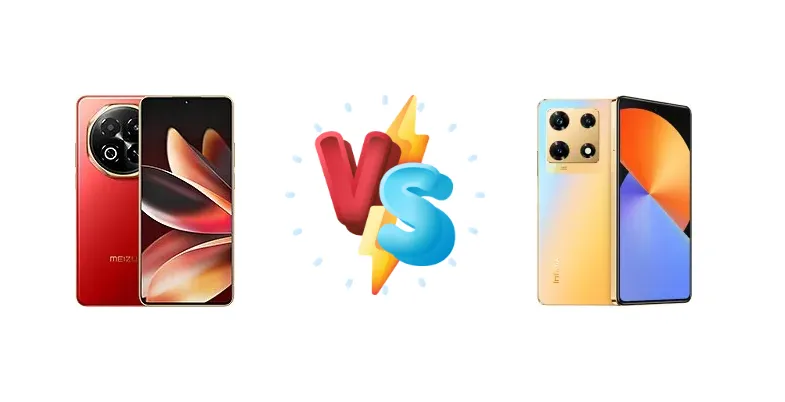
The sub-$250 smartphone market is fiercely competitive, and the Meizu Note 22 and Infinix Note 30 Pro represent compelling options. Both devices target users seeking a balance of performance and features without breaking the bank. However, they diverge in chipset choice and charging capabilities, creating a clear distinction for potential buyers. This comparison dissects these differences to determine which phone delivers the best overall experience.
🏆 Quick Verdict
For the average user prioritizing fast charging and a more versatile charging experience, the Infinix Note 30 Pro is the better choice. Its 68W wired charging, coupled with 15W wireless and reverse wireless capabilities, significantly outperforms the Meizu Note 22’s 40W wired charging. While the Meizu Note 22 offers a respectable chipset, the Infinix’s charging advantage is a decisive win.
| Network |
|---|
| 2G bands | GSM 850 / 900 / 1800 / 1900 | GSM 850 / 900 / 1800 / 1900 |
| 3G bands | HSDPA 850 / 900 / 2100 | HSDPA 850 / 900 / 1700(AWS) / 1900 / 2100 |
| 4G bands | 1, 3, 5, 8, 34, 38, 39, 40, 41 | 1, 2, 3, 4, 5, 7, 8, 12, 17, 20, 28, 38, 40, 41, 66 |
| 5G bands | 1, 3, 5, 8, 28, 41, 78 SA/NSA | - |
| Speed | HSPA, LTE, 5G | HSPA, LTE |
| Technology | GSM / HSPA / LTE / 5G | GSM / HSPA / LTE |
| Launch |
|---|
| Announced | 2025, May 20 | 2023, May 22 |
| Status | Available. Released 2025, May 20 | Available. Released 2023, May 22 |
| Body |
|---|
| Build | - | Glass front, plastic frame, glass back |
| Dimensions | 167.6 x 75.8 x 9.2 mm (6.60 x 2.98 x 0.36 in) | 162.7 x 76 x 8.2 mm (6.41 x 2.99 x 0.32 in) |
| SIM | Nano-SIM + Nano-SIM | Nano-SIM + Nano-SIM |
| Weight | 217 g (7.65 oz) | 203 g (7.16 oz) |
| | - | IP53 |
| Display |
|---|
| Resolution | 1080 x 2460 pixels (~396 ppi density) | 1080 x 2400 pixels, 20:9 ratio (~395 ppi density) |
| Size | 6.78 inches, 109.2 cm2 (~85.9% screen-to-body ratio) | 6.67 inches, 107.4 cm2 (~86.9% screen-to-body ratio) |
| Type | IPS LCD, 120Hz, 1050 nits (HBM), 5000 nits (peak) | AMOLED, 1B colors, 120Hz, 900 nits (peak) |
| | - | * the display diagonal size and resolution is unconfirmed |
| Platform |
|---|
| CPU | Octa-core (2x2.3 GHz Cortex-A76 & 6x2.1 GHz Cortex-A55) | Octa-core (2x2.2 GHz Cortex-A76 & 6x2.0 GHz Cortex-A55) |
| Chipset | Unisoc T8200 (6 nm) | Mediatek Helio G99 (6 nm) |
| GPU | Mali-G57 MC2 | Mali-G57 MC2 |
| OS | Flyme AIOS 2 | Android 13, XOS 13 |
| Memory |
|---|
| Card slot | No | microSDXC (dedicated slot) |
| Internal | 128GB 8GB RAM, 256GB 8GB RAM, 256GB 12GB RAM | 256GB 8GB RAM |
| Main Camera |
|---|
| Dual | 50 MP, f/1.8, 26mm (wide), PDAF
Auxiliary lens | - |
| Features | LED flash, panorama, HDR | Quad-LED flash, HDR, panorama |
| Triple | - | 108 MP, (wide), 1/1.67", PDAF
2 MP (macro)
Auxiliary lens |
| Video | Yes | 1440p@30fps, 1080p@30fps |
| Selfie camera |
|---|
| Features | HDR | LED flash, HDR |
| Single | 8 MP, f/2.0 | 32 MP, f/2.0, (wide), 1/2.8" |
| Video | Yes | 1080p@30fps |
| Sound |
|---|
| 3.5mm jack | - | Yes |
| 35mm jack | Yes | Yes |
| Loudspeaker | Yes, with stereo speakers | Yes, with dual speakers |
| | - | Sound by JBL
24-bit/192kHz audio |
| Comms |
|---|
| Bluetooth | 5.0, A2DP, LE, aptX HD | Yes |
| NFC | Unspecified | Yes (market/region dependent) |
| Positioning | GPS, GALILEO, BDS | GPS |
| Radio | Unspecified | FM radio |
| USB | USB Type-C 2.0 | USB Type-C 2.0, OTG |
| WLAN | Wi-Fi 802.11 a/b/g/n/ac, dual-band | Wi-Fi 802.11 a/b/g/n/ac, dual-band, Wi-Fi Direct |
| Features |
|---|
| Sensors | Fingerprint (side-mounted), accelerometer, proximity, compass | Fingerprint (side-mounted), accelerometer, gyro, proximity, compass |
| Battery |
|---|
| Charging | 40W wired, QC3+ | 68W wired, PD3.0, 80% in 30 min
15W wireless
Reverse wireless |
| Type | 6600 mAh | 5000 mAh |
| Misc |
|---|
| Colors | Pure Flame, Stonehold Black, Snow White | Magic Black, Variable Gold |
| Models | - | X678B |
| Price | About 210 EUR | - |
Meizu Note 22
- Potentially slightly better single-core CPU performance due to higher clocked A76 cores.
- Clean software experience (based on Meizu’s historical software approach).
- Competitive price point.
- Slower 40W wired charging.
- Lacks wireless charging capabilities.
- GPU performance is unknown.
Infinix Note 30 Pro
- Significantly faster 68W wired charging with PD3.0.
- 15W wireless charging and reverse wireless charging.
- MediaTek Helio G99 is a well-established and optimized chipset.
- Slightly lower clocked CPU cores compared to the Meizu Note 22.
- Software experience may include more bloatware (typical of Infinix).
- Potential for more aggressive power saving features.
Display Comparison
Neither device’s display specifications are provided, so a direct comparison is limited. However, given the price bracket, we can expect both to utilize IPS LCD panels. The absence of LTPO technology suggests neither will offer adaptive refresh rates for power saving. Bezels are likely to be comparable, and color accuracy will be a key differentiator determined by software calibration. The user experience will likely hinge on software optimization for color profiles.
Camera Comparison
Without detailed camera specifications, a thorough comparison is impossible. However, the market segment suggests both phones will rely on multi-camera systems with a primary sensor, ultrawide, and potentially a macro lens. The absence of information regarding sensor size and aperture makes it difficult to assess low-light performance. Optical Image Stabilization (OIS) is unlikely on either device at this price point. Image processing algorithms will play a significant role in differentiating image quality, with each brand likely employing its own tuning.
Performance
The Infinix Note 30 Pro’s MediaTek Helio G99 (6nm) and the Meizu Note 22’s Unisoc T8200 (6nm) are closely matched in terms of process node efficiency. However, the Unisoc T8200 features slightly higher clocked Cortex-A76 cores (2.3 GHz vs 2.2 GHz), potentially offering a marginal CPU performance advantage in single-core tasks. Both CPUs utilize the same Cortex-A55 efficiency cores clocked at similar speeds. The G99’s Mali-G57 MC2 GPU is a capable performer for casual gaming, but the Unisoc’s GPU performance is unknown. Thermal management will be crucial; the 6nm process should help, but sustained loads could reveal differences in cooling solutions. The lack of LPDDR5x specification suggests both likely use LPDDR4x, limiting memory bandwidth.
Battery Life
The battery capacity isn’t specified for either device, but the charging capabilities are a major point of divergence. The Infinix Note 30 Pro’s 68W wired charging, supporting PD3.0 and claiming 80% charge in 30 minutes, is significantly faster than the Meizu Note 22’s 40W wired charging with QC3+. The addition of 15W wireless charging and reverse wireless charging on the Infinix provides substantial versatility, allowing for cable-free charging and the ability to charge accessories. Even with a similar battery capacity, the Infinix’s faster charging will translate to less downtime.
Buying Guide
Buy the Meizu Note 22 if you prioritize a clean software experience and are comfortable with a more basic charging setup. It’s a solid all-rounder for everyday tasks. Buy the Infinix Note 30 Pro if you frequently find yourself needing to top up quickly, value wireless charging options, and appreciate a feature-rich package. It’s ideal for users on the go or those who dislike being tethered to a wall.
Frequently Asked Questions
❓ Does the MediaTek Helio G99 in the Infinix Note 30 Pro get hot during extended gaming sessions?
The Helio G99 is a relatively efficient chipset, and the 6nm process helps with thermal management. However, sustained gaming will inevitably generate heat. Infinix typically employs thermal throttling to prevent overheating, which may result in a slight performance decrease after prolonged use. The effectiveness of the cooling solution will be a key factor.
❓ Is the 40W charging on the Meizu Note 22 sufficient for daily use, or will I find myself frequently needing to charge?
40W charging is adequate for topping up overnight, but it’s considerably slower than the 68W charging on the Infinix Note 30 Pro. If you’re a heavy user or frequently forget to charge, you’ll likely find yourself needing to charge the Meizu Note 22 more often throughout the day.
❓ Can the Infinix Note 30 Pro charge other devices wirelessly?
Yes, the Infinix Note 30 Pro supports reverse wireless charging. This allows you to use the phone as a wireless charging pad for other Qi-compatible devices, such as earbuds or smartwatches. The charging speed will be limited to 15W.
❓ What type of USB-C charging cable and adapter does each phone include in the box?
While not explicitly stated, both phones are expected to include a USB-C cable and charging adapter in the box. The Infinix Note 30 Pro’s adapter will likely support 68W Power Delivery, while the Meizu Note 22’s adapter will support 40W Quick Charge. It's advisable to confirm the included adapter specifications with the retailer.