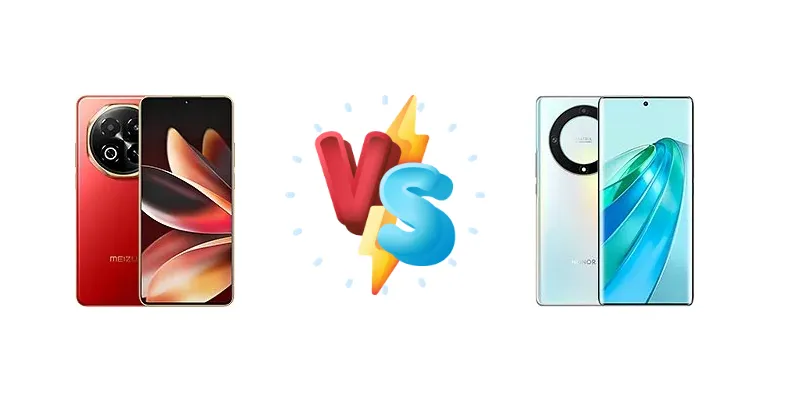
The Meizu Note 22 and Honor X9a represent compelling options in the increasingly competitive budget 5G smartphone market. Both devices aim to deliver a solid experience without breaking the bank, but they take different approaches to achieving this. The Note 22 leverages the Unisoc T8200, while the X9a opts for the Qualcomm Snapdragon 695 5G. This comparison will dissect their key differences to determine which phone offers the best value.
🏆 Quick Verdict
For the average user prioritizing consistent performance and a more established software ecosystem, the Honor X9a emerges as the slightly better choice. While both phones offer 40W charging, the Snapdragon 695 generally provides a smoother experience in demanding tasks, and Qualcomm's optimization often translates to better app compatibility.
| Network |
|---|
| 2G bands | GSM 850 / 900 / 1800 / 1900 | GSM 850 / 900 / 1800 / 1900 |
| 3G bands | HSDPA 850 / 900 / 2100 | HSDPA 850 / 900 / 1900 / 2100 |
| 4G bands | 1, 3, 5, 8, 34, 38, 39, 40, 41 | LTE |
| 5G bands | 1, 3, 5, 8, 28, 41, 78 SA/NSA | SA/NSA |
| Speed | HSPA, LTE, 5G | HSPA, LTE, 5G |
| Technology | GSM / HSPA / LTE / 5G | GSM / HSPA / LTE / 5G |
| Launch |
|---|
| Announced | 2025, May 20 | 2023, January 04 |
| Status | Available. Released 2025, May 20 | Available. Released 2023, January 06 |
| Body |
|---|
| Dimensions | 167.6 x 75.8 x 9.2 mm (6.60 x 2.98 x 0.36 in) | 161.6 x 73.9 x 7.9 mm (6.36 x 2.91 x 0.31 in) |
| SIM | Nano-SIM + Nano-SIM | Nano-SIM + Nano-SIM |
| Weight | 217 g (7.65 oz) | 175 g (6.17 oz) |
| Display |
|---|
| Resolution | 1080 x 2460 pixels (~396 ppi density) | 1080 x 2400 pixels, 20:9 ratio (~395 ppi density) |
| Size | 6.78 inches, 109.2 cm2 (~85.9% screen-to-body ratio) | 6.67 inches, 107.4 cm2 (~89.9% screen-to-body ratio) |
| Type | IPS LCD, 120Hz, 1050 nits (HBM), 5000 nits (peak) | AMOLED, 1B colors, 120Hz, 800 nits (HBM) |
| Platform |
|---|
| CPU | Octa-core (2x2.3 GHz Cortex-A76 & 6x2.1 GHz Cortex-A55) | Octa-core (2x2.2 GHz Kryo 660 Gold & 6x1.7 GHz Kryo 660 Silver) |
| Chipset | Unisoc T8200 (6 nm) | Qualcomm SM6375 Snapdragon 695 5G (6 nm) |
| GPU | Mali-G57 MC2 | Adreno 619 |
| OS | Flyme AIOS 2 | Android 12, upgradable to Android 13, MagicOS 7 |
| Memory |
|---|
| Card slot | No | No |
| Internal | 128GB 8GB RAM, 256GB 8GB RAM, 256GB 12GB RAM | 128GB 6GB RAM, 128GB 8GB RAM, 256GB 8GB RAM |
| Main Camera |
|---|
| Dual | 50 MP, f/1.8, 26mm (wide), PDAF
Auxiliary lens | 64 MP, f/1.8, (wide), PDAF
5 MP, f/2.2, (ultrawide)
2 MP (macro) |
| Features | LED flash, panorama, HDR | LED flash, panorama, HDR |
| Single | - | 16 MP, f/2.5, (wide) |
| Video | Yes | 1080p@30fps |
| Selfie camera |
|---|
| Features | HDR | - |
| Single | 8 MP, f/2.0 | 16 MP, f/2.5, (wide) |
| Video | Yes | 1080p@30fps |
| Sound |
|---|
| 3.5mm jack | - | No |
| 35mm jack | Yes | No |
| Loudspeaker | Yes, with stereo speakers | Yes |
| Comms |
|---|
| Bluetooth | 5.0, A2DP, LE, aptX HD | 5.1, A2DP, LE, aptX HD |
| Infrared port | - | Yes |
| NFC | Unspecified | Yes |
| Positioning | GPS, GALILEO, BDS | GPS, GLONASS, GALILEO, BDS |
| Radio | Unspecified | No |
| USB | USB Type-C 2.0 | USB Type-C 2.0, OTG |
| WLAN | Wi-Fi 802.11 a/b/g/n/ac, dual-band | Wi-Fi 802.11 a/b/g/n/ac, dual-band, Wi-Fi Direct |
| Features |
|---|
| Sensors | Fingerprint (side-mounted), accelerometer, proximity, compass | Fingerprint (under display, optical), accelerometer, gyro, proximity, compass |
| | - | 24-bit/192kHz audio |
| Battery |
|---|
| Charging | 40W wired, QC3+ | 40W wired |
| Type | 6600 mAh | Li-Po 5100 mAh |
| Misc |
|---|
| Colors | Pure Flame, Stonehold Black, Snow White | Titanium Silver, Emerald Green, Midnight Black |
| Models | - | RMO-NX1 |
| Price | About 210 EUR | $ 212.08 |
Meizu Note 22
- Potentially unique Flyme OS experience
- Competitive Unisoc T8200 performance
- 40W fast charging
- Less established brand recognition
- Unisoc chipset may have limited app optimization
Honor X9a
- Proven Snapdragon 695 performance
- Qualcomm’s optimized software ecosystem
- 40W fast charging
- Honor’s software can include pre-installed bloatware
- Design may be less distinctive
Display Comparison
Neither device boasts a standout display, focusing instead on value. While specific display specs (resolution, panel type) are missing, both likely utilize LCD panels given their price point. The focus here is on the processors powering the UI. The absence of high refresh rates is expected. Bezels are likely comparable, prioritizing cost-effectiveness over premium aesthetics. Color accuracy will likely be standard for this segment, leaning towards acceptable rather than exceptional.
Camera Comparison
Detailed camera specs are unavailable, but both phones likely feature a multi-camera setup with a primary sensor and supporting lenses. The emphasis will be on computational photography to enhance image quality. Given the price bracket, expect a primary sensor in the 48MP-64MP range. The Honor X9a, benefiting from Qualcomm’s image signal processor (ISP), may offer slightly better image processing, particularly in low-light conditions. The presence of a dedicated Night Mode and HDR capabilities will be crucial. We can anticipate that both phones will include a 2MP macro lens, which offers limited practical benefit due to its low resolution.
Performance
The core difference lies in the chipsets. The Meizu Note 22’s Unisoc T8200, built on a 6nm process, features a dual-cluster configuration with 2x 2.3 GHz Cortex-A76 cores and 6x 2.1 GHz Cortex-A55 cores. The Honor X9a’s Snapdragon 695 5G, also 6nm, employs 2x 2.2 GHz Kryo 660 Gold cores and 6x 1.7 GHz Kryo 660 Silver cores. While clock speeds are similar, Qualcomm’s Kryo cores and software optimization generally provide a performance edge, particularly in sustained workloads and gaming. The Snapdragon 695 benefits from Qualcomm’s Adreno GPU, which typically outperforms the Mali-G57 MC2 found in the Unisoc T8200. This translates to smoother graphics and higher frame rates in games. RAM speed is not specified, but both likely utilize LPDDR4X to keep costs down.
Battery Life
Both the Meizu Note 22 and Honor X9a feature 40W wired charging, promising relatively quick top-ups. Actual 0-100% charging times will likely be around 60-80 minutes. Battery capacity is not specified, but both likely fall in the 4500mAh-5000mAh range. The Snapdragon 695’s superior power efficiency may result in slightly longer battery life for the Honor X9a, especially during demanding tasks like gaming or video streaming. The 6nm process node contributes to better thermal management, reducing power draw.
Buying Guide
Buy the Meizu Note 22 if you prioritize a potentially more unique software experience and are comfortable with a less mainstream brand. The Unisoc T8200 offers competitive performance, and Meizu's Flyme OS might appeal to users seeking customization. Buy the Honor X9a if you value a proven chipset, wider app compatibility, and a more refined user experience backed by Qualcomm's Snapdragon 695 and Honor's established software support.
Frequently Asked Questions
❓ Will the Unisoc T8200 in the Meizu Note 22 struggle with graphically intensive games like Genshin Impact?
While the Unisoc T8200 is capable, Genshin Impact will likely require reduced graphics settings and may experience occasional frame drops. The Snapdragon 695 in the Honor X9a offers a smoother experience for demanding games due to its more powerful Adreno GPU.
❓ Does the Honor X9a support carrier aggregation for faster 5G speeds?
The Snapdragon 695 generally supports carrier aggregation, allowing for faster and more stable 5G connections. However, specific carrier aggregation band support varies by region and carrier. Check with your mobile provider for compatibility details.
❓ How does the software update policy differ between Meizu and Honor?
Honor typically provides more consistent software updates and security patches compared to Meizu, which has a less predictable update schedule. This is a significant consideration for long-term software support and security.
❓ Is the 40W charging on both phones compatible with Power Delivery (PD) chargers?
While both support 40W charging, compatibility with Power Delivery (PD) chargers isn't guaranteed. It's best to use the included charger or a charger specifically certified for Quick Charge (QC) 3+ compatibility, as the Meizu Note 22 supports QC3+.