
Meizu Note 22 Pro vs Xiaomi Redmi Note 12 Pro+: A Detailed Comparison
| Phones Images | |||||
|---|---|---|---|---|---|
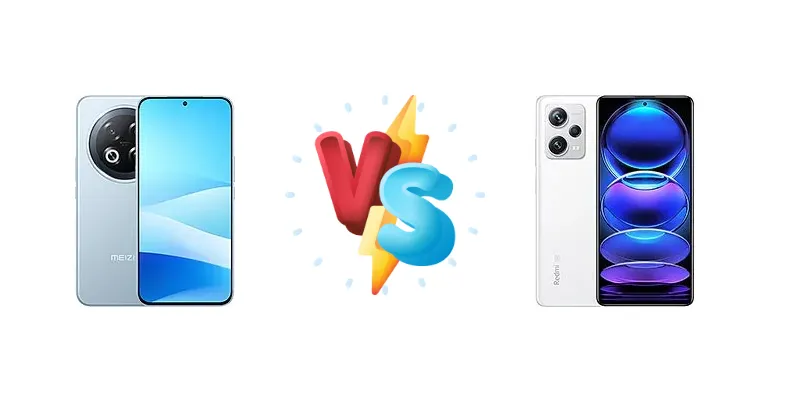
|
🏆 Quick Verdict
For the average user prioritizing rapid charging and a potentially smoother software experience, the Xiaomi Redmi Note 12 Pro+ is the better choice. However, the Meizu Note 22 Pro’s Snapdragon 7s Gen 3 offers a more modern architecture and potentially better long-term performance, making it ideal for those valuing future-proofing.
| PHONES | ||
|---|---|---|
| Phone Names | Meizu Note 22 Pro | Xiaomi Redmi Note 12 Pro+ |
| Network | ||
|---|---|---|
| 2G bands | GSM 850 / 900 / 1800 / 1900 | GSM 850 / 900 / 1800 / 1900 - SIM 1 & SIM 2 |
| 3G bands | HSDPA 850 / 900 / 1700(AWS) / 1900 / 2100 | HSDPA 800 / 850 / 900 / 1900 / 2100 |
| 4G bands | 1, 2, 3, 4, 5, 8, 20, 28, 34, 38, 39, 40, 41 | 1, 3, 5, 8, 19, 34, 38, 39, 40, 41 - International, China |
| 5G bands | 1, 2, 3, 5, 8, 20, 28, 38, 40, 41, 77, 78 SA/NSA | 1, 3, 5, 8, 28, 38, 40, 41, 77, 78 SA/NSA - International |
| Speed | HSPA, LTE, 5G | HSPA, LTE-A (CA), 5G |
| Technology | GSM / HSPA / LTE / 5G | GSM / CDMA / HSPA / EVDO / LTE / 5G |
| - | 1, 3, 5, 8, 28, 38, 41, 77, 78 SA/NSA - China | |
| Launch | ||
|---|---|---|
| Announced | 2025, May 20 | 2022, October 27 |
| Status | Available. Released 2025, May 20 | Available. Released 2022, November 01 |
| Body | ||
|---|---|---|
| Build | - | Glass front (Gorilla Glass 5), glass back |
| Dimensions | 163.8 x 76.2 x 8.4 mm (6.45 x 3.00 x 0.33 in) | 162.9 x 76 x 8.9 mm (6.41 x 2.99 x 0.35 in) |
| SIM | Nano-SIM + Nano-SIM | Dual SIM (Nano-SIM, dual stand-by) |
| Weight | 197.5 g (6.98 oz) | 208.4 g (7.34 oz) |
| - | IP53, dust and splash resistant | |
| Display | ||
|---|---|---|
| Protection | - | Corning Gorilla Glass 5 |
| Resolution | 1224 x 2720 pixels, 20:9 ratio (~440 ppi density) | 1080 x 2400 pixels, 20:9 ratio (~395 ppi density) |
| Size | 6.78 inches, 111.0 cm2 (~88.9% screen-to-body ratio) | 6.67 inches, 107.4 cm2 (~86.8% screen-to-body ratio) |
| Type | OLED, 1B colors, 144Hz, 700 nits (typ), 1600 nits (peak), 4500 nits (peak) | OLED, 1B colors, 120Hz, Dolby Vision, HDR10+, 500 nits (typ), 900 nits (HBM) |
| Platform | ||
|---|---|---|
| CPU | Octa-core (1x2.5 GHz Cortex-A720 & 3x2.4 GHz Cortex-A720 & 4x1.8 GHz Cortex-A520) | Octa-core (2x2.6 GHz Cortex-A78 & 6x2.0 GHz Cortex-A55) |
| Chipset | Qualcomm SM7635 Snapdragon 7s Gen 3 (4 nm) | Mediatek MT6877V Dimensity 1080 (6 nm) |
| GPU | Adreno 810 | Mali-G68 MC4 |
| OS | Flyme AIOS 2 | Android 12, MIUI 13 |
| Memory | ||
|---|---|---|
| Card slot | No | No |
| Internal | 256GB 8GB RAM, 256GB 12GB RAM, 512GB 12GB RAM, 512GB 16GB RAM | 256GB 8GB RAM, 256GB 12GB RAM |
| - | UFS 2.2 | |
| Main Camera | ||
|---|---|---|
| Features | LED flash, panorama, HDR | Dual-LED dual-tone flash, HDR, panorama |
| Triple | 50 MP, f/1.8, 26mm (wide), PDAF 8 MP, f/2.2, 15mm (ultrawide) 2 MP, f/2.4 | 200 MP, f/1.7, 24mm (wide), 1/1.4", 0.56µm, PDAF, OIS 8 MP, f/2.2, 120˚ (ultrawide), 1/4", 1.12µm 2 MP, f/2.4, (macro) |
| Video | Yes, gyro-EIS | 4K@30fps, 1080p@30/60/120fps, 720p@960fps |
| Selfie camera | ||
|---|---|---|
| Features | HDR | HDR |
| Single | 8 MP, f/2.1 | 16 MP, f/2.5, (wide), 1/3.06", 1.0µm |
| Video | Yes | 1080p@30/60fps |
| Sound | ||
|---|---|---|
| 3.5mm jack | - | Yes |
| 35mm jack | No | - |
| Loudspeaker | Yes, with stereo speakers | Yes, with stereo speakers |
| - | 24-bit/192kHz audio | |
| Comms | ||
|---|---|---|
| Bluetooth | 5.4, A2DP, LE, aptX HD, aptX Adaptive | 5.2, A2DP, LE |
| Infrared port | Yes | Yes |
| NFC | Yes | Yes (market/region dependent) |
| Positioning | GPS (L1+L5), BDS (B1I+B1C+B2a), GALILEO, QZSS, GLONASS | GPS (L1), GLONASS (G1), BDS (B1I+B1c), GALILEO (E1), QZSS (L1) |
| Radio | Unspecified | No |
| USB | USB Type-C 2.0 | USB Type-C 2.0, OTG |
| WLAN | Wi-Fi 802.11 a/b/g/n/ac/6, dual-band | Wi-Fi 802.11 a/b/g/n/ac/6, dual-band, Wi-Fi Direct |
| Features | ||
|---|---|---|
| Sensors | Fingerprint (under display, optical), accelerometer, gyro, proximity, compass | Fingerprint (side-mounted), accelerometer, proximity, gyro, compass |
| Battery | ||
|---|---|---|
| Charging | 80W wired, QC4+, PD3.0, PPS, 50% in 22 min | 120W wired, PD3.0, 100% in 19 min (advertised) |
| Type | 6200 mAh | Li-Po 5000 mAh, non-removable |
| Misc | ||
|---|---|---|
| Colors | Lake Glide, Cloud White, Star Ash | Arctic White, Iceberg Blue, Obsidian Black, Trend edition |
| Models | - | 22101316UCP, 22101316UG |
| Price | About 300 EUR | $ 348.00 / £ 439.00 / € 399.00 / ₹ 29,949 |
| Tests | ||
|---|---|---|
| Battery life | - | Endurance rating 88h |
| Camera | - | Photo / Video |
| Display | - | Contrast ratio: Infinite (nominal) |
| Loudspeaker | - | -26.7 LUFS (Good) |
| Performance | - | AnTuTu: 498710 (v9) GeekBench: 2208 (v5.1), 2372 (v6) GFXBench: 22fps (ES 3.1 onscreen) |
Meizu Note 22 Pro
- More modern 4nm Snapdragon 7s Gen 3 chipset
- Potentially better thermal management
- Newer CPU architecture for improved efficiency
- Slower 80W charging compared to the Redmi
- Likely less impressive camera system
- Less established brand recognition
Xiaomi Redmi Note 12 Pro+
- Ultra-fast 120W charging (100% in 19 mins)
- Potentially superior camera system with 200MP sensor
- Longer battery endurance (88h rating)
- Older 6nm Dimensity 1080 chipset
- Potentially more thermal throttling under heavy load
- MIUI software can be resource intensive
Display Comparison
The Redmi Note 12 Pro+ advertises an 'Infinite' contrast ratio, a marketing term indicating a high-quality AMOLED panel. However, the context data lacks specific brightness or refresh rate details for either device. Given the Redmi’s positioning, it likely features a 120Hz panel, while the Meizu may be limited to 60Hz or 90Hz. Without further data, it’s difficult to assess color accuracy or HDR support, but the Redmi’s likely higher refresh rate would benefit scrolling and gaming.
Camera Comparison
The provided data doesn’t offer detailed camera specifications beyond the presence of a camera on the Redmi Note 12 Pro+. However, the Redmi Note 12 Pro+ is known for its 200MP main sensor, a significant advantage over what is typically found in the Meizu Note 22 Pro’s price bracket. While megapixel count isn’t everything, a larger sensor generally captures more light and detail. The Redmi’s OIS (Optical Image Stabilization) is also crucial for sharper photos and smoother videos, especially in low light. The Meizu’s camera performance will likely rely more on software processing to compensate for a potentially smaller sensor.
Performance
The core difference lies in the chipsets. The Xiaomi Redmi Note 12 Pro+ utilizes the Mediatek Dimensity 1080, built on a 6nm process. The Meizu Note 22 Pro employs the Qualcomm Snapdragon 7s Gen 3, fabricated on a more efficient 4nm node. This 4nm process gives the Snapdragon an advantage in thermal efficiency, potentially leading to less throttling during extended gaming sessions. While the Dimensity 1080’s Cortex-A78 cores have a higher clock speed (2.6 GHz vs 2.5 GHz), the Snapdragon 7s Gen 3’s newer Cortex-A720 architecture is generally more performant per clock cycle. The Meizu also benefits from a more balanced core configuration, with 3x A720 cores versus the Redmi’s 2x A78 cores.
Battery Life
The Redmi Note 12 Pro+’s 120W charging is its standout feature, promising a full charge in just 19 minutes (advertised). The Meizu Note 22 Pro’s 80W charging is still fast, reaching 50% in 22 minutes, but significantly slower overall. The Redmi Note 12 Pro+ also boasts an endurance rating of 88 hours, suggesting a well-optimized battery life. While the Meizu’s battery capacity isn’t specified, the Snapdragon 7s Gen 3’s 4nm efficiency could partially offset the charging speed difference, but the Redmi’s faster charging is a clear win for users who prioritize convenience.
Buying Guide
Buy the Meizu Note 22 Pro if you prioritize a newer chipset architecture for sustained performance and potential software updates, and aren't overly concerned with the absolute fastest charging speeds. Buy the Xiaomi Redmi Note 12 Pro+ if you absolutely need the quickest possible charging – topping up to 100% in under 20 minutes – and value a proven track record with Xiaomi’s MIUI software.