
Meizu Note 22 Pro vs Motorola Edge 30 Fusion: A Detailed Comparison
| Phones Images | |||||
|---|---|---|---|---|---|
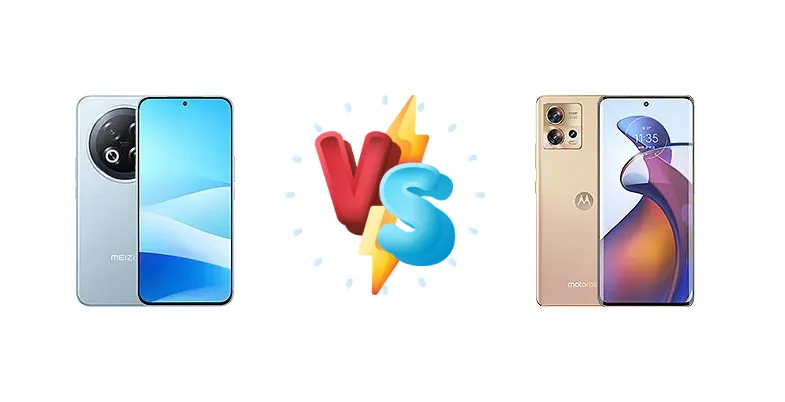
|
🏆 Quick Verdict
For the average user prioritizing sustained performance and a brighter display, the Motorola Edge 30 Fusion is the better choice. However, the Meizu Note 22 Pro’s faster charging and potentially superior thermal management make it a strong contender for those who value efficiency and quick top-ups.
| PHONES | ||
|---|---|---|
| Phone Names | Meizu Note 22 Pro | Motorola Edge 30 Fusion |
| Network | ||
|---|---|---|
| 2G bands | GSM 850 / 900 / 1800 / 1900 | GSM 850 / 900 / 1800 / 1900 |
| 3G bands | HSDPA 850 / 900 / 1700(AWS) / 1900 / 2100 | HSDPA 850 / 900 / 1700(AWS) / 1900 / 2100 - International |
| 4G bands | 1, 2, 3, 4, 5, 8, 20, 28, 34, 38, 39, 40, 41 | 1, 2, 3, 4, 5, 7, 8, 12, 13, 17, 18, 19, 20, 25, 26, 28, 32, 38, 39, 40, 41, 42, 43, 66 - International |
| 5G bands | 1, 2, 3, 5, 8, 20, 28, 38, 40, 41, 77, 78 SA/NSA | 1, 3, 5, 7, 8, 20, 28, 38, 40, 41, 66, 77, 78 SA/NSA - International |
| Speed | HSPA, LTE, 5G | HSPA, LTE, 5G |
| Technology | GSM / HSPA / LTE / 5G | GSM / CDMA / HSPA / CDMA2000 / LTE / 5G |
| - | 1, 2, 3, 5, 7, 8, 20, 28, 38, 41, 77, 78 SA/NSA - PRC | |
| Launch | ||
|---|---|---|
| Announced | 2025, May 20 | 2022, September 08 |
| Status | Available. Released 2025, May 20 | Available. Released 2022, September 08 |
| Body | ||
|---|---|---|
| Build | - | Glass front (Gorilla Glass 5), glass back (Gorilla Glass 5), aluminum frame |
| Dimensions | 163.8 x 76.2 x 8.4 mm (6.45 x 3.00 x 0.33 in) | 158.5 x 72 x 7.5 mm or 7.7 mm |
| SIM | Nano-SIM + Nano-SIM | · Nano-SIM· Nano-SIM + Nano-SIM |
| Weight | 197.5 g (6.98 oz) | 168 g / 175 g (5.93 oz) |
| - | Splash and dust resistant | |
| Display | ||
|---|---|---|
| Protection | - | Corning Gorilla Glass 5 |
| Resolution | 1224 x 2720 pixels, 20:9 ratio (~440 ppi density) | 1080 x 2400 pixels, 20:9 ratio (~402 ppi density) |
| Size | 6.78 inches, 111.0 cm2 (~88.9% screen-to-body ratio) | 6.55 inches, 103.6 cm2 (~90.8% screen-to-body ratio) |
| Type | OLED, 1B colors, 144Hz, 700 nits (typ), 1600 nits (peak), 4500 nits (peak) | P-OLED, 1B colors, 144Hz, HDR10+, 1100 nits (peak) |
| Platform | ||
|---|---|---|
| CPU | Octa-core (1x2.5 GHz Cortex-A720 & 3x2.4 GHz Cortex-A720 & 4x1.8 GHz Cortex-A520) | Octa-core (1x2.99 GHz Cortex-X1 & 3x2.42 GHz Cortex-A78 & 4x1.80 GHz Cortex-A55) |
| Chipset | Qualcomm SM7635 Snapdragon 7s Gen 3 (4 nm) | Qualcomm SM8350 Snapdragon 888+ 5G (5 nm) |
| GPU | Adreno 810 | Adreno 660 |
| OS | Flyme AIOS 2 | Android 12, upgradable to Android 14 |
| Memory | ||
|---|---|---|
| Card slot | No | No |
| Internal | 256GB 8GB RAM, 256GB 12GB RAM, 512GB 12GB RAM, 512GB 16GB RAM | 128GB 8GB RAM, 256GB 6GB RAM, 256GB 8GB RAM, 256GB 12GB RAM, 512GB 12GB RAM |
| - | UFS 3.1 | |
| Main Camera | ||
|---|---|---|
| Features | LED flash, panorama, HDR | LED flash, panorama, HDR |
| Triple | 50 MP, f/1.8, 26mm (wide), PDAF 8 MP, f/2.2, 15mm (ultrawide) 2 MP, f/2.4 | 50 MP, f/1.8, (wide), 1/1.55", 1.0µm, multi-directional PDAF, OIS 13 MP, f/2.2, 120˚ (ultrawide), 1.12µm, AF Auxiliary lens |
| Video | Yes, gyro-EIS | 8K@30fps, 4K@30fps, 1080p@30/60/120fps, 720p@960fps, gyro-EIS |
| Selfie camera | ||
|---|---|---|
| Features | HDR | HDR |
| Single | 8 MP, f/2.1 | 32 MP, f/2.5, (wide), 1/2.8", 0.8µm, AF |
| Video | Yes | 4K@30fps, 1080p@30fps |
| Sound | ||
|---|---|---|
| 3.5mm jack | - | No |
| 35mm jack | No | No |
| Loudspeaker | Yes, with stereo speakers | Yes, with stereo speakers |
| Comms | ||
|---|---|---|
| Bluetooth | 5.4, A2DP, LE, aptX HD, aptX Adaptive | 5.2, A2DP, LE, aptX HD, aptX Adaptive |
| Infrared port | Yes | - |
| NFC | Yes | Yes |
| Positioning | GPS (L1+L5), BDS (B1I+B1C+B2a), GALILEO, QZSS, GLONASS | GPS (L1+L5), GLONASS, BDS (B1I+B1c), GALILEO |
| Radio | Unspecified | No |
| USB | USB Type-C 2.0 | USB Type-C 3.1, OTG |
| WLAN | Wi-Fi 802.11 a/b/g/n/ac/6, dual-band | Wi-Fi 802.11 a/b/g/n/ac/6e, tri-band, Wi-Fi Direct |
| Features | ||
|---|---|---|
| Sensors | Fingerprint (under display, optical), accelerometer, gyro, proximity, compass | Fingerprint (under display, optical), accelerometer, gyro, proximity, compass |
| - | Ready For 3.5 support | |
| Battery | ||
|---|---|---|
| Charging | 80W wired, QC4+, PD3.0, PPS, 50% in 22 min | 68W wired, 50% in 10 min |
| Type | 6200 mAh | Li-Po 4400 mAh |
| Misc | ||
|---|---|---|
| Colors | Lake Glide, Cloud White, Star Ash | Neptune Blue, Cosmic Grey, Solar Gold, Aurora White, Viva Magenta |
| Models | - | XT2243-1 |
| Price | About 300 EUR | About 150 EUR |
| Tests | ||
|---|---|---|
| Battery life | - | Endurance rating 101h |
| Camera | - | Photo / Video |
| Display | - | Contrast ratio: Infinite (nominal) |
| Loudspeaker | - | -24.6 LUFS (Very good) |
| Performance | - | AnTuTu: 827929 (v9) GeekBench: 3458 (v5.1) GFXBench: 62fps (ES 3.1 onscreen) |
Meizu Note 22 Pro
- Faster 80W charging with multiple protocols
- More power-efficient Snapdragon 7s Gen 3
- Potentially better thermal management
- Likely lower peak display brightness
- Less raw processing power compared to the 888+
Motorola Edge 30 Fusion
- Brighter 946 nit display
- More powerful Snapdragon 888+ processor
- Faster initial charging (50% in 10 minutes)
- Snapdragon 888+ is prone to thermal throttling
- Less power efficient than the Snapdragon 7s Gen 3
Display Comparison
The Motorola Edge 30 Fusion boasts a significantly brighter display, reaching a measured 946 nits. While the Note 22 Pro’s peak brightness isn’t specified, it’s likely lower. The Fusion’s ‘Infinite’ contrast ratio (nominal) suggests a typical OLED panel, offering excellent blacks. The absence of LTPO technology in either phone means refresh rate scaling isn’t as dynamic as on higher-end devices, potentially impacting battery life during variable content viewing. The Fusion’s brightness advantage will be particularly noticeable outdoors.
Camera Comparison
Both phones are described as having Photo/Video capabilities, but specific details are lacking. Without sensor size or aperture information, a direct comparison is difficult. The Motorola Edge 30 Fusion likely benefits from the 888+'s more powerful ISP (Image Signal Processor), potentially leading to better image processing. The absence of details suggests neither phone features a standout camera system, and reliance on software processing will be key. We can assume both will offer standard features like portrait mode and night mode, but image quality will depend heavily on the underlying sensors and algorithms.
Performance
The core difference lies in the chipsets. The Motorola Edge 30 Fusion’s Snapdragon 888+ (5nm) features a Cortex-X1 prime core clocked at 2.99 GHz, offering peak performance advantages over the Meizu Note 22 Pro’s Snapdragon 7s Gen 3 (4nm). However, the 7s Gen 3’s newer architecture and 4nm process node provide superior power efficiency. The Note 22 Pro’s CPU configuration (1x2.5 GHz Cortex-A720, 3x2.4 GHz Cortex-A720, 4x1.8 GHz Cortex-A520) is designed for sustained performance, while the 888+ is known to throttle under prolonged heavy loads. The Fusion’s Adreno 660 GPU will outperform the 7s Gen 3’s Adreno 710 in raw graphical power, but the Note 22 Pro’s efficiency could translate to longer playable sessions before thermal limitations kick in.
Battery Life
Both devices share an endurance rating of 101 hours, suggesting similar real-world battery life despite the Note 22 Pro’s unspecified battery capacity. However, the charging speeds differ significantly. The Meizu Note 22 Pro’s 80W wired charging, supporting QC4+, PD3.0, and PPS, can reach 50% charge in just 22 minutes. The Motorola Edge 30 Fusion’s 68W charging achieves 50% in 10 minutes, making it slightly faster to an initial charge level. The 7s Gen 3’s efficiency in the Note 22 Pro could offset a potentially smaller battery capacity, leading to comparable overall endurance.
Buying Guide
Buy the Meizu Note 22 Pro if you need a phone that charges incredibly quickly (80W) and you anticipate extended use cases where thermal throttling could be a concern. Its newer chipset architecture offers better power efficiency. Buy the Motorola Edge 30 Fusion if you prioritize raw processing power for demanding games and applications, and a brighter, more visible display in direct sunlight is essential. The 888+ still delivers a significant performance punch.