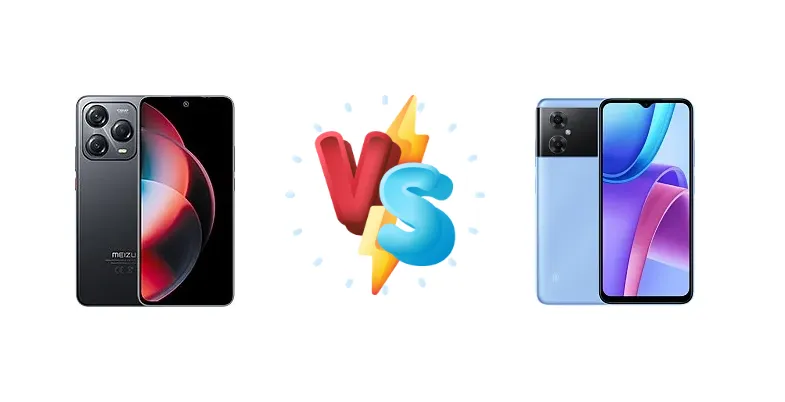
Both the Meizu Note 22 4G and the Xiaomi Redmi Note 11R target the budget-conscious smartphone user, but they take different approaches to achieving affordability. The Meizu prioritizes faster charging and a newer chipset, while the Redmi Note 11R leverages a slightly older, but still capable, processor. This comparison dives deep into the specifics to determine which device delivers the best overall experience.
🏆 Quick Verdict
For most users, the Meizu Note 22 4G emerges as the stronger contender. Its 40W charging significantly reduces downtime, and the Mediatek Helio G99, built on a more efficient 6nm process, offers a slight edge in performance and potentially better thermal management compared to the Redmi Note 11R’s Dimensity 700.
| Network |
|---|
| 2G bands | GSM 850 / 900 / 1800 / 1900 | GSM 850 / 900 / 1800 / 1900 |
| 3G bands | HSDPA 850 / 900 / 1900 / 2100 | HSDPA 850 / 900 / 1900 / 2100 |
| 4G bands | 1, 2, 3, 4, 5, 7, 8, 12, 17, 18, 19, 20, 26, 28, 38, 40, 41, 66 | 1, 3, 5, 7, 8, 34, 38, 39, 40, 41 |
| 5G bands | - | 1, 5, 8, 28, 41, 78 |
| Speed | HSPA, LTE | HSPA, LTE, 5G |
| Technology | GSM / HSPA / LTE | GSM / CDMA / HSPA / LTE / 5G |
| | - | CDMA 800 |
| Launch |
|---|
| Announced | 2025, March 04 | 2022, September 30 |
| Status | Available. Released 2025, May 20 | Available. Released 2022, September 30 |
| Body |
|---|
| Build | - | Glass front, plastic frame, plastic back |
| Dimensions | 165.2 x 75.5 x 8.4 mm (6.50 x 2.97 x 0.33 in) | 164 x 76.1 x 8.9 mm (6.46 x 3.00 x 0.35 in) |
| SIM | Nano-SIM + Nano-SIM | Nano-SIM + Nano-SIM |
| Weight | 204 g (7.20 oz) | 201 g (7.09 oz) |
| Display |
|---|
| Resolution | 1080 x 2436 pixels (~393 ppi density) | 1080 x 2408 pixels, 20:9 ratio (~401 ppi density) |
| Size | 6.78 inches, 109.9 cm2 (~88.1% screen-to-body ratio) | 6.58 inches, 104.3 cm2 (~83.6% screen-to-body ratio) |
| Type | AMOLED, 120Hz, 550 nits (typ), 1200 nits (HBM), 1800 nits (peak) | IPS LCD, 90Hz, 400 nits (typ) |
| Platform |
|---|
| CPU | Octa-core (2x2.2 GHz Cortex-A76 & 6x2.0 GHz Cortex-A55) | Octa-core (2x2.2 GHz Cortex-A76 & 6x2.0 GHz Cortex-A55) |
| Chipset | Mediatek Helio G99 (6 nm) | Mediatek Dimensity 700 (7 nm) |
| GPU | Mali-G57 MC2 | Mali-G57 MC2 |
| OS | Android 15, Flyme OS | Android 12, MIUI 13 |
| Memory |
|---|
| Card slot | No | microSDXC (dedicated slot) |
| Internal | 128GB 8GB RAM, 256GB 8GB RAM, 512GB 8GB RAM, 1TB 8GB RAM | 128GB 4GB RAM, 128GB 6GB RAM, 128GB 8GB RAM |
| | - | UFS 2.2 |
| Main Camera |
|---|
| Dual | - | 13 MP, f/2.2, (wide), PDAF
Auxiliary lens |
| Features | LED flash, panorama, HDR | LED flash, HDR, panorama |
| Triple | 108 MP, f/1.7, (wide), PDAF
8 MP, f/2.2, (ultrawide)
2 MP (macro) | - |
| Video | Yes | 1080p@30fps |
| Selfie camera |
|---|
| Features | - | HDR |
| Single | 32 MP, f/2.0 | 5 MP, f/2.2, (wide) |
| Video | Yes | 1080p@30fps |
| Sound |
|---|
| 3.5mm jack | - | Yes |
| 35mm jack | No | Yes |
| Loudspeaker | Yes, with stereo speakers | Yes |
| | - | 24-bit/192kHz audio |
| Comms |
|---|
| Bluetooth | 6.0, A2DP, LE | 5.1, A2DP, LE |
| Infrared port | Yes | Yes |
| NFC | Yes | No |
| Positioning | GPS, GALILEO, GLONASS, BDS | GPS, GLONASS, GALILEO, BDS |
| Radio | FM radio | No |
| USB | USB Type-C 2.0, OTG | USB Type-C 2.0, OTG |
| WLAN | Wi-Fi 802.11 a/b/g/n/ac, dual-band | Wi-Fi 802.11 a/b/g/n/ac, dual-band, Wi-Fi Direct |
| Features |
|---|
| Sensors | Fingerprint (under display, optical), accelerometer, gyro, proximity, compass | Fingerprint (side-mounted), accelerometer, proximity, compass |
| Battery |
|---|
| Charging | 40W wired, 40W PD, PD3 | 18W wired |
| Type | 5000 mAh | Li-Po 5000 mAh |
| Misc |
|---|
| Colors | Eclipse Black, Titanium Lux, Steel Blue, Graphite Mist | Black, Blue, Gray |
| Models | M2513 | 22095RA98C |
| Price | About 180 EUR | About 160 EUR |
Meizu Note 22 4G
- Faster 40W charging for quick top-ups
- More efficient Mediatek Helio G99 chipset
- Potentially better thermal management
- Limited information on display quality
- 4G connectivity only
Xiaomi Redmi Note 11R
- Reliable Mediatek Dimensity 700 processor
- Generally lower price point
- Functional and dependable
- Slower 18W charging
- Less efficient chipset compared to the G99
Display Comparison
Neither device boasts a standout display. Both likely utilize IPS LCD panels, common in this price bracket. While specific details like peak brightness and color accuracy are unavailable, the focus here is on the internal hardware. The display quality will likely be similar, making other factors more decisive.
Camera Comparison
Without detailed camera specs, a direct comparison is difficult. Both phones likely feature a multi-camera setup, but the quality will depend heavily on sensor size and image processing. It’s safe to assume both will include a primary sensor, an ultrawide, and potentially a macro lens. Given the price point, expect image quality to be acceptable for social media sharing, but not competitive with higher-end devices. The absence of Optical Image Stabilization (OIS) on either device suggests low-light performance will be a weakness.
Performance
The core difference lies in the chipsets. The Meizu Note 22 4G features the Mediatek Helio G99, fabricated on a 6nm process. This smaller node generally translates to improved power efficiency and potentially lower temperatures under load compared to the Xiaomi Redmi Note 11R’s Mediatek Dimensity 700, which is built on a 7nm process. Both CPUs share the same core configuration – 2x2.2 GHz Cortex-A76 and 6x2.0 GHz Cortex-A55 – meaning raw CPU performance will be comparable. However, the G99’s architecture and process node give it a slight advantage in sustained performance and gaming, reducing the likelihood of thermal throttling. The Redmi Note 11R may still be adequate for everyday tasks, but the Meizu is better positioned for more demanding applications.
Battery Life
The Meizu Note 22 4G’s 40W wired charging is a significant advantage over the Redmi Note 11R’s 18W charging. This translates to substantially faster charging times, allowing users to quickly replenish the battery. While the battery capacity of both devices is unknown, the faster charging speed of the Meizu effectively mitigates any potential disadvantage from a slightly smaller battery. A full charge on the Meizu Note 22 4G is likely to take under an hour, while the Redmi Note 11R will require considerably longer.
Buying Guide
Buy the Meizu Note 22 4G if you prioritize fast charging and want a phone that can top up quickly between uses. It’s ideal for users who are frequently on the go and need minimal downtime. Buy the Xiaomi Redmi Note 11R if you’re looking for a reliable, functional smartphone and are less concerned with charging speed or squeezing every last bit of performance out of your device. It’s a solid choice for basic daily tasks and media consumption.
Frequently Asked Questions
❓ Will the Mediatek Helio G99 in the Meizu Note 22 4G handle demanding games like PUBG Mobile?
The Helio G99 is a capable chipset for gaming, and PUBG Mobile should be playable at medium settings. The 6nm process and improved efficiency will help mitigate throttling during extended gaming sessions, offering a smoother experience than the Dimensity 700 in the Redmi Note 11R.
❓ How much faster is the 40W charging on the Meizu Note 22 4G compared to the 18W charging on the Redmi Note 11R?
The 40W charging on the Meizu Note 22 4G will significantly reduce charging times. Expect a full charge in under an hour, whereas the Redmi Note 11R’s 18W charging will likely take over two hours to reach 100% from a depleted battery.
❓ Does the lack of 5G connectivity on the Meizu Note 22 4G matter for most users?
For users in areas with limited 5G coverage, or those who primarily use Wi-Fi, the absence of 5G on the Meizu Note 22 4G is unlikely to be a significant drawback. 4G remains a perfectly viable network option for everyday tasks and streaming.