
Meizu Note 22 4G vs Samsung Galaxy A52s 5G: A Detailed Comparison
| Phones Images | |||||
|---|---|---|---|---|---|
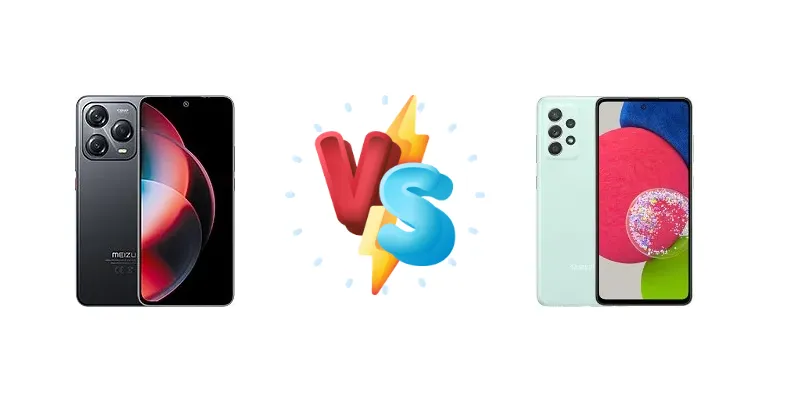
|
🏆 Quick Verdict
For most users, the Samsung Galaxy A52s 5G emerges as the stronger choice. Its Snapdragon 778G chipset provides a noticeable performance advantage, particularly in gaming and demanding applications, and the 5G connectivity offers future-proofing. However, the Meizu Note 22 is a viable alternative for those prioritizing a newer device and faster charging.
| PHONES | ||
|---|---|---|
| Phone Names | Meizu Note 22 4G | Samsung Galaxy A52s 5G |
| Network | ||
|---|---|---|
| 2G bands | GSM 850 / 900 / 1800 / 1900 | GSM 850 / 900 / 1800 / 1900 |
| 3G bands | HSDPA 850 / 900 / 1900 / 2100 | HSDPA 850 / 900 / 1700(AWS) / 1900 / 2100 |
| 4G bands | 1, 2, 3, 4, 5, 7, 8, 12, 17, 18, 19, 20, 26, 28, 38, 40, 41, 66 | 1, 2, 3, 4, 5, 7, 8, 12, 17, 20, 26, 28, 32, 38, 40, 41, 66 |
| 5G bands | - | 1, 3, 5, 7, 8, 20, 28, 38, 40, 41, 66, 78 SA/NSA/Sub6 |
| Speed | HSPA, LTE | HSPA 42.2/5.76 Mbps, LTE Cat18 1200/150 Mbps, 5G |
| Technology | GSM / HSPA / LTE | GSM / HSPA / LTE / 5G |
| Launch | ||
|---|---|---|
| Announced | 2025, March 04 | 2021, August 17 |
| Status | Available. Released 2025, May 20 | Available. Released 2021, September 01 |
| Body | ||
|---|---|---|
| Build | - | Glass front (Gorilla Glass 5), plastic back |
| Dimensions | 165.2 x 75.5 x 8.4 mm (6.50 x 2.97 x 0.33 in) | 159.9 x 75.1 x 8.4 mm (6.30 x 2.96 x 0.33 in) |
| SIM | Nano-SIM + Nano-SIM | · Nano-SIM· Nano-SIM + Nano-SIM |
| Weight | 204 g (7.20 oz) | 189 g (6.67 oz) |
| - | IP67 dust/water resistant (up to 1m for 30 min) | |
| Display | ||
|---|---|---|
| Protection | - | Corning Gorilla Glass 5 |
| Resolution | 1080 x 2436 pixels (~393 ppi density) | 1080 x 2400 pixels, 20:9 ratio (~405 ppi density) |
| Size | 6.78 inches, 109.9 cm2 (~88.1% screen-to-body ratio) | 6.5 inches, 102.0 cm2 (~84.9% screen-to-body ratio) |
| Type | AMOLED, 120Hz, 550 nits (typ), 1200 nits (HBM), 1800 nits (peak) | Super AMOLED, 120Hz, 800 nits (HBM) |
| Platform | ||
|---|---|---|
| CPU | Octa-core (2x2.2 GHz Cortex-A76 & 6x2.0 GHz Cortex-A55) | Octa-core (1x2.4 GHz Cortex-A78 & 3x2.2 GHz Cortex-A78 & 4x1.9 GHz Cortex-A55) |
| Chipset | Mediatek Helio G99 (6 nm) | Qualcomm SM7325 Snapdragon 778G 5G (6 nm) |
| GPU | Mali-G57 MC2 | Adreno 642L |
| OS | Android 15, Flyme OS | Android 11, upgradable to Android 14, One UI 6 |
| Memory | ||
|---|---|---|
| Card slot | No | microSDXC (uses shared SIM slot) |
| Internal | 128GB 8GB RAM, 256GB 8GB RAM, 512GB 8GB RAM, 1TB 8GB RAM | 128GB 4GB RAM, 128GB 6GB RAM, 128GB 8GB RAM, 256GB 6GB RAM, 256GB 8GB RAM |
| Main Camera | ||
|---|---|---|
| Features | LED flash, panorama, HDR | LED flash, panorama, HDR |
| Quad | - | 64 MP, f/1.8, 26mm (wide), 1/1.7", 0.8µm, PDAF, OIS 12 MP, f/2.2, 123˚ (ultrawide), 1.12µm 5 MP (macro) Auxiliary lens |
| Single | - | 32 MP, f/2.2, 26mm (wide), 1/2.8", 0.8µm |
| Triple | 108 MP, f/1.7, (wide), PDAF 8 MP, f/2.2, (ultrawide) 2 MP (macro) | - |
| Video | Yes | 4K@30fps, 1080p@30/60fps; gyro-EIS |
| Selfie camera | ||
|---|---|---|
| Features | - | HDR |
| Single | 32 MP, f/2.0 | 32 MP, f/2.2, 26mm (wide), 1/2.8", 0.8µm |
| Video | Yes | 4K@30fps, 1080p@30/60fps |
| Sound | ||
|---|---|---|
| 3.5mm jack | - | Yes |
| 35mm jack | No | Yes |
| Loudspeaker | Yes, with stereo speakers | Yes, with stereo speakers |
| Comms | ||
|---|---|---|
| Bluetooth | 6.0, A2DP, LE | 5.0, A2DP, LE |
| Infrared port | Yes | - |
| NFC | Yes | Yes (market/region dependent) |
| Positioning | GPS, GALILEO, GLONASS, BDS | GPS, GLONASS, GALILEO, BDS, QZSS |
| Radio | FM radio | No |
| USB | USB Type-C 2.0, OTG | USB Type-C 2.0, OTG |
| WLAN | Wi-Fi 802.11 a/b/g/n/ac, dual-band | Wi-Fi 802.11 a/b/g/n/ac/6, dual-band, Wi-Fi Direct |
| Features | ||
|---|---|---|
| Sensors | Fingerprint (under display, optical), accelerometer, gyro, proximity, compass | Fingerprint (under display, optical), accelerometer, gyro, compass |
| - | Virtual Proximity Sensing | |
| Battery | ||
|---|---|---|
| Charging | 40W wired, 40W PD, PD3 | 25W wired |
| Type | 5000 mAh | Li-Ion 4500 mAh |
| Misc | ||
|---|---|---|
| Colors | Eclipse Black, Titanium Lux, Steel Blue, Graphite Mist | Awesome Black, Awesome White, Awesome Purple, Awesome Mint |
| Models | M2513 | SM-A528B, SM-A528B/DS, SM-A528N |
| Price | About 180 EUR | £ 112.98 / € 249.47 |
| SAR | - | 0.72 W/kg (head) |
| SAR EU | - | 0.88 W/kg (head) 0.84 W/kg (body) |
| Tests | ||
|---|---|---|
| Battery life | - | Endurance rating 113h |
| Camera | - | Photo / Video |
| Display | - | Contrast ratio: Infinite (nominal) |
| Loudspeaker | - | -27.5 LUFS (Good) |
| Performance | - | AnTuTu: 429675 (v8), 506432(v9) GeekBench: 11060 (v4.4), 2801 (v5.1) GFXBench: 28fps (ES 3.1 onscreen) |
Meizu Note 22 4G
- Faster 40W charging with PD/PD3
- Newer device with potentially longer software support
- Modern design aesthetic
- 4G connectivity only
- Less powerful processor than the A52s
- Limited camera information
Samsung Galaxy A52s 5G
- More powerful Snapdragon 778G chipset
- 5G connectivity for future-proofing
- Higher peak display brightness
- Slower 25W charging
- Older device with potentially degrading battery
- May be harder to find new
Display Comparison
The Samsung Galaxy A52s boasts a measured peak brightness of 800 nits, providing excellent visibility outdoors, a specification the Meizu Note 22’s display data lacks. While both likely utilize AMOLED panels given their market segment, the A52s’ higher brightness is a significant advantage. The A52s also benefits from an 'Infinite' contrast ratio, typical of AMOLED technology, delivering deep blacks and vibrant colors. Without specific display specs for the Meizu Note 22, it’s difficult to assess its color accuracy or viewing angles relative to the A52s.
Camera Comparison
Both devices offer photo and video capabilities, but detailed sensor information is limited for both. The Snapdragon 778G’s ISP (Image Signal Processor) generally delivers excellent image processing, known for its dynamic range and color accuracy. While the A52s likely features a more sophisticated camera system overall, the Meizu Note 22’s image quality will depend heavily on its sensor size and software optimization. Without specific details, it’s difficult to definitively declare a winner, but the A52s’ chipset suggests a more capable camera experience.
Performance
The core difference lies in the chipsets. The Samsung Galaxy A52s 5G is powered by the Qualcomm Snapdragon 778G 5G (6nm), featuring a 1x2.4 GHz Cortex-A78 prime core and 3x2.2 GHz Cortex-A78 performance cores, alongside 4x1.9 GHz Cortex-A55 efficiency cores. This configuration provides a substantial performance uplift compared to the Meizu Note 22’s MediaTek Helio G99 (6nm) with its 2x2.2 GHz Cortex-A76 and 6x2.0 GHz Cortex-A55 cores. The Snapdragon 778G’s more advanced core architecture and higher clock speeds translate to smoother multitasking, faster app loading times, and superior gaming performance. The A52s also benefits from 5G connectivity, a feature absent in the Note 22.
Battery Life
Both phones share an endurance rating of 113 hours, suggesting comparable real-world battery life despite potentially different battery capacities. However, the charging speeds differ significantly. The Meizu Note 22 supports 40W wired charging with PD and PD3 protocols, enabling faster top-ups compared to the Samsung Galaxy A52s’ 25W charging. This means the Meizu Note 22 can replenish its battery more quickly, mitigating any potential battery life differences. The A52s' older battery may show some degradation over time, further favoring the Note 22 in charging speed.
Buying Guide
Buy the Meizu Note 22 4G if you prioritize a brand-new device with a modern design and 40W fast charging, and 5G isn't a necessity. Buy the Samsung Galaxy A52s 5G if you value a more powerful processor for gaming and multitasking, and want the flexibility of 5G connectivity, even if the battery is showing its age.