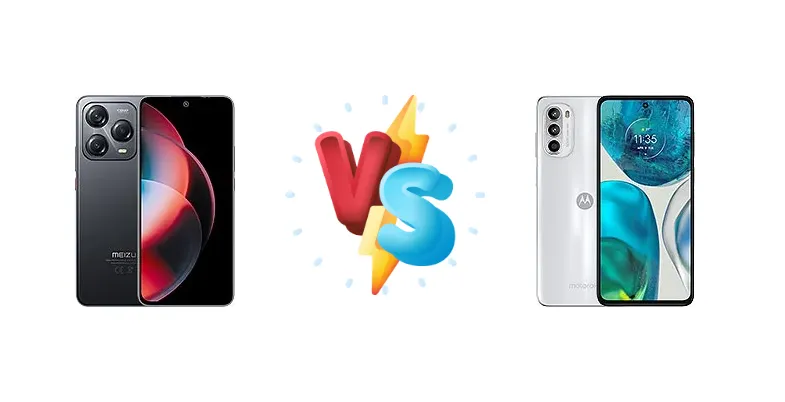
The Meizu Note 22 4G and Motorola Moto G52 represent compelling options in the increasingly competitive sub-$200 4G smartphone market. While both devices aim for affordability, they take different approaches to performance and features. The Meizu prioritizes processing power with its Mediatek Helio G99, while the Motorola focuses on a balanced experience with the Qualcomm Snapdragon 680. This comparison will dissect their key differences to help you determine which device best suits your needs.
🏆 Quick Verdict
For users prioritizing raw performance and faster charging, the Meizu Note 22 4G emerges as the winner. Its Helio G99 chipset offers a noticeable edge in CPU and GPU performance, and the 40W charging significantly reduces downtime. However, the Moto G52 remains a solid choice for those seeking a more efficient processor and a potentially smoother software experience.
| Network |
|---|
| 2G bands | GSM 850 / 900 / 1800 / 1900 | GSM 850 / 900 / 1800 / 1900 |
| 3G bands | HSDPA 850 / 900 / 1900 / 2100 | HSDPA 850 / 900 / 1700(AWS) / 1900 / 2100 |
| 4G bands | 1, 2, 3, 4, 5, 7, 8, 12, 17, 18, 19, 20, 26, 28, 38, 40, 41, 66 | LTE |
| Speed | HSPA, LTE | HSPA, LTE |
| Technology | GSM / HSPA / LTE | GSM / HSPA / LTE |
| Launch |
|---|
| Announced | 2025, March 04 | 2022, April 12 |
| Status | Available. Released 2025, May 20 | Available. Released 2022, April 20 |
| Body |
|---|
| Dimensions | 165.2 x 75.5 x 8.4 mm (6.50 x 2.97 x 0.33 in) | 160.1 x 74.5 x 8 mm (6.30 x 2.93 x 0.31 in) |
| SIM | Nano-SIM + Nano-SIM | Nano-SIM + Nano-SIM |
| Weight | 204 g (7.20 oz) | 169 g (5.96 oz) |
| | - | Water-repellent design |
| Display |
|---|
| Resolution | 1080 x 2436 pixels (~393 ppi density) | 1080 x 2400 pixels, 20:9 ratio (~402 ppi density) |
| Size | 6.78 inches, 109.9 cm2 (~88.1% screen-to-body ratio) | 6.6 inches, 103.6 cm2 (~86.9% screen-to-body ratio) |
| Type | AMOLED, 120Hz, 550 nits (typ), 1200 nits (HBM), 1800 nits (peak) | AMOLED, 90Hz |
| Platform |
|---|
| CPU | Octa-core (2x2.2 GHz Cortex-A76 & 6x2.0 GHz Cortex-A55) | Octa-core (4x2.4 GHz Kryo 265 Gold & 4x1.9 GHz Kryo 265 Silver) |
| Chipset | Mediatek Helio G99 (6 nm) | Qualcomm SM6225 Snapdragon 680 4G (6 nm) |
| GPU | Mali-G57 MC2 | Adreno 610 |
| OS | Android 15, Flyme OS | Android 12, planned upgrade to Android 13 |
| Memory |
|---|
| Card slot | No | microSDXC (uses shared SIM slot) |
| Internal | 128GB 8GB RAM, 256GB 8GB RAM, 512GB 8GB RAM, 1TB 8GB RAM | 64GB 4GB RAM, 128GB 4GB RAM, 128GB 6GB RAM, 256GB 6GB RAM |
| Main Camera |
|---|
| Features | LED flash, panorama, HDR | LED flash, HDR, panorama |
| Triple | 108 MP, f/1.7, (wide), PDAF
8 MP, f/2.2, (ultrawide)
2 MP (macro) | 50 MP, f/1.8 (wide), 1/2.76", 0.64µm, PDAF
8 MP, f/2.2, 118˚ (ultrawide), 1/4.0", 1.12µm
2 MP (macro) |
| Video | Yes | 1080p@30fps |
| Selfie camera |
|---|
| Single | 32 MP, f/2.0 | 16 MP, f/2.5, (wide), 1.0µm |
| Video | Yes | 1080p@30fps |
| Sound |
|---|
| 3.5mm jack | - | Yes |
| 35mm jack | No | Yes |
| Loudspeaker | Yes, with stereo speakers | Yes, with stereo speakers |
| Comms |
|---|
| Bluetooth | 6.0, A2DP, LE | 5.0, A2DP, LE |
| Infrared port | Yes | - |
| NFC | Yes | Yes (market/region dependent) |
| Positioning | GPS, GALILEO, GLONASS, BDS | GPS, GLONASS, GALILEO |
| Radio | FM radio | Unspecified |
| USB | USB Type-C 2.0, OTG | USB Type-C 2.0 |
| WLAN | Wi-Fi 802.11 a/b/g/n/ac, dual-band | Wi-Fi 802.11 a/b/g/n/ac, dual-band, Wi-Fi Direct |
| Features |
|---|
| Sensors | Fingerprint (under display, optical), accelerometer, gyro, proximity, compass | Fingerprint (side-mounted), accelerometer, gyro, proximity, compass |
| Battery |
|---|
| Charging | 40W wired, 40W PD, PD3 | 30W wired |
| Type | 5000 mAh | Li-Po 5000 mAh |
| Misc |
|---|
| Colors | Eclipse Black, Titanium Lux, Steel Blue, Graphite Mist | Charcoal Gray, Porcelain White |
| Models | M2513 | XT2221-1, XT2221-2 |
| Price | About 180 EUR | About 470 EUR |
Meizu Note 22 4G
- Faster charging with 40W support
- More powerful Helio G99 chipset for gaming
- Potentially better single-core performance
- Software experience may be less refined
- Potential for higher thermal throttling under sustained load
Motorola Moto G52
- Potentially better battery efficiency with Snapdragon 680
- Likely cleaner software experience
- Balanced performance for everyday tasks
- Slower 30W charging
- Less powerful chipset for demanding applications
Display Comparison
Neither device boasts a standout display. Both utilize 6nm chipsets, suggesting a focus on efficiency over pushing display boundaries. While specific display specs (resolution, panel type) are missing, the focus here is on processing power. The absence of high refresh rates on either device indicates a cost-saving measure, prioritizing battery life over visual fluidity. Bezels are likely comparable given the price point, and color accuracy will likely be standard for this segment.
Camera Comparison
Without detailed camera specifications, a direct comparison is challenging. However, the focus in this segment is rarely on flagship-level imaging. Both devices likely feature a primary camera accompanied by auxiliary lenses (depth, macro). The Meizu Note 22 4G’s image processing will likely lean towards vibrant colors, typical of Mediatek-powered devices. The Motorola Moto G52, leveraging Qualcomm’s image signal processor, may offer more natural color reproduction. The absence of OIS on either device suggests reliance on software stabilization, which may struggle in low-light conditions.
Performance
The core difference lies in the chipsets. The Meizu Note 22 4G’s Mediatek Helio G99, built on a 6nm process, features an octa-core configuration with 2x2.2 GHz Cortex-A76 and 6x2.0 GHz Cortex-A55 cores. This architecture prioritizes peak performance. Conversely, the Motorola Moto G52’s Qualcomm Snapdragon 680 (also 6nm) employs 4x2.4 GHz Kryo 265 Gold and 4x1.9 GHz Kryo 265 Silver cores. While the Snapdragon 680 boasts higher clock speeds on its performance cores, the Cortex-A76 cores in the Helio G99 generally offer superior single-core performance, crucial for responsive app launches and smoother UI navigation. The G99 will likely excel in graphically intensive tasks. The lack of LPDDR5x RAM specification for either device suggests they likely utilize LPDDR4x, a common choice in this price bracket.
Battery Life
The Meizu Note 22 4G’s 40W wired charging, supporting PD and PD3 standards, is a significant advantage over the Motorola Moto G52’s 30W charging. This translates to substantially faster charging times, minimizing downtime. While battery capacity isn’t specified, the more efficient Helio G99 in the Meizu Note 22 4G could potentially offset a slightly smaller battery compared to the Moto G52. The 40W charging allows for a quicker top-up, crucial for users who frequently use their phones throughout the day.
Buying Guide
Buy the Meizu Note 22 4G if you frequently engage in mobile gaming, multitasking, or require faster app loading times. Its Helio G99 chipset and 40W charging are geared towards power users. Buy the Motorola Moto G52 if you prioritize efficient power consumption for all-day battery life, a potentially cleaner software experience, and a more balanced overall performance profile for everyday tasks.
Frequently Asked Questions
❓ Will the Helio G99 in the Meizu Note 22 4G overheat during prolonged gaming sessions?
While the Helio G99 is a capable chipset, its thermal performance will depend on Meizu’s cooling solution. The 6nm process helps, but sustained gaming at high settings could lead to throttling. Monitoring temperatures during gameplay is recommended.
❓ Does the Motorola Moto G52 support VoLTE and VoWiFi on all carriers?
Carrier compatibility for VoLTE and VoWiFi varies significantly. It's crucial to check Motorola's official compatibility list or contact your carrier to confirm support before purchasing, especially if you rely on these features.
❓ Is the software on the Meizu Note 22 4G heavily customized?
Meizu's Flyme OS is known for its customization. Expect a different user interface compared to stock Android, with potential pre-installed apps and a unique aesthetic. This may appeal to some users but could be a drawback for those preferring a cleaner Android experience.
❓ How does the Snapdragon 680's efficiency impact real-world battery life on the Moto G52?
The Snapdragon 680 is designed for efficiency. Users can expect all-day battery life with moderate usage, even with a potentially smaller battery capacity. This makes the Moto G52 a good choice for users who prioritize longevity over peak performance.