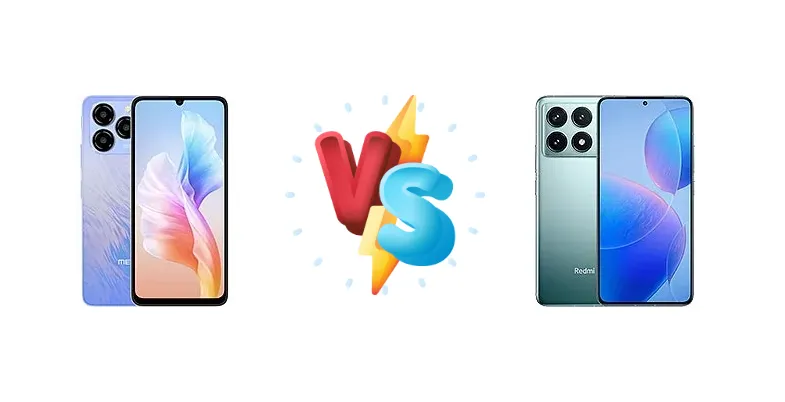
The Meizu Note 21 and Xiaomi Redmi K70 Pro represent opposite ends of the smartphone spectrum. The Note 21 aims for affordability and efficiency, while the K70 Pro throws down a gauntlet with flagship-level performance. This comparison dissects the core differences, helping you determine which device aligns with your needs and budget.
🏆 Quick Verdict
For the average user prioritizing raw power, gaming, and future-proofing, the Xiaomi Redmi K70 Pro is the clear winner. Its Snapdragon 8 Gen 3 chipset delivers a performance leap over the Meizu Note 21’s Unisoc T606, coupled with blazing-fast 120W charging. However, the Note 21 remains a viable option for basic tasks and users on a tight budget.
| Network |
|---|
| 2G bands | GSM 850 / 900 / 1800 / 1900 | GSM 850 / 900 / 1800 / 1900 |
| 3G bands | HSDPA 850 / 900 / 1900 / 2100 | HSDPA 800 / 850 / 900 / 1700(AWS) / 2100 |
| 4G bands | LTE | 1, 3, 4, 5, 8, 18, 19, 26, 28, 34, 38, 39, 40, 41, 42, 48, 66 |
| 5G bands | - | 1, 3, 5, 8, 28, 38, 41, 48, 66, 77, 78 SA/NSA |
| Speed | HSPA, LTE | HSPA, LTE, 5G |
| Technology | GSM / HSPA / LTE | GSM / CDMA / HSPA / CDMA2000 / LTE / 5G |
| Launch |
|---|
| Announced | 2024, September 13 | 2023, November 29 |
| Status | Available. Released 2024, October | Available. Released 2023, November 29 |
| Body |
|---|
| Dimensions | - | 160.9 x 75 x 8.2 mm (6.33 x 2.95 x 0.32 in) |
| SIM | Nano-SIM + Nano-SIM | Nano-SIM + Nano-SIM |
| Weight | - | 209 g (7.37 oz) |
| Display |
|---|
| Resolution | 720 x 1600 pixels*, 20:9 ratio (~260 ppi density) | 1440 x 3200 pixels, 20:9 ratio (~526 ppi density) |
| Size | 6.74 inches, 109.7 cm2 | 6.67 inches, 107.4 cm2 (~89.0% screen-to-body ratio) |
| Type | IPS LCD, 90Hz, 450 nits | OLED, 68B colors, 120Hz, Dolby Vision, HDR10+, 4000 nits (peak) |
| Platform |
|---|
| CPU | Octa-core (2x1.6 GHz Cortex-A75 & 6x1.6 GHz Cortex-A55) | Octa-core (1x3.3 GHz Cortex-X4 & 3x3.2 GHz Cortex-A720 & 2x3.0 GHz Cortex-A720 & 2x2.3 GHz Cortex-A520) |
| Chipset | Unisoc T606 (12 nm) | Qualcomm SM8650-AB Snapdragon 8 Gen 3 (4 nm) |
| GPU | Mali-G57 MP1 | Adreno 750 |
| OS | Flyme OS | Android 14, HyperOS |
| Memory |
|---|
| Card slot | microSDXC | No |
| Internal | 256GB 8GB RAM | 256GB 12GB RAM, 256GB 16GB RAM, 512GB 12GB RAM, 512GB 16GB RAM, 1TB 24GB RAM |
| Main Camera |
|---|
| Dual | 50 MP, AF
2 MP | - |
| Features | LED flash, panorama, HDR | Color spectrum sensor, LED flash, HDR, panorama |
| Triple | - | 50 MP, f/1.6, (wide), 1/1.55", 1.0µm, PDAF, OIS
50 MP, (telephoto), PDAF, 2x optical zoom
12 MP, (ultrawide) |
| Video | Yes | 8K@24fps, 4K@24/30/60fps, 1080p@30/60/120/240/960fps, 720p@1920fps, gyro-EIS |
| Selfie camera |
|---|
| Features | - | HDR |
| Single | 8 MP | 16 MP, (wide) |
| Video | Yes | 1080p@30/60fps, gyro-EIS |
| Sound |
|---|
| 35mm jack | Yes | No |
| Loudspeaker | Yes | Yes, with stereo speakers |
| Comms |
|---|
| Bluetooth | 5.3, A2DP | 5.4, A2DP, LE, aptX HD, aptX Adaptive, aptX Lossless |
| Infrared port | - | Yes |
| NFC | No | Yes |
| Positioning | GPS | GPS (L1+L5), GLONASS (G1), BDS (B1I+B1c+B2a), GALILEO (E1+E5a), QZSS (L1+L5), NavIC (L5) |
| Radio | No | No |
| USB | USB Type-C | USB Type-C, OTG |
| WLAN | Wi-Fi 802.11 a/b/g/n/ac, dual-band | Wi-Fi 802.11 a/b/g/n/ac/6e/7, dual-band, Wi-Fi Direct |
| Features |
|---|
| Sensors | Fingerprint (side-mounted); unspecified sensors | Fingerprint (under display, optical), accelerometer, proximity, gyro, compass |
| Battery |
|---|
| Charging | 18W wired | 120W wired, PD3.0, QC3+, 100% in 18 min |
| Type | 6000 mAh | Li-Po 5000 mAh |
| Misc |
|---|
| Colors | Ivory, Diamond Black, Gulf Blue | Black, Silver, Blue/Green, Lamborgini Green, Lamborgini Yellow |
| Models | - | 23117RK66C |
| Price | - | About 430 EUR |
Meizu Note 21
- Significantly more affordable
- Potentially better battery life due to efficient chipset
- Simple and user-friendly experience
- Substantially slower performance
- Limited gaming capabilities
- Slower charging speeds
Xiaomi Redmi K70 Pro
- Exceptional performance with Snapdragon 8 Gen 3
- Ultra-fast 120W charging
- Superior camera capabilities
- Higher price point
- Potentially shorter battery life under heavy load
- More complex software features
Display Comparison
While display specifications aren't provided for the Meizu Note 21, it's reasonable to expect a standard LCD panel given its price point. The Redmi K70 Pro, however, benefits from a likely AMOLED display (typical for the K series) offering superior contrast and color accuracy. The absence of LTPO technology in either device suggests neither will have dynamically variable refresh rates for optimal power saving. Bezels are likely to be more pronounced on the Note 21 due to cost constraints. The K70 Pro will likely have a higher peak brightness, making it more usable in direct sunlight.
Camera Comparison
Without detailed camera specs for the Meizu Note 21, it’s safe to assume a basic camera setup focused on affordability. The Redmi K70 Pro, while details are missing, typically features a high-resolution main sensor with OIS (Optical Image Stabilization) in the K series. The Snapdragon 8 Gen 3’s ISP (Image Signal Processor) will provide superior image processing capabilities, resulting in better dynamic range, noise reduction, and overall image quality. The K70 Pro will likely excel in low-light photography due to its advanced image processing and potentially larger sensor size.
Performance
The performance disparity is the most significant difference. The Unisoc T606 in the Meizu Note 21, built on a 12nm process, is an entry-level chipset geared towards efficiency. Its octa-core configuration (2x1.6 GHz Cortex-A75 & 6x1.6 GHz Cortex-A55) is adequate for basic tasks but will struggle with demanding games or multitasking. Conversely, the Snapdragon 8 Gen 3 in the Redmi K70 Pro, fabricated on a 4nm process, is a flagship powerhouse. Its CPU configuration (1x3.3 GHz Cortex-X4 & 3x3.2 GHz Cortex-A720 & 2x3.0 GHz Cortex-A720 & 2x2.3 GHz Cortex-A520) delivers significantly faster processing speeds and improved efficiency. The K70 Pro will exhibit far less throttling under sustained load, making it ideal for gamers and power users. The K70 Pro will also benefit from faster LPDDR5x RAM, further enhancing performance.
Battery Life
The Meizu Note 21’s 18W wired charging is comparatively slow. While battery capacity isn’t specified, it’s likely smaller than the Redmi K70 Pro’s. The K70 Pro’s 120W wired charging is a game-changer, capable of fully charging the device in approximately 18 minutes. This rapid charging significantly reduces downtime and provides a more convenient user experience. While a larger battery capacity on the Note 21 might offset the slower charging, the K70 Pro’s charging speed offers a substantial advantage for users who frequently need to top up their battery.
Buying Guide
Buy the Meizu Note 21 if you need a reliable, affordable smartphone for everyday tasks like calling, texting, social media, and light web browsing. It’s ideal for users who prioritize battery life over performance and aren’t demanding gamers. Buy the Xiaomi Redmi K70 Pro if you prioritize performance for gaming, demanding apps, and content creation. It’s the choice for users who want a future-proof device with incredibly fast charging and a premium experience.
Frequently Asked Questions
❓ Will the Unisoc T606 in the Meizu Note 21 struggle with popular games like Genshin Impact or Call of Duty Mobile?
Yes, the Unisoc T606 is an entry-level chipset and will likely struggle to run graphically demanding games like Genshin Impact or Call of Duty Mobile at playable frame rates. You'll likely need to lower graphics settings significantly, and even then, expect stuttering and lag. It's better suited for less demanding titles.
❓ How does the 120W charging on the Redmi K70 Pro affect battery health over the long term?
While 120W charging is incredibly fast, Xiaomi incorporates several technologies to mitigate potential battery degradation. These include optimized charging algorithms and temperature control. However, consistently using extremely fast charging *can* contribute to slightly faster battery wear over several years compared to slower charging methods. The convenience often outweighs this minor concern for most users.
❓ Is the performance difference between these two phones noticeable for everyday tasks like browsing and social media?
For basic tasks like browsing, social media, and messaging, the performance difference won't be dramatically noticeable. Both phones will handle these tasks adequately. However, the Redmi K70 Pro will feel significantly snappier and more responsive when switching between apps or opening multiple tabs.