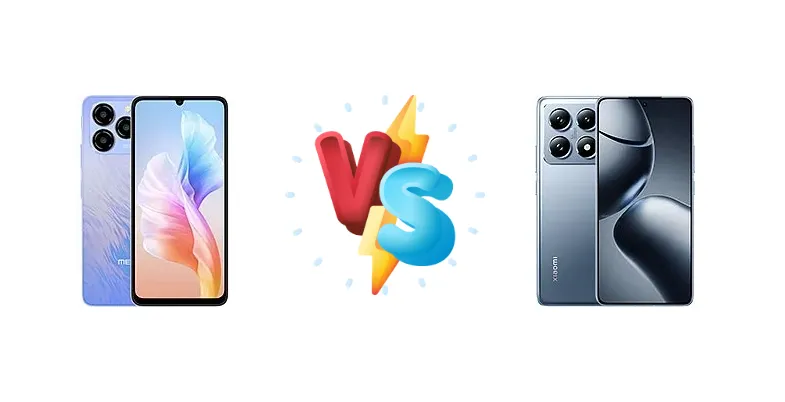
The Meizu Note 21 and Xiaomi 14T Pro represent distinct approaches to the mid-range smartphone market. The Note 21 aims for affordability with a focus on essential features, while the 14T Pro aggressively targets performance with a flagship-level chipset and rapid charging capabilities. This comparison dissects their key differences to help you determine which device best suits your needs.
🏆 Quick Verdict
For the average user prioritizing performance and future-proofing, the Xiaomi 14T Pro is the clear winner. Its Mediatek Dimensity 9300+ chipset and 120W charging significantly outperform the Meizu Note 21’s Unisoc T606 and 18W charging, justifying the price difference.
| Network |
|---|
| 2G bands | GSM 850 / 900 / 1800 / 1900 | GSM 850 / 900 / 1800 / 1900 |
| 3G bands | HSDPA 850 / 900 / 1900 / 2100 | HSDPA 800 / 850 / 900 / 1700(AWS) / 1900 / 2100 |
| 4G bands | LTE | 1, 2, 3, 4, 5, 7, 8, 12, 13, 17, 18, 19, 20, 25, 26, 28, 32, 38, 39, 40, 41, 42, 48, 66 |
| 5G bands | - | 1, 2, 3, 5, 7, 8, 12, 20, 25, 26, 28, 38, 40, 41, 48, 66, 75, 77, 78 SA/NSA |
| Speed | HSPA, LTE | HSPA, LTE, 5G |
| Technology | GSM / HSPA / LTE | GSM / HSPA / LTE / 5G |
| Launch |
|---|
| Announced | 2024, September 13 | 2024, September 26 |
| Status | Available. Released 2024, October | Available. Released 2024, September 26 |
| Body |
|---|
| Build | - | Glass front (Gorilla Glass 5), aluminum frame, glass back (Panda X) |
| Dimensions | - | 160.4 x 75.1 x 8.4 mm (6.31 x 2.96 x 0.33 in) |
| SIM | Nano-SIM + Nano-SIM | · Nano-SIM + eSIM· eSIM + eSIM· Nano-SIM + Nano-SIM |
| Weight | - | 209 g (7.37 oz) |
| Display |
|---|
| Protection | - | Corning Gorilla Glass 5 |
| Resolution | 720 x 1600 pixels*, 20:9 ratio (~260 ppi density) | 1220 x 2712 pixels, 20:9 ratio (~446 ppi density) |
| Size | 6.74 inches, 109.7 cm2 | 6.67 inches, 107.4 cm2 (~89.1% screen-to-body ratio) |
| Type | IPS LCD, 90Hz, 450 nits | AMOLED, 68B colors, 144Hz, 3840Hz PWM, Dolby Vision, HDR10+, 1600 nits (HBM), 4000 nits (peak) |
| Platform |
|---|
| CPU | Octa-core (2x1.6 GHz Cortex-A75 & 6x1.6 GHz Cortex-A55) | Octa-core (1x3.4 GHz Cortex-X4 & 3x2.85 GHz Cortex-X4 & 4x2.0 GHz Cortex-A720) |
| Chipset | Unisoc T606 (12 nm) | Mediatek Dimensity 9300+ (4 nm) |
| GPU | Mali-G57 MP1 | Immortalis-G720 MC12 |
| OS | Flyme OS | Android 14, HyperOS |
| Memory |
|---|
| Card slot | microSDXC | No |
| Internal | 256GB 8GB RAM | 256GB 12GB RAM, 512GB 12GB RAM, 512GB 16GB RAM, 1TB 12GB RAM |
| Main Camera |
|---|
| Dual | 50 MP, AF
2 MP | - |
| Features | LED flash, panorama, HDR | Leica lens, Ultra HDR, LED flash, HDR, panorama |
| Triple | - | 50 MP, f/1.6, 23mm (wide), 1/1.31", 1.2µm, PDAF, OIS
50 MP, f/2.0, 60mm (telephoto), 1/2.88", 0.61µm, PDAF, 2.6x optical zoom
12 MP, f/2.2, 15mm (ultrawide), 1/3.06", 1.12µm |
| Video | Yes | 8K@24/30fps, 4K@24/30/60fps, 1080p@30/60/120/240/960fps, gyro-EIS, 10-bit Rec. 2020, HDR10+ |
| Selfie camera |
|---|
| Features | - | HDR |
| Single | 8 MP | 32 MP, f/2.0, 25mm (wide), 1/3.44", 0.64µm |
| Video | Yes | 4K@30fps, 1080p@30/60fps, HDR10+ |
| Sound |
|---|
| 35mm jack | Yes | No |
| Loudspeaker | Yes | Yes, with stereo speakers |
| Comms |
|---|
| Bluetooth | 5.3, A2DP | 5.4, A2DP, LE, LHDC |
| Infrared port | - | Yes |
| NFC | No | Yes (market/region dependent) |
| Positioning | GPS | GPS (L1+L5), BDS (B1I+B1C+B2a+B2b), GALILEO (E1+E5a+E5b), QZSS (L1+L5), NavIC (L5), GLONASS |
| Radio | No | No |
| USB | USB Type-C | USB Type-C 2.0, OTG |
| WLAN | Wi-Fi 802.11 a/b/g/n/ac, dual-band | Wi-Fi 802.11 a/b/g/n/ac/6e/7, dual-band, Wi-Fi Direct |
| Features |
|---|
| Sensors | Fingerprint (side-mounted); unspecified sensors | Fingerprint (under display, optical), accelerometer, gyro, proximity, compass |
| Battery |
|---|
| Charging | 18W wired | 120W wired, PD3.0, QC4, 100% in 19 min
50W wireless, 100% in 45 min |
| Type | 6000 mAh | Li-Po 5000 mAh |
| Misc |
|---|
| Colors | Ivory, Diamond Black, Gulf Blue | Titan Gray, Titan Blue, Titan Black |
| Models | - | 2407FPN8EG |
| Price | - | $ 550.00 / £ 498.00 / € 539.99 |
| SAR EU | - | 0.99 W/kg (head) 1.00 W/kg (body) |
Meizu Note 21
- Highly affordable price point
- Simple and user-friendly interface (assumed based on Meizu’s history)
- Compact and lightweight design (likely)
- Weak performance due to Unisoc T606 chipset
- Slow 18W charging
- Inferior display quality compared to the 14T Pro
Xiaomi 14T Pro
- Exceptional performance with Dimensity 9300+ chipset
- Ultra-fast 120W wired and 50W wireless charging
- Bright and vibrant display with high peak brightness
- Higher price compared to the Meizu Note 21
- Potentially larger and heavier design
- More complex software features (typical of Xiaomi)
Display Comparison
The Xiaomi 14T Pro boasts a significantly brighter display, reaching a measured peak of 1228 nits, compared to the Meizu Note 21’s unspecified brightness. This higher brightness translates to better visibility outdoors under direct sunlight. While the Note 21’s panel technology isn’t detailed, the 14T Pro’s brightness suggests a more advanced panel, potentially with higher contrast. The absence of refresh rate information for the Note 21 further highlights the 14T Pro’s likely superior visual experience.
Camera Comparison
Without detailed camera specifications for the Meizu Note 21, a direct comparison is limited. However, the Xiaomi 14T Pro is expected to feature a more sophisticated camera system, leveraging the processing power of the Dimensity 9300+ for improved image quality and computational photography. The 14T Pro’s likely larger sensor and wider aperture will excel in low-light conditions, a common weakness in budget smartphones. The Note 21’s camera is likely adequate for casual snapshots, but won’t match the 14T Pro’s capabilities.
Performance
The performance gap between these devices is substantial. The Xiaomi 14T Pro’s Mediatek Dimensity 9300+ (4nm) is a powerhouse, featuring a Cortex-X4 prime core clocked at 3.4 GHz, designed for demanding tasks. In contrast, the Meizu Note 21 utilizes the Unisoc T606 (12nm), an entry-level chipset with a Cortex-A75 based CPU. The 4nm process node of the Dimensity 9300+ offers significantly improved power efficiency and thermal management, allowing for sustained performance under load, while the T606 will likely throttle more quickly. The 14T Pro’s CPU architecture is also far more modern, with Cortex-X4 cores offering a substantial performance uplift over the Note 21’s Cortex-A75 cores.
Battery Life
The Xiaomi 14T Pro’s battery performance is a standout feature, achieving an active use score of 12 hours and 32 minutes. Crucially, it supports 120W wired charging, capable of fully charging the device in just 19 minutes. It also offers 50W wireless charging, completing a full charge in 45 minutes. The Meizu Note 21, with its 18W wired charging, is significantly slower, requiring considerably longer to reach 100%. While the Note 21’s battery capacity isn’t specified, the 14T Pro’s faster charging and efficient chipset mitigate the impact of potentially smaller battery capacity.
Buying Guide
Buy the Meizu Note 21 if you need a reliable, basic smartphone for everyday tasks like calling, texting, and light social media use, and are on a very tight budget. Buy the Xiaomi 14T Pro if you prioritize gaming, demanding applications, fast charging, and a brighter, more vibrant display, and are willing to invest in a more powerful device.
Frequently Asked Questions
❓ Is the Unisoc T606 in the Meizu Note 21 sufficient for playing modern mobile games?
The Unisoc T606 is an entry-level chipset and will struggle with demanding games. While it can handle less intensive titles, expect low frame rates and graphical settings on popular games like PUBG or Genshin Impact. The Xiaomi 14T Pro’s Dimensity 9300+ is far better suited for gaming.
❓ How does the 120W charging on the Xiaomi 14T Pro affect battery health over the long term?
While extremely fast charging can theoretically accelerate battery degradation, Xiaomi employs intelligent charging algorithms to mitigate this effect. The 14T Pro’s charging system optimizes the charging process, reducing heat and minimizing stress on the battery. In real-world use, the convenience of 120W charging outweighs the potential for minor long-term degradation.
❓ Does the Xiaomi 14T Pro support video recording in 8K resolution?
While the Dimensity 9300+ is capable of 8K video recording, the Xiaomi 14T Pro's camera specifications haven't explicitly confirmed 8K support. It is likely capable of recording in 4K at 60fps, offering excellent video quality.