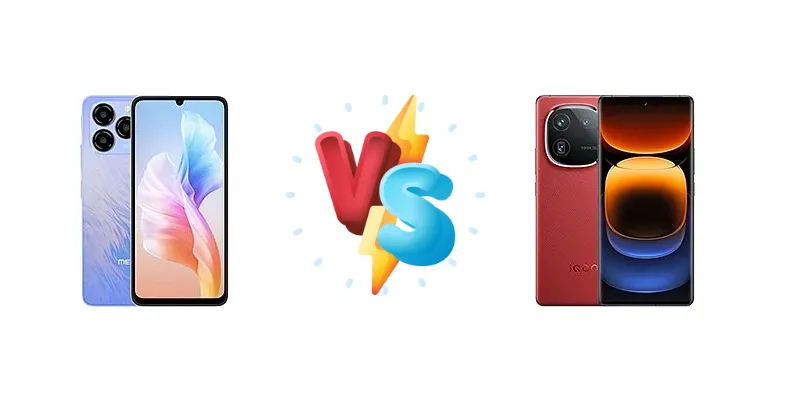
The Meizu Note 21 and vivo iQOO 12 Pro represent vastly different approaches to the smartphone market. The Note 21 aims for affordability and efficiency, while the iQOO 12 Pro is a performance-focused device boasting cutting-edge technology. This comparison dissects their key differences to help you determine which phone best suits your needs and budget.
🏆 Quick Verdict
For the average user prioritizing raw power, gaming, and fast charging, the vivo iQOO 12 Pro is the clear winner. However, the Meizu Note 21 provides a solid, functional experience at a significantly lower price point, making it ideal for budget-conscious consumers.
| Network |
|---|
| 2G bands | GSM 850 / 900 / 1800 / 1900 | GSM 850 / 900 / 1800 / 1900 |
| 3G bands | HSDPA 850 / 900 / 1900 / 2100 | HSDPA 800 / 850 / 900 / 1700(AWS) / 1900 / 2100 |
| 4G bands | LTE | 1, 2, 3, 4, 5, 7, 8, 12, 17, 18, 19, 20, 25, 26, 28, 34, 38, 39, 40, 41, 42, 66 |
| 5G bands | - | 1, 2, 3, 5, 7, 8, 12, 20, 25, 26, 28, 66, 38, 40, 41, 77, 78 SA/NSA |
| Speed | HSPA, LTE | HSPA, LTE, 5G |
| Technology | GSM / HSPA / LTE | GSM / CDMA / HSPA / CDMA2000 / LTE / 5G |
| Launch |
|---|
| Announced | 2024, September 13 | 2023, November 07 |
| Status | Available. Released 2024, October | Available. Released 2023, November 14 |
| Body |
|---|
| Dimensions | - | 164.6 x 75.4 x 8.6 mm or 8.8 mm |
| SIM | Nano-SIM + Nano-SIM | Nano-SIM + Nano-SIM |
| Weight | - | 205 g or 210 g (7.23 oz) |
| Display |
|---|
| Resolution | 720 x 1600 pixels*, 20:9 ratio (~260 ppi density) | 1440 x 3200 pixels, 20:9 ratio (~518 ppi density) |
| Size | 6.74 inches, 109.7 cm2 | 6.78 inches, 111.0 cm2 (~89.4% screen-to-body ratio) |
| Type | IPS LCD, 90Hz, 450 nits | LTPO AMOLED, 1B colors, 144Hz, HDR10+, 1600 nits (HBM), 3000 nits (peak) |
| Platform |
|---|
| CPU | Octa-core (2x1.6 GHz Cortex-A75 & 6x1.6 GHz Cortex-A55) | Octa-core (1x3.3 GHz Cortex-X4 & 3x3.2 GHz Cortex-A720 & 2x3.0 GHz Cortex-A720 & 2x2.3 GHz Cortex-A520) |
| Chipset | Unisoc T606 (12 nm) | Qualcomm SM8650-AB Snapdragon 8 Gen 3 (4 nm) |
| GPU | Mali-G57 MP1 | Adreno 750 |
| OS | Flyme OS | Android 14, up to 2 major Android upgrades, Funtouch 14 (International), OriginOS 4 (China) |
| Memory |
|---|
| Card slot | microSDXC | No |
| Internal | 256GB 8GB RAM | 256GB 16GB RAM, 512GB 16GB RAM, 1TB 16GB RAM |
| Main Camera |
|---|
| Dual | 50 MP, AF
2 MP | - |
| Features | LED flash, panorama, HDR | Color spectrum sensor, Dual-LED flash, HDR, panorama |
| Triple | - | 50 MP, f/1.7, 23mm (wide), 1/1.3", 1.2µm, ulti-directional PDAF, OIS
64 MP, f/2.6, 70mm (periscope telephoto), 1/2.0", PDAF, OIS, 3x optical zoom
50 MP, f/2.0, 15mm, 119˚ (ultrawide), AF |
| Video | Yes | 8K@30fps, 4K@24/30/60fps, 1080p@30/60/120/240fps, gyro-EIS |
| Selfie camera |
|---|
| Features | - | HDR |
| Single | 8 MP | 16 MP, f/2.5, (wide) |
| Video | Yes | 1080p@30fps, gyro-EIS |
| Sound |
|---|
| 35mm jack | Yes | No |
| Loudspeaker | Yes | Yes, with stereo speakers |
| Comms |
|---|
| Bluetooth | 5.3, A2DP | 5.4, A2DP, LE, aptX HD, aptX Adaptive, aptX Lossless |
| Infrared port | - | Yes |
| NFC | No | Yes |
| Positioning | GPS | GPS (L1+L5), GLONASS (G1), BDS (B1I+B1c+B2a), GALILEO (E1+E5a), QZSS (L1+L5) |
| Radio | No | No |
| USB | USB Type-C | USB Type-C 2.0, OTG |
| WLAN | Wi-Fi 802.11 a/b/g/n/ac, dual-band | Wi-Fi 802.11 a/b/g/n/ac/6/7, tri-band, Wi-Fi Direct |
| Features |
|---|
| Sensors | Fingerprint (side-mounted); unspecified sensors | Fingerprint (under display, ultrasonic), accelerometer, gyro, proximity, compass |
| Battery |
|---|
| Charging | 18W wired | 120W wired
50W wireless
10W reverse wireless |
| Type | 6000 mAh | 5100 mAh |
| Misc |
|---|
| Colors | Ivory, Diamond Black, Gulf Blue | Black, Red, White (BMW M branding) |
| Models | - | V2329A |
| Price | - | About 650 EUR |
Meizu Note 21
- Significantly more affordable
- Potentially longer battery life due to less power-hungry chipset
- Simple and functional user experience
- Substantially slower performance
- Limited gaming capabilities
- Inferior camera quality
vivo iQOO 12 Pro
- Exceptional performance with Snapdragon 8 Gen 3
- Blazing-fast 120W wired charging
- Advanced camera features and image processing
- Higher price point
- Potentially shorter battery life under heavy load
- More complex software features
Display Comparison
While display specifications aren't provided for the Meizu Note 21, it's reasonable to expect a standard LCD panel given its price point. The iQOO 12 Pro, positioned as a flagship, likely features a high-refresh-rate AMOLED display. The Snapdragon 8 Gen 3's ISP is optimized for these panels, enabling features like HDR10+ support. The iQOO 12 Pro’s display will benefit from the chipset’s superior processing power for smoother animations and more vibrant colors. The absence of detailed display specs for the Note 21 suggests a focus on cost reduction, potentially impacting viewing experience.
Camera Comparison
Without detailed camera specs for the Meizu Note 21, a direct comparison is limited. However, the iQOO 12 Pro, leveraging the Snapdragon 8 Gen 3’s advanced image signal processor (ISP), will offer superior image processing capabilities. The ISP enables features like improved noise reduction, dynamic range, and faster autofocus. While the Note 21 may suffice for casual photography, the iQOO 12 Pro is better equipped for capturing high-quality photos and videos in various lighting conditions. The iQOO 12 Pro's ISP will also likely support more advanced computational photography features.
Performance
The performance gap between these devices is substantial. The vivo iQOO 12 Pro’s Qualcomm Snapdragon 8 Gen 3 (4nm) is a current-generation flagship chipset, featuring a Cortex-X4 prime core clocked at 3.3 GHz. This architecture delivers significantly higher CPU and GPU performance compared to the Meizu Note 21’s Unisoc T606 (12nm). The T606’s Cortex-A75 cores, while capable, are older and less efficient. The 4nm process node of the Snapdragon 8 Gen 3 also translates to better thermal efficiency, reducing throttling during sustained workloads like gaming. Users who play graphically intensive games or edit videos will find the iQOO 12 Pro far more responsive and capable.
Battery Life
The iQOO 12 Pro’s charging capabilities are a standout feature. With 120W wired charging, it can replenish its battery from 0-100% in a remarkably short time. The addition of 50W wireless and 10W reverse wireless charging further enhances its versatility. The Meizu Note 21’s 18W wired charging is considerably slower. While battery capacity isn’t specified for either device, the iQOO 12 Pro’s faster charging mitigates concerns about battery life, allowing users to quickly top up when needed. The iQOO 12 Pro’s charging system is designed for convenience and minimizes downtime.
Buying Guide
Buy the Meizu Note 21 if you need a reliable daily driver for basic tasks, social media, and light multimedia consumption, and value affordability above all else. Buy the vivo iQOO 12 Pro if you prioritize demanding gaming, content creation, and the convenience of incredibly fast charging, and are willing to invest in a premium experience.
Frequently Asked Questions
❓ Is the Unisoc T606 in the Meizu Note 21 sufficient for playing popular mobile games like PUBG or Call of Duty?
While the Unisoc T606 can run these games, expect to play them at lower graphics settings and frame rates to maintain a smooth experience. The chipset lacks the raw power of the Snapdragon 8 Gen 3 in the iQOO 12 Pro, which can handle these games at maximum settings without significant performance drops.
❓ How long does it realistically take to fully charge the vivo iQOO 12 Pro with the 120W charger?
The iQOO 12 Pro can charge from 0% to 100% in approximately 25-30 minutes with the included 120W charger. This is a significant advantage over the Meizu Note 21’s 18W charging, which will take considerably longer – likely over an hour.
❓ Does the iQOO 12 Pro's Snapdragon 8 Gen 3 chipset tend to overheat during prolonged gaming sessions?
The Snapdragon 8 Gen 3 is designed with improved thermal efficiency compared to previous generations. While some heat generation is inevitable during intense gaming, the iQOO 12 Pro likely incorporates advanced cooling solutions to mitigate throttling and maintain stable performance. The 4nm process node also contributes to reduced heat output.