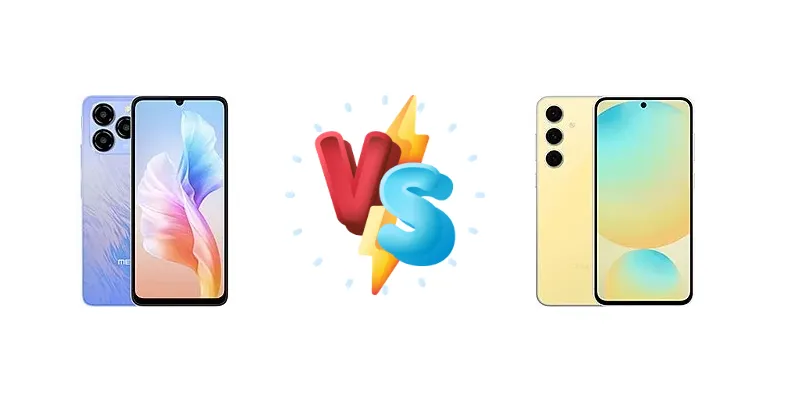
The Meizu Note 21 represents a compelling budget option, while the Samsung Galaxy S24 FE aims to deliver a flagship-adjacent experience at a more accessible price point. This comparison dissects the core differences between these two devices, focusing on where each excels and who will benefit most from their respective strengths.
🏆 Quick Verdict
For the average user prioritizing long-term performance, a vibrant display, and fast charging, the Samsung Galaxy S24 FE is the clear winner. Its Exynos 2400e chipset and 42-hour battery endurance significantly outperform the Meizu Note 21, justifying the price difference.
| Network |
|---|
| 2G bands | GSM 850 / 900 / 1800 / 1900 | GSM 850 / 900 / 1800 / 1900 |
| 3G bands | HSDPA 850 / 900 / 1900 / 2100 | HSDPA 850 / 900 / 1700(AWS) / 1900 / 2100 |
| 4G bands | LTE | 1, 2, 3, 4, 5, 7, 8, 12, 17, 18, 19, 20, 25, 26, 28, 32, 38, 40, 41, 66 - International |
| 5G bands | - | 1, 2, 3, 5, 7, 8, 12, 20, 25, 26, 28, 38, 40, 41, 66, 75, 77, 78 SA/NSA/Sub6 - International |
| Speed | HSPA, LTE | HSPA, LTE, 5G |
| Technology | GSM / HSPA / LTE | GSM / HSPA / LTE / 5G |
| Launch |
|---|
| Announced | 2024, September 13 | 2024, September 26 |
| Status | Available. Released 2024, October | Available. Released 2024, October 03 |
| Body |
|---|
| Build | - | Glass front (Gorilla Glass Victus+), glass back (Gorilla Glass Victus+), aluminum frame |
| Dimensions | - | 162 x 77.3 x 8 mm (6.38 x 3.04 x 0.31 in) |
| SIM | Nano-SIM + Nano-SIM | · Nano-SIM· Nano-SIM + Nano-SIM· Nano-SIM + eSIM· eSIM + eSIM |
| Weight | - | 213 g (7.51 oz) |
| Display |
|---|
| Protection | - | Corning Gorilla Glass Victus+, Mohs level 5 |
| Resolution | 720 x 1600 pixels*, 20:9 ratio (~260 ppi density) | 1080 x 2340 pixels, 19.5:9 ratio (~385 ppi density) |
| Size | 6.74 inches, 109.7 cm2 | 6.7 inches, 110.2 cm2 (~88.0% screen-to-body ratio) |
| Type | IPS LCD, 90Hz, 450 nits | Dynamic AMOLED 2X, 120Hz, HDR10+, 1900 nits (peak) |
| Platform |
|---|
| CPU | Octa-core (2x1.6 GHz Cortex-A75 & 6x1.6 GHz Cortex-A55) | 10-core (1x3.1 GHz + 2x2.9 GHz + 3x2.6 GHz + 4x1.95 GHz) |
| Chipset | Unisoc T606 (12 nm) | Exynos 2400e (4 nm) |
| GPU | Mali-G57 MP1 | Xclipse 940 |
| OS | Flyme OS | Android 14, up to 7 major Android upgrades, One UI 8.0 |
| Memory |
|---|
| Card slot | microSDXC | No |
| Internal | 256GB 8GB RAM | 128GB 8GB RAM, 256GB 8GB RAM, 512GB 8GB RAM |
| Main Camera |
|---|
| Dual | 50 MP, AF
2 MP | - |
| Features | LED flash, panorama, HDR | LED flash, HDR, panorama |
| Triple | - | 50 MP, f/1.8, 24mm (wide), 1/1.57", 1.0µm, dual pixel PDAF, OIS
8 MP, f/2.4, 75mm (telephoto), 1/4.4", 1.0µm, PDAF, OIS, 3x optical zoom
12 MP, f/2.2, 13mm, 123˚ (ultrawide), 1/3.0", 1.12µm |
| Video | Yes | 8K@30fps, 4K@30/60/120fps, 1080p@30/60/120/240fps |
| Selfie camera |
|---|
| Single | 8 MP | 10 MP, f/2.4, 26mm (wide), 1/3.0", 1.22µm |
| Video | Yes | 4K@30/60fps, 1080p@30/60fps; gyro-EIS |
| Sound |
|---|
| 35mm jack | Yes | No |
| Loudspeaker | Yes | Yes, with stereo speakers |
| Comms |
|---|
| Bluetooth | 5.3, A2DP | 5.3, A2DP, LE |
| NFC | No | Yes |
| Positioning | GPS | GPS, GLONASS, GALILEO, BDS |
| Radio | No | Unspecified |
| USB | USB Type-C | USB Type-C 3.2, OTG |
| WLAN | Wi-Fi 802.11 a/b/g/n/ac, dual-band | Wi-Fi 802.11 a/b/g/n/ac/6e, dual-band or tri-band (market/region dependent), Wi-Fi Direct |
| Features |
|---|
| Sensors | Fingerprint (side-mounted); unspecified sensors | Fingerprint (under display, optical), accelerometer, gyro, compass |
| Battery |
|---|
| Charging | 18W wired | 25W wired, PD, QC2, 50% in 30 min
15W wireless
Reverse wireless |
| Type | 6000 mAh | 4700 mAh |
| Misc |
|---|
| Colors | Ivory, Diamond Black, Gulf Blue | Blue, Graphite, Gray, Mint, Yellow |
| Models | - | SM-S721B, SM-S721B/DS, SM-S721U1, SM-S721U, SM-S721W, SM-S7210, SM-S721N |
| Price | - | $ 249.74 / C$ 498.99 / £ 335.00 / € 387.00 / ₹ 34,180 |
| SAR | - | 0.94 W/kg (head) 0.71 W/kg (body) |
| SAR EU | - | 0.86 W/kg (head) 1.29 W/kg (body) |
| EU LABEL |
|---|
| Battery | - | 42:00h endurance, 2000 cycles |
| Energy | - | Class B |
| Free fall | - | Class A (270 falls) |
| Repairability | - | Class C |
Meizu Note 21
- More affordable price point
- Potentially lighter and more compact design (speculation)
- Functional for basic smartphone tasks
- Significantly weaker performance
- Slower charging speed
- Inferior display quality (likely)
- Limited camera capabilities (likely)
Samsung Galaxy S24 FE
- Powerful Exynos 2400e processor
- Excellent battery life and fast charging
- Bright and vibrant display
- Versatile camera system
- Higher price tag
- Potential for thermal throttling under extreme load (though mitigated by 4nm process)
- Samsung’s One UI software may not appeal to all users
Display Comparison
The Samsung Galaxy S24 FE boasts a significantly brighter display, reaching a measured 1372 nits, making it far more usable in direct sunlight compared to the Meizu Note 21 (brightness data unavailable). While the Note 21’s panel technology isn’t specified, the S24 FE’s superior brightness and likely higher color accuracy provide a more immersive viewing experience. The S24 FE’s display is likely to have a higher refresh rate as well, contributing to smoother scrolling and animations, a feature absent from the specs of the Note 21.
Camera Comparison
Camera details for the Meizu Note 21 are limited, but the Samsung Galaxy S24 FE is expected to offer a more versatile and capable camera system. While sensor sizes and apertures aren’t provided for the Note 21, the S24 FE likely features optical image stabilization (OIS) and advanced image processing algorithms. The S24 FE’s camera is geared towards capturing detailed photos and videos in various lighting conditions, while the Note 21 is likely to deliver acceptable results in optimal scenarios. The absence of details regarding the Note 21’s camera suggests it’s not a primary selling point.
Performance
The performance gap between these devices is substantial. The Samsung Galaxy S24 FE’s Exynos 2400e, a 10-core processor built on a 4nm process, offers a massive advantage over the Meizu Note 21’s Unisoc T606 (12nm). The Exynos 2400e’s architecture – with its varying core clock speeds (3.1 GHz, 2.9 GHz, 2.6 GHz, 1.95 GHz) – is designed for demanding tasks and multitasking. The Unisoc T606, while adequate for basic use, will struggle with graphically intensive games and complex applications. The 4nm fabrication process of the Exynos also translates to better thermal efficiency, reducing the likelihood of performance throttling under sustained load.
Battery Life
The Samsung Galaxy S24 FE excels in battery performance, offering a remarkable 42-hour endurance and an active use score of 11 hours and 48 minutes. Its 25W wired charging, with support for PD and QC2, can replenish 50% of the battery in just 30 minutes. The addition of 15W wireless charging and reverse wireless charging adds further convenience. The Meizu Note 21’s 18W wired charging is significantly slower, and the lack of wireless charging options limits its versatility. While the Note 21’s battery capacity isn’t specified, the S24 FE’s superior endurance and charging capabilities provide a clear advantage.
Buying Guide
Buy the Meizu Note 21 if you need a functional, affordable smartphone for basic tasks like calling, texting, and light social media use, and are willing to compromise on performance and features. Buy the Samsung Galaxy S24 FE if you prioritize a smoother user experience, better camera capabilities, faster charging, and a display that’s easily visible outdoors, even if it means a higher upfront cost.
Frequently Asked Questions
❓ Does the Exynos 2400e in the S24 FE tend to overheat during prolonged gaming sessions?
While the Exynos 2400e is a powerful chip, the 4nm fabrication process and Samsung’s thermal management solutions are designed to mitigate overheating. However, extended gaming at maximum settings may still result in some thermal throttling, but it’s unlikely to be severe enough to render the phone unusable.
❓ Is the 18W charging on the Meizu Note 21 slow enough to be a major inconvenience?
Yes, 18W charging is considerably slower than the 25W charging on the S24 FE. Expect significantly longer charge times, especially from low battery levels. This is a key area where the S24 FE offers a more convenient user experience.
❓ How does the Unisoc T606 handle popular games like PUBG Mobile or Call of Duty Mobile?
The Unisoc T606 will likely be able to run PUBG Mobile and Call of Duty Mobile, but you’ll need to lower the graphics settings to medium or low to achieve a playable frame rate. Expect occasional stuttering and lag, especially during intense firefights. The S24 FE’s Exynos 2400e will provide a much smoother and more consistent gaming experience.
❓ What kind of software updates can I expect on the Meizu Note 21?
Meizu’s software update track record is less consistent than Samsung’s. While the Note 21 will likely receive some security updates, major Android version updates are less guaranteed compared to the S24 FE, which is expected to receive several years of software support.