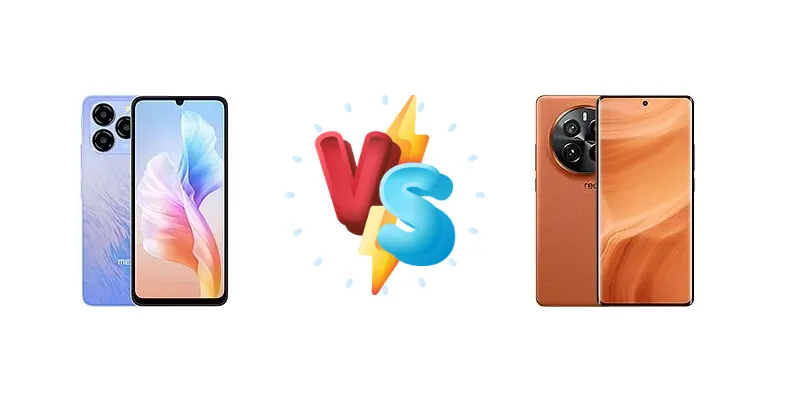
The smartphone landscape is increasingly segmented, with options ranging from ultra-premium flagships to aggressively priced budget devices. The Realme GT5 Pro aims to disrupt the upper-midrange with its Snapdragon 8 Gen 3 chipset, while the Meizu Note 21 focuses on delivering a solid experience at a significantly lower price point. This comparison dissects the key differences to help you determine which device best aligns with your priorities.
🏆 Quick Verdict
For users prioritizing raw performance, gaming, and fast charging, the Realme GT5 Pro is the clear winner. However, the Meizu Note 21 provides a surprisingly capable experience for everyday tasks and media consumption, making it an excellent choice for budget-conscious buyers.
| Network |
|---|
| 2G bands | GSM 850 / 900 / 1800 / 1900 | GSM 850 / 900 / 1800 / 1900 |
| 3G bands | HSDPA 850 / 900 / 1900 / 2100 | HSDPA 850 / 900 / 2100 |
| 4G bands | LTE | 1, 3, 5, 7, 8, 28, 34, 38, 39, 40, 41 |
| 5G bands | - | 1, 3, 5, 8, 28, 41, 77, 78 SA/NSA |
| Speed | HSPA, LTE | HSPA, LTE, 5G |
| Technology | GSM / HSPA / LTE | GSM / CDMA / HSPA / CDMA2000 / LTE / 5G |
| Launch |
|---|
| Announced | 2024, September 13 | 2023, December 07 |
| Status | Available. Released 2024, October | Available. Released 2023, December 14 |
| Body |
|---|
| Build | - | Glass front, glass back or silicone polymer back (eco leather), aluminum frame |
| Dimensions | - | 161.7 x 75.1 x 9.2 mm (6.37 x 2.96 x 0.36 in) |
| SIM | Nano-SIM + Nano-SIM | Nano-SIM + Nano-SIM |
| Weight | - | 218 g / 224 g (7.69 oz) |
| Display |
|---|
| Resolution | 720 x 1600 pixels*, 20:9 ratio (~260 ppi density) | 1264 x 2780 pixels (~450 ppi density) |
| Size | 6.74 inches, 109.7 cm2 | 6.78 inches, 111.7 cm2 (~92.0% screen-to-body ratio) |
| Type | IPS LCD, 90Hz, 450 nits | LTPO AMOLED, 1B colors, 144Hz, HDR10+, Dolby Vision, 4500 nits (peak) |
| Platform |
|---|
| CPU | Octa-core (2x1.6 GHz Cortex-A75 & 6x1.6 GHz Cortex-A55) | Octa-core (1x3.3 GHz Cortex-X4 & 3x3.2 GHz Cortex-A720 & 2x3.0 GHz Cortex-A720 & 2x2.3 GHz Cortex-A520) |
| Chipset | Unisoc T606 (12 nm) | Qualcomm SM8650-AB Snapdragon 8 Gen 3 (4 nm) |
| GPU | Mali-G57 MP1 | Adreno 750 |
| OS | Flyme OS | Android 14, upgradable to Android 15, Realme UI 6.0 |
| Memory |
|---|
| Card slot | microSDXC | No |
| Internal | 256GB 8GB RAM | 256GB 12GB RAM, 256GB 16GB RAM, 512GB 16GB RAM, 1TB 16GB RAM |
| Main Camera |
|---|
| Dual | 50 MP, AF
2 MP | - |
| Features | LED flash, panorama, HDR | Color spectrum sensor, Dual-LED dual-tone flash, HDR, panorama |
| Triple | - | 50 MP, f/1.7, 23mm (wide), 1/1.43", 1.12µm, dual pixel PDAF, OIS
50 MP, f/2.6, 65mm (periscope telephoto), 1/1.56", 1.0µm, multi-directional PDAF, OIS, 2.7x optical zoom
8 MP, f/2.2, 16mm, 112˚ (ultrawide), 1/4.0", 1.12µm |
| Video | Yes | 8K@24fps, 4K@30/60fps, 1080p@30/60fps, gyro-EIS, Dolby Vision |
| Selfie camera |
|---|
| Features | - | HDR, panorama |
| Single | 8 MP | 32 MP, f/2.5, 22mm (wide), 1/2.74" |
| Video | Yes | 4K@30fps, 1080p@30fps, gyro-EIS |
| Sound |
|---|
| 35mm jack | Yes | No |
| Loudspeaker | Yes | Yes, with stereo speakers (Dolby Atmos certified) |
| Comms |
|---|
| Bluetooth | 5.3, A2DP | 5.4, A2DP, LE, aptX HD |
| Infrared port | - | Yes |
| NFC | No | Yes, 360˚ |
| Positioning | GPS | GPS (L1+L5), GLONASS, BDS (B1I+B1c+B2a), GALILEO (E1+E5a), QZSS (L1+L5), NavIC |
| Radio | No | No |
| USB | USB Type-C | USB Type-C 3.2 |
| WLAN | Wi-Fi 802.11 a/b/g/n/ac, dual-band | Wi-Fi 802.11 a/b/g/n/ac/6/7, tri-band, Wi-Fi Direct |
| Features |
|---|
| Sensors | Fingerprint (side-mounted); unspecified sensors | Fingerprint (under display, optical), accelerometer, gyro, proximity, compass |
| Battery |
|---|
| Charging | 18W wired | 100W wired, 50% in 12 min
50W wireless |
| Type | 6000 mAh | Li-Ion 5400 mAh |
| Misc |
|---|
| Colors | Ivory, Diamond Black, Gulf Blue | Black, Silver, Orange |
| Models | - | RMX3888 |
| Price | - | About 430 EUR |
Meizu Note 21
- Excellent value for money
- Efficient processor for everyday tasks
- Simple and user-friendly experience
- Limited gaming performance
- Slow charging speed
- Lower display brightness
Realme GT5 Pro
- Flagship-level performance with Snapdragon 8 Gen 3
- Ultra-fast 100W wired and 50W wireless charging
- Bright and vibrant display
- Higher price point
- Potential for thermal throttling under extreme load
- More complex software experience
Display Comparison
The Realme GT5 Pro boasts a significantly brighter display, reaching a measured peak of 1660 nits, ensuring excellent visibility even in direct sunlight. While the Meizu Note 21’s display specifications are not provided, it’s reasonable to assume a lower peak brightness given its price point. The GT5 Pro’s higher brightness is particularly beneficial for HDR content and outdoor use. The absence of LTPO technology in either device suggests both will rely on adaptive refresh rate scaling rather than variable refresh rates for power efficiency.
Camera Comparison
The Realme GT5 Pro is equipped with a photo/video focused camera system, though specific sensor details are missing. The emphasis on photo and video suggests a more sophisticated image processing pipeline and potentially larger sensor sizes. The Meizu Note 21’s camera specifications are not detailed, but given its price bracket, it likely features a more basic camera setup geared towards casual photography. The absence of information regarding OIS on the Meizu Note 21 suggests a reliance on software stabilization, which is less effective in low-light conditions.
Performance
The performance gap between these two devices is substantial. The Realme GT5 Pro’s Qualcomm Snapdragon 8 Gen 3 (4nm) is a flagship-level chipset featuring a Cortex-X4 prime core clocked at 3.3 GHz, designed for demanding applications. In contrast, the Meizu Note 21 utilizes the Unisoc T606 (12nm), an octa-core processor with a more modest configuration (2x1.6 GHz Cortex-A75 & 6x1.6 GHz Cortex-A55). This translates to a vastly superior experience on the GT5 Pro for gaming, video editing, and multitasking. The 4nm process node of the Snapdragon 8 Gen 3 also contributes to better thermal efficiency, minimizing throttling during sustained workloads.
Battery Life
The Realme GT5 Pro offers a compelling charging solution with 100W wired charging, capable of reaching 50% charge in just 12 minutes, and 50W wireless charging. While the Meizu Note 21 supports 18W wired charging, it’s considerably slower. The GT5 Pro’s active use score of 14:16h indicates excellent battery life, likely due to the efficient Snapdragon 8 Gen 3 chipset and optimized software. The Meizu Note 21’s battery capacity is not specified, but its less powerful chipset may compensate for a smaller battery in some scenarios.
Buying Guide
Buy the Meizu Note 21 if you need a reliable daily driver for basic tasks, social media, and light media consumption, and value affordability above all else. You'll appreciate its simplicity and efficiency. Buy the Realme GT5 Pro if you demand top-tier performance for gaming, content creation, and multitasking, and are willing to pay a premium for features like 100W charging and a brighter display.
Frequently Asked Questions
❓ Is the Unisoc T606 in the Meizu Note 21 capable of handling demanding games like Genshin Impact?
While the Unisoc T606 can run less graphically intensive games, Genshin Impact and similar titles will likely require significant graphical settings reductions and may still experience noticeable frame rate drops. It's best suited for casual gaming and less demanding titles.
❓ How does the 100W charging on the Realme GT5 Pro compare to standard fast charging?
100W charging is significantly faster than typical fast charging solutions. The GT5 Pro can reach 50% charge in just 12 minutes, whereas standard fast charging often takes over an hour to fully charge a similar-sized battery. This is a major convenience factor for users who frequently need to top up their phone quickly.
❓ Does the Realme GT5 Pro get excessively hot during prolonged gaming sessions?
While the Snapdragon 8 Gen 3 is thermally efficient, it can still generate heat under sustained load. The GT5 Pro likely incorporates cooling solutions to mitigate this, but some throttling may occur during extended gaming sessions to prevent overheating. The extent of throttling will depend on the game and ambient temperature.
❓ What type of storage does the Meizu Note 21 use, and is it expandable?
The storage type for the Meizu Note 21 is not specified. However, given its price point, it likely utilizes eMMC storage, which is slower than UFS storage found in higher-end devices. Expandability via microSD card is also unknown, but less common in this price range.