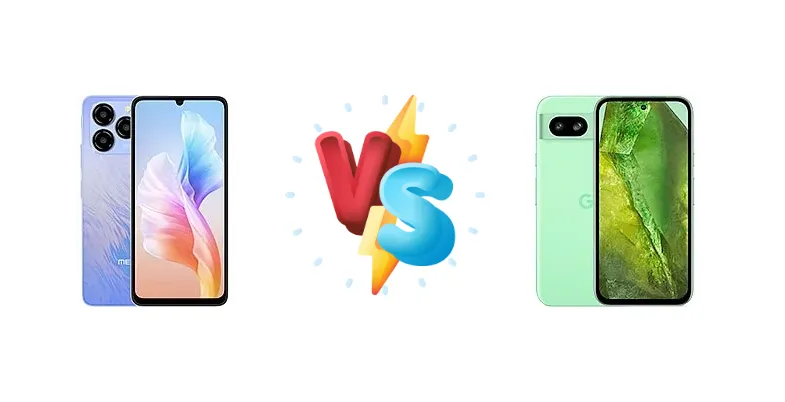
The Google Pixel 8a enters a competitive mid-range market, promising Google’s renowned camera and AI features. However, the Meizu Note 21 offers a compelling alternative, focusing on affordability and a streamlined experience. This comparison dissects the key differences between these two devices, helping you determine which best suits your priorities.
🏆 Quick Verdict
For most users, the Google Pixel 8a is the superior choice. Its Google Tensor G3 chipset delivers significantly faster performance and superior image processing, while the impressive 40:06h battery endurance ensures all-day usability. The Meizu Note 21 is a viable option for those on a very tight budget, but compromises are made in processing power and camera quality.
| Network |
|---|
| 2G bands | GSM 850 / 900 / 1800 / 1900 | GSM 850 / 900 / 1800 / 1900 |
| 3G bands | HSDPA 850 / 900 / 1900 / 2100 | HSDPA 800 / 850 / 900 / 1700(AWS) / 1900 / 2100 |
| 4G bands | LTE | 1, 2, 3, 4, 5, 7, 8, 12, 17, 18, 19, 20, 26, 28, 32, 38, 40, 41, 42, 66 - G6GPR (International) |
| 5G bands | - | 1, 2, 3, 5, 7, 8, 12, 20, 26, 28, 38, 40, 41, 66, 75, 76, 77, 78 SA/NSA/Sub6 - G6GPR (International) |
| Speed | HSPA, LTE | HSPA, LTE, 5G |
| Technology | GSM / HSPA / LTE | GSM / HSPA / LTE / 5G |
| Launch |
|---|
| Announced | 2024, September 13 | 2024, May 07 |
| Status | Available. Released 2024, October | Available. Released 2024, May 14 |
| Body |
|---|
| Build | - | Glass front (Gorilla Glass 3), aluminum frame, plastic back |
| Dimensions | - | 152.1 x 72.7 x 8.9 mm (5.99 x 2.86 x 0.35 in) |
| SIM | Nano-SIM + Nano-SIM | Nano-SIM + eSIM |
| Weight | - | 188 g (6.63 oz) |
| Display |
|---|
| Protection | - | Corning Gorilla Glass 3, Mohs level 5 |
| Resolution | 720 x 1600 pixels*, 20:9 ratio (~260 ppi density) | 1080 x 2400 pixels, 20:9 ratio (~430 ppi density) |
| Size | 6.74 inches, 109.7 cm2 | 6.1 inches, 90.3 cm2 (~81.6% screen-to-body ratio) |
| Type | IPS LCD, 90Hz, 450 nits | OLED, HDR, 120Hz, 2000 nits (peak) |
| Platform |
|---|
| CPU | Octa-core (2x1.6 GHz Cortex-A75 & 6x1.6 GHz Cortex-A55) | Nona-core (1x3.0 GHz Cortex-X3 & 4x2.45 GHz Cortex-A715 & 4x2.15 GHz Cortex-A510) |
| Chipset | Unisoc T606 (12 nm) | Google Tensor G3 (4 nm) |
| GPU | Mali-G57 MP1 | Immortalis-G715s MC10 |
| OS | Flyme OS | Android 14, upgradable to Android 16, up to 7 major Android upgrades |
| Memory |
|---|
| Card slot | microSDXC | No |
| Internal | 256GB 8GB RAM | 128GB 8GB RAM, 256GB 8GB RAM |
| Main Camera |
|---|
| Dual | 50 MP, AF
2 MP | 64 MP (16 MP eff.), f/1.9, 26mm (wide), 1/1.73", 0.8µm, dual pixel PDAF, OIS
13 MP, f/2.2, 120˚ (ultrawide), 1.12µm |
| Features | LED flash, panorama, HDR | Dual-LED flash, Pixel Shift, Ultra HDR, panorama, Best Take |
| Video | Yes | 4K@30/60fps, 1080p@30/60/120/240fps, OIS |
| Selfie camera |
|---|
| Features | - | HDR, panorama |
| Single | 8 MP | 13 MP, f/2.2, 20mm (ultrawide), 1.12µm |
| Video | Yes | 4K@30fps, 1080p@30/60fps |
| Sound |
|---|
| 35mm jack | Yes | No |
| Loudspeaker | Yes | Yes, with stereo speakers |
| Comms |
|---|
| Bluetooth | 5.3, A2DP | 5.3, A2DP, LE |
| NFC | No | Yes |
| Positioning | GPS | GPS, GLONASS, GALILEO, BDS, QZSS, NavIC |
| Radio | No | No |
| USB | USB Type-C | USB Type-C 3.2 |
| WLAN | Wi-Fi 802.11 a/b/g/n/ac, dual-band | Wi-Fi 802.11 a/b/g/n/ac/6e, dual/tri-band (market/region dependent) |
| Features |
|---|
| Sensors | Fingerprint (side-mounted); unspecified sensors | Fingerprint (under display, optical), accelerometer, gyro, proximity, compass, barometer |
| Battery |
|---|
| Charging | 18W wired | 18W wired, PD3.0
7.5W wireless
Bypass charging |
| Type | 6000 mAh | Li-Po 4492 mAh |
| Misc |
|---|
| Colors | Ivory, Diamond Black, Gulf Blue | Obsidian, Porcelain, Bay, Aloe |
| Models | - | GKV4X, G6GPR, G8HHN, G576D |
| Price | - | $ 229.98 / C$ 417.99 / £ 279.00 / € 299.99 / ₹ 33,300 |
| EU LABEL |
|---|
| Battery | - | 40:06h endurance, 1000 cycles |
| Energy | - | Class B |
| Free fall | - | Class A (270 falls) |
| Repairability | - | Class B |
Meizu Note 21
- Significantly faster processor with the Google Tensor G3
- Superior camera performance with Google’s computational photography
- Excellent battery life and wireless charging support
- Higher price point compared to the Meizu Note 21
- May not be as readily available in all markets
Google Pixel 8a
- More affordable price point
- Simple and streamlined Android experience
- Potentially lighter and more compact design (speculation based on brand history)
- Significantly slower processor and limited performance
- Inferior camera quality compared to the Pixel 8a
- Limited software support and updates
Display Comparison
The Pixel 8a boasts a significantly brighter display, reaching a measured peak of 1508 nits, making it far more usable in direct sunlight compared to the Meizu Note 21 (brightness data unavailable). While both likely utilize OLED panels, the Pixel 8a’s higher brightness and potentially superior color calibration (based on Pixel lineage) offer a more vibrant and accurate viewing experience. The absence of LTPO technology on either device suggests standard 60Hz or 90Hz refresh rates, but the Pixel 8a’s panel is demonstrably superior in terms of visibility.
Camera Comparison
While specific camera specs for the Meizu Note 21 are unavailable, the Pixel 8a’s strength lies in Google’s computational photography prowess. The Tensor G3’s image signal processor (ISP) excels at noise reduction, dynamic range optimization, and detail enhancement. The Pixel 8a’s camera system benefits from features like Magic Eraser and Photo Unblur, unavailable on the Meizu Note 21. Without detailed information on the Meizu Note 21’s sensor size and aperture, it’s safe to assume the Pixel 8a will deliver superior image quality, particularly in low-light conditions.
Performance
The performance gap between these phones is substantial. The Google Pixel 8a’s Google Tensor G3, built on a 4nm process, features a nona-core CPU configuration with a high-performance Cortex-X3 core clocked at 3.0 GHz. This contrasts sharply with the Meizu Note 21’s Unisoc T606 (12nm), an octa-core chip with older Cortex-A75 cores clocked at 1.6 GHz. The Tensor G3’s advanced architecture and smaller node size translate to significantly faster processing speeds, improved efficiency, and better handling of demanding tasks like video editing and gaming. The Pixel 8a will offer a smoother, more responsive user experience.
Battery Life
The Google Pixel 8a demonstrates impressive battery endurance, achieving 40:06h of overall usage and 11:25h of active use. While both phones offer 18W wired charging, the Pixel 8a also supports 7.5W wireless charging and bypass charging, allowing you to use the phone while it’s charging. The Pixel 8a’s battery is rated for 1000 cycles, suggesting long-term reliability. The Meizu Note 21’s battery capacity and cycle life are unknown, but the Pixel 8a’s superior endurance and charging versatility provide a clear advantage.
Buying Guide
Buy the Meizu Note 21 if you prioritize extreme affordability and a simple, uncluttered Android experience, and your usage primarily involves basic tasks like calling, texting, and light social media. Buy the Google Pixel 8a if you value a powerful processor for demanding apps and games, a class-leading camera with Google’s computational photography, and long-term software support with guaranteed updates.
Frequently Asked Questions
❓ Does the Unisoc T606 in the Meizu Note 21 struggle with multitasking or demanding apps?
Yes, the Unisoc T606 is a budget-focused chipset. While adequate for basic tasks, it will likely exhibit slowdowns and lag when running multiple apps simultaneously or playing graphically intensive games. The Pixel 8a’s Tensor G3 offers a far smoother and more responsive experience in these scenarios.
❓ How does the Pixel 8a's software update policy compare to the Meizu Note 21?
Google guarantees several years of software and security updates for the Pixel 8a, ensuring your device remains secure and receives the latest features. Meizu’s update track record is less consistent, and the Note 21 is likely to receive fewer updates, potentially leaving it vulnerable to security threats over time.
❓ Is the 18W charging on both phones equally fast in real-world use?
While both phones support 18W charging, the Pixel 8a’s PD3.0 support and bypass charging offer advantages. PD3.0 allows for more efficient power delivery, and bypass charging lets you use the phone while it’s charging, which the Meizu Note 21 likely doesn't support.