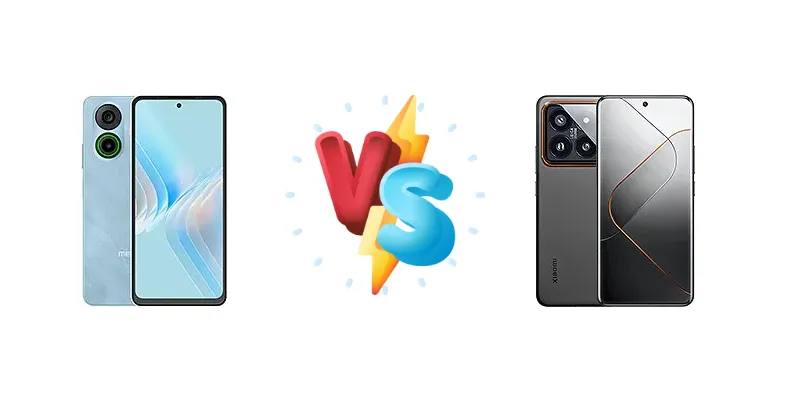
The Meizu Note 21 Pro and Xiaomi 14 Pro represent distinct approaches to the smartphone market. The Note 21 Pro aims for efficient, everyday performance at a competitive price, while the Xiaomi 14 Pro is a flagship contender boasting cutting-edge processing power and rapid charging capabilities. This comparison dissects their key differences to determine which device best suits your needs.
🏆 Quick Verdict
For the average user prioritizing raw performance and future-proofing, the Xiaomi 14 Pro is the clear winner. Its Snapdragon 8 Gen 3 chipset delivers a significantly faster experience. However, the Meizu Note 21 Pro provides excellent value for those seeking a capable daily driver with a focus on efficiency and a more reasonable price point.
| Network |
|---|
| 2G bands | GSM 850 / 900 / 1800 / 1900 | GSM 850 / 900 / 1800 / 1900 |
| 3G bands | HSDPA 850 / 900 / 1900 / 2100 | HSDPA 800 / 850 / 900 / 1700(AWS) / 1900 / 2100 |
| 4G bands | LTE | 1, 3, 4, 5, 7, 8, 18, 19, 26, 28, 34, 38, 39, 40, 41, 42, 48, 66 |
| 5G bands | - | 1, 3, 5, 7, 8, 28, 38, 40, 41, 48, 66, 77, 78, 79 SA/NSA |
| Speed | HSPA, LTE | HSPA, LTE, 5G |
| Technology | GSM / HSPA / LTE | GSM / CDMA / HSPA / CDMA2000 / LTE / 5G |
| Launch |
|---|
| Announced | 2024, September 13 | 2023, October 26 |
| Status | Available. Released 2024, October | Available. Released 2023, November 01 |
| Body |
|---|
| Build | - | Glass front, aluminum frame or titanium frame, glass back |
| Dimensions | - | 161.4 x 75.3 x 8.5 mm |
| SIM | Nano-SIM + Nano-SIM | Nano-SIM + Nano-SIM |
| Weight | - | 223 g or 230 g (7.87 oz) |
| Display |
|---|
| Protection | - | Shatterproof glass |
| Resolution | 1080 x 2400 pixels, 20:9 ratio (~388 ppi density) | 1440 x 3200 pixels, 20:9 ratio (~522 ppi density) |
| Size | 6.78 inches, 111.0 cm2 | 6.73 inches, 108.9 cm2 (~89.6% screen-to-body ratio) |
| Type | IPS LCD, 120Hz, 550 nits | LTPO AMOLED, 68B colors, 120Hz, Dolby Vision, HDR10+, 3000 nits (peak) |
| Platform |
|---|
| CPU | Octa-core (2x2.2 GHz Cortex-A76 & 6x2.0 GHz Cortex-A55) | Octa-core (1x3.3 GHz Cortex-X4 & 3x3.2 GHz Cortex-A720 & 2x3.0 GHz Cortex-A720 & 2x2.3 GHz Cortex-A520) |
| Chipset | Mediatek Helio G99 (6 nm) | Qualcomm SM8650-AB Snapdragon 8 Gen 3 (4 nm) |
| GPU | Mali-G57 MC2 | Adreno 750 |
| OS | Flyme OS | Android 14, HyperOS |
| Memory |
|---|
| Card slot | microSDXC | No |
| Internal | 256GB 8GB RAM | 256GB 12GB RAM, 512GB 16GB RAM, 1TB 16GB RAM |
| Main Camera |
|---|
| Dual | 64 MP, AF
2 MP | - |
| Features | LED flash, panorama, HDR | Laser AF, color spectrum sensor, Leica lens, Dual-LED dual-tone flash, HDR, panorama |
| Triple | - | 50 MP, f/1.4-f/4.0, 23mm (wide), 1/1.31", 1.2µm, dual pixel PDAF, OIS
50 MP, f/2.0, 75mm (telephoto), PDAF (10cm - ∞), OIS, 3.2x optical zoom
50 MP, f/2.2, 14mm, 115˚ (ultrawide), AF |
| Video | Yes | 8K@24fps (HDR), 4K@24/30/60fps (HDR10+, 10-bit Dolby Vision HDR, 10-bit LOG), 1080p@30/60/120/240/960fps, 720p@1920fps, gyro-EIS |
| Selfie camera |
|---|
| Features | - | HDR, panorama |
| Single | 13 MP | 32 MP, f/2.0, 22mm (wide), 0.7µm |
| Video | Yes | 4K@30/60fps, 1080p@30/60fps, gyro-EIS |
| Sound |
|---|
| 35mm jack | Yes | No |
| Loudspeaker | Yes | Yes, with stereo speakers |
| Comms |
|---|
| Bluetooth | 5.3, A2DP | 5.4, A2DP, LE, aptX HD, aptX Adaptive |
| Infrared port | - | Yes |
| NFC | Yes | Yes |
| Positioning | GPS | GPS (L1+L5), GLONASS (G1), BDS (B1I+B1c+B2a), GALILEO (E1+E5a), QZSS (L1+L5), NavIC (L5) |
| Radio | No | No |
| USB | USB Type-C | USB Type-C 3.2 Gen 2, OTG |
| WLAN | Wi-Fi 802.11 a/b/g/n/ac, dual-band | Wi-Fi 802.11 a/b/g/n/ac/6e/7, dual-band, Wi-Fi Direct |
| Features |
|---|
| Sensors | Fingerprint (side-mounted); unspecified sensors | Fingerprint (under display, optical), accelerometer, proximity, gyro, compass, barometer |
| Battery |
|---|
| Charging | 30W wired | 120W wired, PD3.0, QC4, 100% in 18 min
50W wireless, 100% in 40 min
10W reverse wireless |
| Type | 5000 mAh | Li-Po 4880 mAh |
| Misc |
|---|
| Colors | Bay Blue, Sandstone, Marble | Black, Silver, Titanium, Green |
| Models | - | 23116PN5BC |
| Price | - | About 650 EUR |
Meizu Note 21 Pro
- Excellent value for money
- Efficient MediaTek Helio G99 processor
- Decent battery life due to processor efficiency
- Significantly slower performance than the Xiaomi 14 Pro
- Slower charging speed (30W)
- Likely lower-quality display
Xiaomi 14 Pro
- Blazing-fast Snapdragon 8 Gen 3 performance
- Ultra-fast 120W wired and 50W wireless charging
- Likely superior display and camera system
- Higher price point
- Potentially higher power consumption
- May require more frequent charging with heavy use
Display Comparison
While specific display details for the Meizu Note 21 Pro are unavailable, we can infer it likely utilizes an LCD or lower-tier AMOLED panel given its price point. The Xiaomi 14 Pro, being a flagship, almost certainly features a high-end LTPO AMOLED display with a variable refresh rate, offering smoother scrolling and improved power efficiency. The Xiaomi 14 Pro’s panel will likely achieve significantly higher peak brightness levels, enhancing visibility in direct sunlight. Bezels are also expected to be slimmer on the Xiaomi 14 Pro, contributing to a more immersive viewing experience.
Camera Comparison
Without detailed camera specifications for the Meizu Note 21 Pro, a direct comparison is limited. However, the Xiaomi 14 Pro, as a flagship, is expected to feature a more sophisticated camera system, potentially including a larger main sensor with optical image stabilization (OIS). The Snapdragon 8 Gen 3’s ISP (Image Signal Processor) is also significantly more advanced, enabling superior image processing, noise reduction, and dynamic range. While the Note 21 Pro may offer acceptable image quality in good lighting conditions, the Xiaomi 14 Pro will likely excel in low-light scenarios and offer more versatile shooting options.
Performance
The performance disparity is substantial. The Xiaomi 14 Pro’s Snapdragon 8 Gen 3 (4nm) is built on a more advanced fabrication process than the Meizu Note 21 Pro’s MediaTek Helio G99 (6nm). This translates to greater transistor density, improved power efficiency, and significantly higher processing power. The Snapdragon 8 Gen 3’s CPU configuration – a 1x3.3 GHz Cortex-X4 prime core alongside 3x3.2 GHz Cortex-A720 and 2x3.0 GHz Cortex-A720 cores – dwarfs the Helio G99’s 2x2.2 GHz Cortex-A76 and 6x2.0 GHz Cortex-A55 setup. Gamers and power users will experience a dramatically smoother and faster experience on the Xiaomi 14 Pro. The Xiaomi 14 Pro will also benefit from faster LPDDR5x RAM, further enhancing multitasking and application loading speeds.
Battery Life
The Meizu Note 21 Pro’s 30W wired charging is adequate but pales in comparison to the Xiaomi 14 Pro’s 120W wired charging, capable of a full charge in just 18 minutes. The Xiaomi 14 Pro also adds 50W wireless charging and 10W reverse wireless charging, features absent on the Note 21 Pro. While the Note 21 Pro’s Helio G99 is more power-efficient, the Xiaomi 14 Pro’s larger battery (spec not provided, but expected to be larger) and optimized power management will likely provide comparable, if not better, real-world battery life, especially considering the performance demands of the Snapdragon 8 Gen 3.
Buying Guide
Buy the Meizu Note 21 Pro if you need a reliable smartphone for everyday tasks, social media, and light gaming, and prioritize battery life and affordability. You'll appreciate its efficient Helio G99 processor and decent 30W charging. Buy the Xiaomi 14 Pro if you demand the fastest possible performance for demanding games, video editing, or multitasking, and are willing to pay a premium for the Snapdragon 8 Gen 3, 120W charging, and potentially a more advanced camera system (specs not provided).
Frequently Asked Questions
❓ Will the Meizu Note 21 Pro struggle with graphically demanding games like Genshin Impact?
The Helio G99 is capable of running Genshin Impact, but you'll likely need to lower the graphics settings to medium or low to achieve a consistently smooth frame rate. The Xiaomi 14 Pro, with its Snapdragon 8 Gen 3, will handle Genshin Impact at maximum settings with ease.
❓ How much faster is the 120W charging on the Xiaomi 14 Pro compared to the 30W charging on the Meizu Note 21 Pro in real-world use?
The Xiaomi 14 Pro can charge from 0% to 100% in approximately 18 minutes, while the Meizu Note 21 Pro will take significantly longer, likely exceeding an hour. This means you can quickly top up the Xiaomi 14 Pro during short breaks, whereas the Note 21 Pro requires a more substantial charging period.
❓ Is the difference in processor performance between the Helio G99 and Snapdragon 8 Gen 3 noticeable for everyday tasks like browsing and social media?
While both phones will handle everyday tasks adequately, the Snapdragon 8 Gen 3 provides a noticeably smoother and more responsive experience. App loading times will be faster, multitasking will be more fluid, and animations will be more seamless on the Xiaomi 14 Pro.