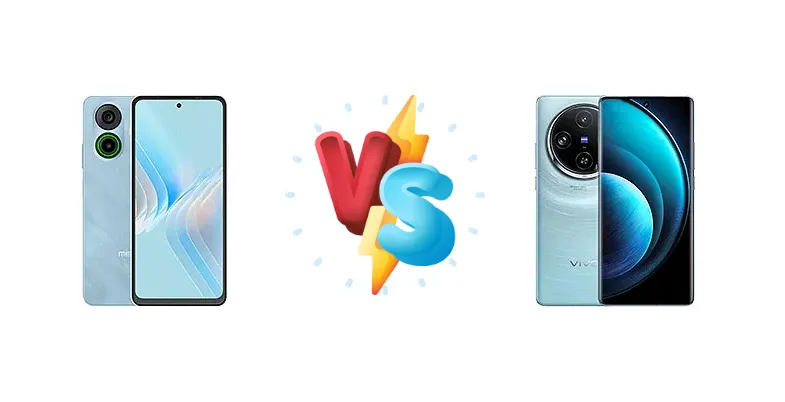
The Meizu Note 21 Pro aims to deliver a solid smartphone experience at a competitive price point, while the vivo X100 Pro represents a leap into flagship territory with cutting-edge components. This comparison dissects the core differences between these two devices, focusing on performance, camera capabilities, and charging speeds to determine which phone best suits your needs.
🏆 Quick Verdict
For the average user prioritizing performance and camera quality, the vivo X100 Pro is the clear winner. Its Dimensity 9300 chipset and 100W charging significantly outperform the Meizu Note 21 Pro’s Helio G99. However, the Note 21 Pro remains a strong contender for budget-conscious buyers.
| Network |
|---|
| 2G bands | GSM 850 / 900 / 1800 / 1900 | GSM 850 / 900 / 1800 / 1900 |
| 3G bands | HSDPA 850 / 900 / 1900 / 2100 | HSDPA 800 / 850 / 900 / 1700(AWS) / 1900 / 2100 |
| 4G bands | LTE | 1, 2, 3, 4, 5, 7, 8, 12, 17, 18, 19, 20, 26, 28, 32, 38, 39, 40, 41, 42, 66 - International |
| 5G bands | - | 1, 3, 5, 7, 8, 20, 28, 38, 40, 41, 66, 75, 77, 78, 79 SA/NSA - International |
| Speed | HSPA, LTE | HSPA, LTE, 5G |
| Technology | GSM / HSPA / LTE | GSM / CDMA / HSPA / LTE / 5G |
| Launch |
|---|
| Announced | 2024, September 13 | 2023, November 13 |
| Status | Available. Released 2024, October | Available. Released 2023, November 21 |
| Body |
|---|
| Build | - | Glass front, aluminum frame, glass back |
| Dimensions | - | 164.1 x 75.3 x 8.9 mm or 9.1 mm |
| SIM | Nano-SIM + Nano-SIM | · Nano-SIM + eSIM· Nano-SIM + Nano-SIM |
| Weight | - | 221 g or 225 g (7.80 oz) |
| Display |
|---|
| Resolution | 1080 x 2400 pixels, 20:9 ratio (~388 ppi density) | 1260 x 2800 pixels, 20:9 ratio (~452 ppi density) |
| Size | 6.78 inches, 111.0 cm2 | 6.78 inches, 111.5 cm2 (~90.2% screen-to-body ratio) |
| Type | IPS LCD, 120Hz, 550 nits | LTPO AMOLED, 1B colors, 120Hz, HDR10+, 3000 nits (peak) |
| Platform |
|---|
| CPU | Octa-core (2x2.2 GHz Cortex-A76 & 6x2.0 GHz Cortex-A55) | Octa-core (1x3.25 GHz Cortex-X4 & 3x2.85 GHz Cortex-X4 & 4x2.0 GHz Cortex-A720) |
| Chipset | Mediatek Helio G99 (6 nm) | Mediatek Dimensity 9300 (4 nm) |
| GPU | Mali-G57 MC2 | Immortalis-G720 MC12 |
| OS | Flyme OS | Android 14, upgradable to Android 15, Funtouch 15 (International), OriginOS 4 (China) |
| Memory |
|---|
| Card slot | microSDXC | No |
| Internal | 256GB 8GB RAM | 256GB 12GB RAM, 256GB 16GB RAM, 512GB 16GB RAM, 1TB 16GB RAM |
| Main Camera |
|---|
| Dual | 64 MP, AF
2 MP | - |
| Features | LED flash, panorama, HDR | Laser AF, color spectrum sensor, Zeiss optics, Zeiss T* lens coating, LED flash, panorama, HDR, 3D LUT import |
| Triple | - | 50 MP, f/1.8, 23mm (wide), 1/0.98", 1.6µm, dual pixel PDAF, OIS
50 MP, f/2.5, 100mm (periscope telephoto), 1/2.51", 0.7µm, PDAF (18cm - ∞), OIS, 4.3x optical zoom
50 MP, f/2.0, 15mm, 119˚ (ultrawide), 1/2.76", 0.64µm, AF |
| Video | Yes | 8K@30fps, 4K@30/60fps, 1080p, gyro-EIS |
| Selfie camera |
|---|
| Features | - | HDR |
| Single | 13 MP | 32 MP, f/2.0, 20mm (ultrawide) |
| Video | Yes | 4K@30/60fps, 1080p@30/60fps |
| Sound |
|---|
| 35mm jack | Yes | No |
| Loudspeaker | Yes | Yes, with stereo speakers |
| Comms |
|---|
| Bluetooth | 5.3, A2DP | 5.4, A2DP, LE, aptX HD, LHDC |
| Infrared port | - | Yes |
| NFC | Yes | Yes |
| Positioning | GPS | GPS (L1+L5), GLONASS (L1), BDS (B1I+B1c+B2a+B2b), GALILEO (E1+E5a+E5b), QZSS (L1+L5), NavIC (L5) |
| Radio | No | No |
| USB | USB Type-C | USB Type-C 3.2, OTG |
| WLAN | Wi-Fi 802.11 a/b/g/n/ac, dual-band | Wi-Fi 802.11 a/b/g/n/ac/6/7, tri-band, Wi-Fi Direct |
| Features |
|---|
| Sensors | Fingerprint (side-mounted); unspecified sensors | Fingerprint (under display, optical), accelerometer, gyro, proximity, compass |
| Battery |
|---|
| Charging | 30W wired | 100W wired, 50% in 14 min
50W wireless
Reverse wired |
| Type | 5000 mAh | Li-Ion 5400 mAh |
| Misc |
|---|
| Colors | Bay Blue, Sandstone, Marble | Startrail Blue, Asteroid Black, Sunset Orange, White |
| Models | - | V2324A, V2309 |
| Price | - | ₹ 59,999 |
| SAR EU | - | 0.99 W/kg (head) 1.19 W/kg (body) |
Meizu Note 21 Pro
- Affordable price point
- Decent performance for everyday tasks
- Reliable brand reputation
- Outdated chipset
- Slow charging speed
- Likely inferior camera performance
vivo X100 Pro
- Flagship-level performance
- Ultra-fast 100W wired and 50W wireless charging
- Excellent display brightness and quality
- Advanced camera system
- Higher price tag
- Potential for software bloat (typical of vivo)
- Larger size and weight
Display Comparison
The vivo X100 Pro boasts a significantly brighter display, reaching a measured peak of 1472 nits, ensuring excellent visibility even in direct sunlight. While the Meizu Note 21 Pro’s display specifications are not provided, it’s likely to be considerably dimmer. The X100 Pro’s panel likely incorporates LTPO technology, enabling variable refresh rates for improved power efficiency, a feature absent in the Note 21 Pro’s likely standard LCD or lower-tier AMOLED panel. This difference impacts both viewing experience and battery consumption.
Camera Comparison
The vivo X100 Pro is equipped with a sophisticated camera system, though specific sensor details are not provided, it is expected to feature a high-resolution main sensor with Optical Image Stabilization (OIS) and advanced image processing algorithms. The Meizu Note 21 Pro’s camera specifications are not detailed, suggesting a more basic setup. The X100 Pro’s camera system is geared towards both high-quality photography and videography, offering features like advanced night mode and cinematic video recording. The Note 21 Pro will likely suffice for casual snapshots, but will fall short in challenging lighting conditions or when demanding advanced features.
Performance
The performance gap between these devices is substantial. The vivo X100 Pro’s Mediatek Dimensity 9300, fabricated on a 4nm process, features a powerful CPU configuration with a 1x3.25 GHz Cortex-X4 prime core, three 2.85 GHz Cortex-X4 cores, and four 2.0 GHz Cortex-A720 efficiency cores. This contrasts sharply with the Meizu Note 21 Pro’s Mediatek Helio G99 (6nm), utilizing older Cortex-A76 and A55 cores. The Dimensity 9300’s architecture delivers significantly higher single-core and multi-core performance, translating to smoother multitasking, faster app loading times, and superior gaming capabilities. The 4nm process also contributes to better thermal management, reducing throttling during sustained workloads.
Battery Life
The vivo X100 Pro excels in charging speed, supporting 100W wired charging, capable of reaching 50% charge in just 14 minutes, and 50W wireless charging. The Meizu Note 21 Pro is limited to 30W wired charging, resulting in a considerably slower charging experience. While the X100 Pro’s battery capacity isn’t specified, its active use score of 13:53h indicates excellent battery life, likely optimized by the efficient Dimensity 9300 chipset. The Note 21 Pro’s battery life will depend on its capacity, but the slower charging speed will be a significant drawback for users who frequently need to top up their device.
Buying Guide
Buy the Meizu Note 21 Pro if you need a reliable daily driver with decent performance for basic tasks and prioritize affordability above all else. You'll appreciate its simplicity and reasonable price. Buy the vivo X100 Pro if you demand flagship-level performance for gaming and demanding applications, require a versatile camera system, and value the convenience of incredibly fast charging – both wired and wireless.
Frequently Asked Questions
❓ Does the Dimensity 9300 in the vivo X100 Pro get noticeably hot during extended gaming sessions?
While the Dimensity 9300 is a powerful chip, its 4nm fabrication process and vivo’s thermal management system are designed to mitigate overheating. Expect some warmth during prolonged gaming, but it’s unlikely to reach throttling levels that significantly impact performance. The X100 Pro is designed to sustain peak performance for longer than devices with less efficient chipsets.
❓ Is the 30W charging on the Meizu Note 21 Pro sufficient for overnight charging?
Yes, 30W charging is adequate for overnight charging. While it won’t be as fast as the X100 Pro’s 100W charging, it will fully charge the device overnight without any issues. However, if you frequently need to quickly top up your battery during the day, the slower charging speed will be a limitation.
❓ How does the Helio G99 in the Meizu Note 21 Pro handle graphically intensive games like PUBG Mobile?
The Helio G99 can run PUBG Mobile, but you’ll likely need to lower the graphics settings to achieve a smooth frame rate. It won’t deliver the same level of performance or visual fidelity as the Dimensity 9300 in the vivo X100 Pro, which can handle PUBG Mobile at maximum settings with ease.
❓ Does the vivo X100 Pro support reverse wireless charging to charge other devices?
Yes, the vivo X100 Pro supports reverse wired charging, allowing you to use it as a power bank to charge other devices via a USB-C cable. This is a convenient feature for topping up accessories like wireless earbuds or smartwatches on the go.