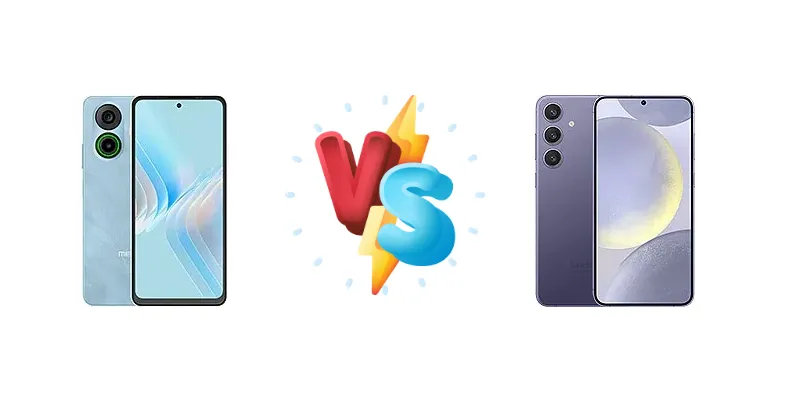
The Samsung Galaxy S24+ represents the latest in Samsung’s flagship offerings, boasting a cutting-edge processor and a premium display. Conversely, the Meizu Note 21 Pro aims to deliver a compelling experience at a significantly lower price point, relying on efficient hardware and a streamlined software approach. This comparison dissects these two devices to determine which best suits your needs and budget.
🏆 Quick Verdict
For most users, the Samsung Galaxy S24+ is the superior choice, offering a demonstrably faster processor, a brighter and more advanced display, and faster charging. However, the Meizu Note 21 Pro provides excellent value for budget-conscious buyers who prioritize efficiency and don't require top-tier performance.
| Network |
|---|
| 2G bands | GSM 850 / 900 / 1800 / 1900 | GSM 850 / 900 / 1800 / 1900 |
| 3G bands | HSDPA 850 / 900 / 1900 / 2100 | HSDPA 850 / 900 / 1700(AWS) / 1900 / 2100 |
| 4G bands | LTE | 1, 2, 3, 4, 5, 7, 8, 12, 13, 17, 18, 19, 20, 25, 26, 28, 32, 38, 39, 40, 41, 66 - International |
| 5G bands | - | 1, 2, 3, 5, 7, 8, 12, 20, 25, 26, 28, 38, 40, 41, 66, 75, 77, 78 SA/NSA/Sub6 - International |
| Speed | HSPA, LTE | HSPA, LTE (up to 7CA), 5G |
| Technology | GSM / HSPA / LTE | GSM / CDMA / HSPA / EVDO / LTE / 5G |
| Launch |
|---|
| Announced | 2024, September 13 | 2024, January 17 |
| Status | Available. Released 2024, October | Available. Released 2024, January 24 |
| Body |
|---|
| Build | - | Glass front (Gorilla Glass Victus 2), glass back (Gorilla Glass Victus 2), aluminum frame |
| Dimensions | - | 158.5 x 75.9 x 7.7 mm (6.24 x 2.99 x 0.30 in) |
| SIM | Nano-SIM + Nano-SIM | · Nano-SIM + Nano-SIM + eSIM + eSIM (max 2 at a time) - INT· Nano-SIM + eSIM + eSIM (max 2 at a time) - USA· Nano-SIM + Nano-SIM - CN |
| Weight | - | 196 g or 197 g (6.91 oz) |
| Display |
|---|
| Protection | - | Corning Gorilla Glass Victus 2 |
| Resolution | 1080 x 2400 pixels, 20:9 ratio (~388 ppi density) | 1440 x 3120 pixels, 19.5:9 ratio (~513 ppi density) |
| Size | 6.78 inches, 111.0 cm2 | 6.7 inches, 110.2 cm2 (~91.6% screen-to-body ratio) |
| Type | IPS LCD, 120Hz, 550 nits | Dynamic LTPO AMOLED 2X, 120Hz, HDR10+, 2600 nits (peak) |
| Platform |
|---|
| CPU | Octa-core (2x2.2 GHz Cortex-A76 & 6x2.0 GHz Cortex-A55) | 8-core (1x3.39GHz Cortex-X4 & 3x3.1GHz Cortex-A720 & 2x2.9GHz Cortex-A720 & 2x2.2GHz Cortex-A520)10-core (1x3.2GHz Cortex-X4 & 2x2.9GHz Cortex-A720 & 3x2.6GHz Cortex-A720 & 4x1.95GHz Cortex-A520) |
| Chipset | Mediatek Helio G99 (6 nm) | Qualcomm SM8650-AC Snapdragon 8 Gen 3 (4 nm) - USA/Canada/ChinaExynos 2400 (4 nm) - International |
| GPU | Mali-G57 MC2 | Adreno 750 (1 GHz) - USA/Canada/ChinaXclipse 940 - International |
| OS | Flyme OS | Android 14, up to 7 major Android upgrades, One UI 8.0 |
| Memory |
|---|
| Card slot | microSDXC | No |
| Internal | 256GB 8GB RAM | 256GB 12GB RAM, 512GB 12GB RAM |
| Main Camera |
|---|
| Dual | 64 MP, AF
2 MP | - |
| Features | LED flash, panorama, HDR | LED flash, auto-HDR, panorama |
| Triple | - | 50 MP, f/1.8, 24mm (wide), 1/1.56", 1.0µm, dual pixel PDAF, OIS
10 MP, f/2.4, 67mm (telephoto), 1/3.94", 1.0µm, PDAF, OIS, 3x optical zoom
12 MP, f/2.2, 13mm, 120˚ (ultrawide), 1/2.55" 1.4µm, Super Steady video |
| Video | Yes | 8K@24/30fps, 4K@30/60fps, 1080p@30/60/120/240fps, HDR10+, stereo sound rec., gyro-EIS |
| Selfie camera |
|---|
| Features | - | HDR, HDR10+ |
| Single | 13 MP | 12 MP, f/2.2, 26mm (wide), 1/3.2", 1.12µm, dual pixel PDAF |
| Video | Yes | 4K@30/60fps, 1080p@30fps |
| Sound |
|---|
| 35mm jack | Yes | No |
| Loudspeaker | Yes | Yes, with stereo speakers |
| Comms |
|---|
| Bluetooth | 5.3, A2DP | 5.3, A2DP, LE |
| NFC | Yes | Yes |
| Positioning | GPS | GPS, GLONASS, BDS, GALILEO, QZSS |
| Radio | No | No |
| USB | USB Type-C | USB Type-C 3.2, DisplayPort 1.2, OTG |
| WLAN | Wi-Fi 802.11 a/b/g/n/ac, dual-band | Wi-Fi 802.11 a/b/g/n/ac/6e, tri-band, Wi-Fi Direct |
| Features |
|---|
| Sensors | Fingerprint (side-mounted); unspecified sensors | Fingerprint (under display, ultrasonic), accelerometer, gyro, proximity, compass, barometer |
| Battery |
|---|
| Charging | 30W wired | 45W wired, PD3.0, 65% in 30 min
15W wireless (Qi)
4.5W reverse wireless |
| Type | 5000 mAh | Li-Ion 4900 mAh |
| Misc |
|---|
| Colors | Bay Blue, Sandstone, Marble | Onyx Black, Marble Grey, Cobalt Violet, Amber Yellow, Jade Green, Sandstone Orange, Sapphire Blue |
| Models | - | SM-S926B, SM-S926B/DS, SM-S926U, SM-S926U1, SM-S926W, SM-S926N, SM-S9260, SM-S926E, SM-S926E/DS |
| Price | - | $ 429.50 / € 549.00 / £ 445.98 |
| SAR | - | 1.16 W/kg (head) 0.84 W/kg (body) |
| SAR EU | - | 0.74 W/kg (head) 1.25 W/kg (body) |
Meizu Note 21 Pro
- Significantly faster processor for demanding tasks
- Brighter and more advanced display technology
- Faster charging speeds and wireless charging support
- Higher price point
- Potential for Exynos variant to exhibit thermal throttling
Samsung Galaxy S24+
- Excellent value for money
- Good battery efficiency
- More affordable entry point
- Less powerful processor for gaming and intensive apps
- Likely inferior display quality
Display Comparison
The Samsung Galaxy S24+ boasts a significantly brighter display, reaching a measured 1452 nits, ensuring excellent visibility even in direct sunlight. While the Note 21 Pro’s display specifications are not provided, it’s unlikely to match the S24+'s peak brightness. The S24+ likely utilizes LTPO technology for adaptive refresh rates, contributing to improved battery efficiency, a feature absent in the Note 21 Pro. The S24+'s panel is expected to have superior color accuracy and viewing angles, enhancing the overall visual experience.
Camera Comparison
The Galaxy S24+’s camera system is expected to feature advanced image processing and potentially larger sensors, delivering superior image quality in various lighting conditions. While the Note 21 Pro’s camera specifications are not detailed, it’s unlikely to compete with the S24+'s capabilities. The S24+ likely includes Optical Image Stabilization (OIS) for sharper photos and smoother videos, a feature that may or may not be present on the Note 21 Pro. The S24+'s video recording capabilities will also be significantly more advanced.
Performance
The core difference lies in the chipsets: the Galaxy S24+ utilizes either the Qualcomm Snapdragon 8 Gen 3 (4nm) or the Exynos 2400 (4nm), depending on the region, while the Meizu Note 21 Pro is powered by the Mediatek Helio G99 (6nm). The Snapdragon 8 Gen 3, with its Cortex-X4 prime core clocked at 3.39GHz, offers a substantial performance advantage in CPU-intensive tasks and gaming. The 4nm process node of the Snapdragon and Exynos chips provides better thermal efficiency compared to the 6nm Helio G99, minimizing throttling during sustained workloads. The S24+'s LPDDR5x RAM further enhances performance, while the Note 21 Pro’s RAM specifications are unknown, but likely slower.
Battery Life
The Samsung Galaxy S24+ achieves an impressive 12:30h of active use, demonstrating excellent battery life despite its powerful processor. It supports 45W wired charging, capable of reaching 65% charge in 30 minutes, along with 15W wireless and 4.5W reverse wireless charging. The Meizu Note 21 Pro, with its 30W wired charging, will take considerably longer to fully charge. While the Note 21 Pro may have a comparable or even slightly larger battery capacity, the S24+'s superior power efficiency and faster charging provide a more convenient user experience.
Buying Guide
Buy the Meizu Note 21 Pro if you need a reliable daily driver with good battery life and are comfortable with a less powerful processor. It’s ideal for users who prioritize efficiency and affordability over demanding tasks like heavy gaming or video editing. Buy the Samsung Galaxy S24+ if you demand the best possible performance, a vibrant display for media consumption, and a versatile camera system, and are willing to pay a premium for these features.
Frequently Asked Questions
❓ Does the Exynos 2400 chip in the international Galaxy S24+ overheat during prolonged gaming sessions?
Early reports suggest the Exynos 2400 can experience more thermal throttling than the Snapdragon 8 Gen 3, particularly during extended gaming. However, Samsung has implemented software optimizations to mitigate this issue, and real-world performance remains very good. The S24+'s larger chassis and cooling system help to manage heat dissipation.
❓ Is the 30W charging on the Meizu Note 21 Pro slow compared to the S24+'s 45W charging?
Yes, 30W charging is noticeably slower than 45W. While 30W is adequate for overnight charging, the S24+ can top up significantly faster, reaching 65% in just 30 minutes. This difference is particularly noticeable for users who frequently need a quick power boost.
❓ How does the Helio G99 processor handle graphically demanding games like PUBG Mobile?
The Helio G99 can run PUBG Mobile, but you'll likely need to lower the graphics settings to achieve a smooth frame rate. It won't deliver the same level of performance or graphical fidelity as the Snapdragon 8 Gen 3, and may exhibit frame drops during intense firefights.
❓ Does the Samsung Galaxy S24+ support DeX mode for desktop-like productivity?
Yes, the Galaxy S24+ supports Samsung DeX, allowing you to connect the phone to a monitor and use it as a desktop computer with a keyboard and mouse. This feature is not available on the Meizu Note 21 Pro.