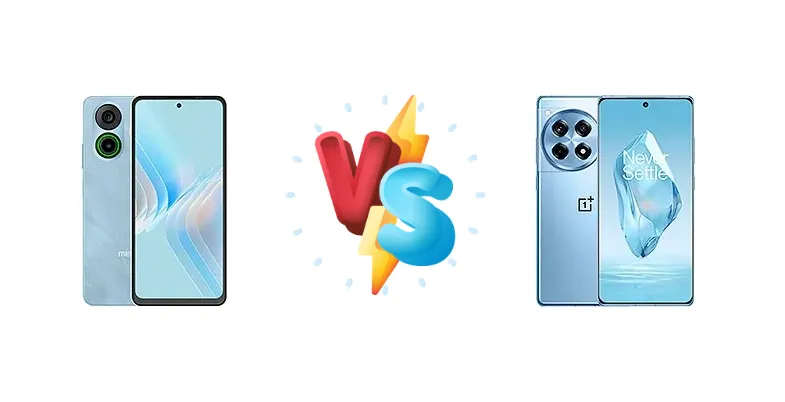
The Meizu Note 21 Pro and OnePlus 12R represent distinct approaches to the mid-range smartphone market. The Meizu focuses on efficient gaming with its Helio G99, while the OnePlus 12R aims for flagship-level performance with the Snapdragon 8 Gen 2. This comparison dissects their key differences to help you choose the right device.
🏆 Quick Verdict
For most users, the OnePlus 12R emerges as the stronger choice. Its Snapdragon 8 Gen 2 chipset delivers significantly superior performance, coupled with blazing-fast 100W charging and a brighter display. While the Meizu Note 21 Pro offers respectable efficiency, the 12R’s power advantage is hard to ignore.
| Network |
|---|
| 2G bands | GSM 850 / 900 / 1800 / 1900 | GSM 850 / 900 / 1800 / 1900 |
| 3G bands | HSDPA 850 / 900 / 1900 / 2100 | HSDPA 850 / 900 / 1700(AWS) / 1900 / 2100 |
| 4G bands | LTE | 1, 2, 3, 4, 5, 7, 8, 12, 17, 18, 19, 20, 26, 28, 32, 38, 39, 40, 41, 66 |
| 5G bands | - | 1, 2, 3, 5, 7, 8, 12, 20, 28, 38, 40, 41, 66, 77, 78 SA/NSA |
| Speed | HSPA, LTE | HSPA, LTE, 5G |
| Technology | GSM / HSPA / LTE | GSM / CDMA / HSPA / LTE / 5G |
| Launch |
|---|
| Announced | 2024, September 13 | 2024, January 23 |
| Status | Available. Released 2024, October | Available. Released 2024, February 06 |
| Body |
|---|
| Build | - | Glass front (Gorilla Glass Victus 2), aluminum frame, glass back |
| Dimensions | - | 163.3 x 75.3 x 8.8 mm (6.43 x 2.96 x 0.35 in) |
| SIM | Nano-SIM + Nano-SIM | · Nano-SIM + Nano-SIM + eSIM (max 2 at a time)· Nano-SIM + Nano-SIM |
| Weight | - | 207 g (7.30 oz) |
| Display |
|---|
| Protection | - | Corning Gorilla Glass Victus 2 |
| Resolution | 1080 x 2400 pixels, 20:9 ratio (~388 ppi density) | 1264 x 2780 pixels (~450 ppi density) |
| Size | 6.78 inches, 111.0 cm2 | 6.78 inches, 111.7 cm2 (~90.9% screen-to-body ratio) |
| Type | IPS LCD, 120Hz, 550 nits | LTPO4 AMOLED, 1B colors, 120Hz, HDR10+, Dolby Vision, 1600 nits (HBM), 4500 nits (peak) |
| Platform |
|---|
| CPU | Octa-core (2x2.2 GHz Cortex-A76 & 6x2.0 GHz Cortex-A55) | Octa-core (1x3.2 GHz Cortex-X3 & 2x2.8 GHz Cortex-A715 & 2x2.8 GHz Cortex-A710 & 3x2.0 GHz Cortex-A510) |
| Chipset | Mediatek Helio G99 (6 nm) | Qualcomm SM8550-AB Snapdragon 8 Gen 2 (4 nm) |
| GPU | Mali-G57 MC2 | Adreno 740 |
| OS | Flyme OS | Android 14, up to 3 major Android upgrades, OxygenOS 15 |
| Memory |
|---|
| Card slot | microSDXC | No |
| Internal | 256GB 8GB RAM | 128GB 8GB RAM, 256GB 8GB RAM, 256GB 12GB RAM, 256GB 16GB RAM |
| Main Camera |
|---|
| Dual | 64 MP, AF
2 MP | - |
| Features | LED flash, panorama, HDR | Laser AF, color spectrum sensor, LED flash, HDR, panorama |
| Triple | - | 50 MP, f/1.8, 24mm (wide), 1/1.56", 1.0µm, multi-directional PDAF, OIS
8 MP, f/2.2, 16mm, 112˚ (ultrawide), 1/4.0", 1.12µm
2 MP (macro) |
| Video | Yes | 4K@30/60fps, 1080p@30/60/120/240fps, gyro-EIS, OIS |
| Selfie camera |
|---|
| Features | - | HDR, panorama |
| Single | 13 MP | 16 MP, f/2.4, 26mm (wide), 1/3", 1.0µm |
| Video | Yes | 1080p@30fps, gyro-EIS |
| Sound |
|---|
| 35mm jack | Yes | No |
| Loudspeaker | Yes | Yes, with stereo speakers |
| Comms |
|---|
| Bluetooth | 5.3, A2DP | 5.3, A2DP, LE, aptX HD |
| Infrared port | - | Yes |
| NFC | Yes | Yes |
| Positioning | GPS | GPS, GALILEO, GLONASS, BDS, QZSS |
| Radio | No | No |
| USB | USB Type-C | USB Type-C 2.0 |
| WLAN | Wi-Fi 802.11 a/b/g/n/ac, dual-band | Wi-Fi 802.11 a/b/g/n/ac/6/7, dual-band |
| Features |
|---|
| Sensors | Fingerprint (side-mounted); unspecified sensors | Fingerprint (under display, optical), accelerometer, gyro, proximity, compass |
| Battery |
|---|
| Charging | 30W wired | 100W wired, 100% in 26 min |
| Type | 5000 mAh | Li-Ion 5500 mAh |
| Misc |
|---|
| Colors | Bay Blue, Sandstone, Marble | Iron Gray, Cool Blue, Electric Violet, Sunset Dune |
| Models | - | CPH2609, CPH2585, CPH2611 |
| Price | - | € 410.84 / $ 399.95 / £ 649.00 |
| SAR | - | 1.19 W/kg (head) 0.82 W/kg (body) |
Meizu Note 21 Pro
- Potentially longer battery life during light use
- More affordable price point (likely)
- Efficient processor for everyday tasks
- Significantly slower charging speed
- Substantially lower performance compared to Snapdragon 8 Gen 2
- Likely inferior display quality
OnePlus 12R
- Flagship-level performance with Snapdragon 8 Gen 2
- Ultra-fast 100W charging
- Brighter and higher-quality display
- Potentially shorter battery life under heavy load
- Higher price tag
- May run warmer under sustained gaming
Display Comparison
The OnePlus 12R boasts a significantly brighter display, reaching a measured 1181 nits, compared to an unspecified brightness for the Meizu Note 21 Pro. This higher peak brightness translates to better visibility outdoors under direct sunlight. While the Meizu’s panel specifics are unknown, the 12R’s likely utilizes a higher-quality AMOLED panel, offering richer colors and deeper blacks. The absence of LTPO technology on either device suggests both will rely on adaptive refresh rate switching rather than variable refresh rates for power saving.
Camera Comparison
Without detailed camera specifications for the Meizu Note 21 Pro, a direct comparison is limited. However, given its positioning, it’s likely to feature a more modest camera system. The OnePlus 12R, while not explicitly detailed in the provided data, typically features a capable main sensor. The Snapdragon 8 Gen 2’s ISP (Image Signal Processor) offers advanced image processing capabilities, potentially resulting in better dynamic range and low-light performance compared to the G99’s ISP. The absence of information regarding OIS (Optical Image Stabilization) on either device makes it difficult to assess video stabilization capabilities.
Performance
The performance gap between these devices is substantial. The OnePlus 12R’s Snapdragon 8 Gen 2 (4nm) is a flagship-tier chipset featuring a 1x3.2 GHz Cortex-X3 prime core, vastly outperforming the Meizu Note 21 Pro’s MediaTek Helio G99 (6nm). The Snapdragon 8 Gen 2’s architecture – with its Cortex-A715 and A710 cores – provides a significant uplift in both single-core and multi-core performance. The G99, while efficient, relies on older Cortex-A76 and A55 cores. This difference will be most noticeable in demanding tasks like video editing, heavy gaming, and running multiple apps simultaneously. The 4nm process node of the Snapdragon 8 Gen 2 also contributes to better thermal efficiency, reducing the likelihood of performance throttling under sustained load.
Battery Life
The OnePlus 12R’s 100W wired charging is a game-changer, achieving a full charge in just 26 minutes. The Meizu Note 21 Pro’s 30W charging is considerably slower. While the Meizu may have a larger battery capacity (not specified), the 12R’s faster charging mitigates the impact of a potentially smaller battery. The OnePlus 12R’s active use score of 14:32h demonstrates strong battery life despite its powerful chipset, suggesting efficient power management. The G99 in the Meizu Note 21 Pro is designed for efficiency, but the Snapdragon 8 Gen 2’s optimizations and the 12R’s overall system efficiency likely close the gap.
Buying Guide
Buy the Meizu Note 21 Pro if you prioritize long-lasting battery life during moderate use and enjoy mobile gaming at medium settings without demanding peak performance. Buy the OnePlus 12R if you demand flagship-level speed for demanding apps, gaming, and multitasking, and value the convenience of incredibly fast charging and a vibrant display.
Frequently Asked Questions
❓ Will the Meizu Note 21 Pro struggle with graphically demanding games like Genshin Impact?
The Helio G99 is capable of running Genshin Impact, but you'll likely need to lower the graphics settings to medium or low to maintain a stable frame rate. The Snapdragon 8 Gen 2 in the OnePlus 12R will handle Genshin Impact at maximum settings with ease.
❓ How much faster is the 100W charging on the OnePlus 12R compared to the 30W charging on the Meizu Note 21 Pro in real-world use?
The OnePlus 12R can go from 0% to 100% in approximately 26 minutes. The Meizu Note 21 Pro, with its 30W charging, will likely take well over an hour to fully charge, making the 12R significantly more convenient for users who frequently need to top up their battery.
❓ Is the Snapdragon 8 Gen 2 in the OnePlus 12R prone to overheating during extended gaming sessions?
While the Snapdragon 8 Gen 2 is a powerful chip, the OnePlus 12R incorporates thermal management solutions to mitigate overheating. While some warmth is expected during prolonged gaming, it's unlikely to experience significant throttling that impacts performance, unlike some earlier Snapdragon 8 Gen 2 implementations.