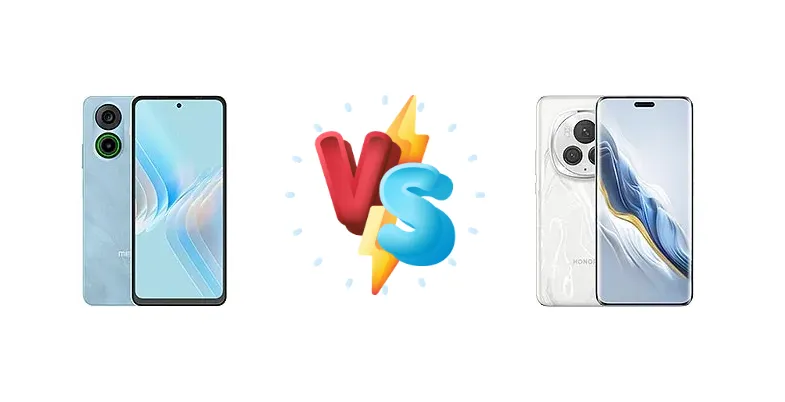
The Meizu Note 21 Pro and Honor Magic6 Pro represent distinct approaches to the smartphone market. The Meizu aims for affordability with a focus on essential features, while the Honor Magic6 Pro positions itself as a premium device boasting cutting-edge technology. This comparison dissects their core components to determine which phone best suits your needs and budget.
🏆 Quick Verdict
For the average user prioritizing performance and future-proofing, the Honor Magic6 Pro is the clear winner. Its Snapdragon 8 Gen 3 chipset and significantly faster charging capabilities justify the higher price. However, the Meizu Note 21 Pro offers compelling value for budget-conscious users who don't demand top-tier processing power.
| Network |
|---|
| 2G bands | GSM 850 / 900 / 1800 / 1900 | GSM 850 / 900 / 1800 / 1900 |
| 3G bands | HSDPA 850 / 900 / 1900 / 2100 | HSDPA 800 / 850 / 900 / 1700(AWS) / 1900 / 2100 |
| 4G bands | LTE | LTE |
| 5G bands | - | SA/NSA |
| Speed | HSPA, LTE | HSPA, LTE, 5G |
| Technology | GSM / HSPA / LTE | GSM / CDMA / HSPA / CDMA2000 / LTE / 5G |
| Launch |
|---|
| Announced | 2024, September 13 | 2024, January 11 |
| Status | Available. Released 2024, October | Available. Released 2024, January 18 |
| Body |
|---|
| Build | - | Glass front (NanoCrystal Shield), glass back or silicone polymer back (eco leather) |
| Dimensions | - | 162.5 x 75.8 x 8.9 mm (6.40 x 2.98 x 0.35 in) |
| SIM | Nano-SIM + Nano-SIM | · Nano-SIM + eSIM· Nano-SIM + Nano-SIM |
| Weight | - | 225 g or 229 g (7.94 oz) |
| Display |
|---|
| Protection | - | NanoCrystal Shield |
| Resolution | 1080 x 2400 pixels, 20:9 ratio (~388 ppi density) | 1280 x 2800 pixels, 19.5:9 ratio (~453 ppi density) |
| Size | 6.78 inches, 111.0 cm2 | 6.8 inches, 112.8 cm2 (~91.6% screen-to-body ratio) |
| Type | IPS LCD, 120Hz, 550 nits | LTPO OLED, 1B colors, 120Hz, Dolby Vision, HDR, 1600 nits (HBM), 5000 nits (peak) |
| Platform |
|---|
| CPU | Octa-core (2x2.2 GHz Cortex-A76 & 6x2.0 GHz Cortex-A55) | Octa-core (1x3.3 GHz Cortex-X4 & 3x3.2 GHz Cortex-A720 & 2x3.0 GHz Cortex-A720 & 2x2.3 GHz Cortex-A520) |
| Chipset | Mediatek Helio G99 (6 nm) | Qualcomm SM8650-AB Snapdragon 8 Gen 3 (4 nm) |
| GPU | Mali-G57 MC2 | Adreno 750 |
| OS | Flyme OS | Android 14, up to 4 major Android upgrades, MagicOS 8 |
| Memory |
|---|
| Card slot | microSDXC | No |
| Internal | 256GB 8GB RAM | 256GB 12GB RAM, 256GB 16GB RAM, 512GB 12GB RAM, 512GB 16GB RAM, 1TB 16GB RAM |
| Main Camera |
|---|
| Dual | 64 MP, AF
2 MP | - |
| Features | LED flash, panorama, HDR | Laser AF, color spectrum sensor, LED flash, HDR, panorama |
| Triple | - | 50 MP, f/1.4-2.0, 23mm (wide), 1/1.3", 1.2µm, PDAF, OIS
180 MP, f/2.6, (periscope telephoto), 1/1.49", 0.56µm, PDAF, OIS, 2.5x optical zoom
50 MP, f/2.0, 13mm, 122˚ (ultrawide), 1/2.88", 0.61µm, AF |
| Video | Yes | 4K@24/30/60fps, 1080p@30/60/120/240fps, gyro-EIS, OIS, HDR, 10-bit video |
| Selfie camera |
|---|
| Single | 13 MP | 50 MP, f/2.0, 22mm (wide), 1/2.93", 0.6µm, AF
TOF 3D, (depth/biometrics sensor) |
| Video | Yes | 4K@30fps, 1080p@30/60fps, gyro-EIS |
| Sound |
|---|
| 35mm jack | Yes | No |
| Loudspeaker | Yes | Yes, with stereo speakers |
| Comms |
|---|
| Bluetooth | 5.3, A2DP | 5.3, A2DP, LE, aptX HD |
| Infrared port | - | Yes |
| NFC | Yes | Yes |
| Positioning | GPS | GPS (L1+L5), GLONASS, BDS (B1I+B1c+B2a), GALILEO (E1+E5a) |
| Radio | No | No |
| USB | USB Type-C | USB Type-C 3.2, DisplayPort 1.2, OTG |
| WLAN | Wi-Fi 802.11 a/b/g/n/ac, dual-band | Wi-Fi 802.11 a/b/g/n/ac/6/7, dual-band, Wi-Fi Direct |
| Features |
|---|
| Sensors | Fingerprint (side-mounted); unspecified sensors | Fingerprint (under display, optical), Face ID, accelerometer, gyro, proximity, compass |
| Battery |
|---|
| Charging | 30W wired | 80W wired
66W wireless
Reverse wireless
5W reverse wired |
| Type | 5000 mAh | Si/C Li-Ion 5600 mAh |
| Misc |
|---|
| Colors | Bay Blue, Sandstone, Marble | Black, Green, Blue, Purple, White |
| Models | - | BVL-AN16, BVL-N49 |
| Price | - | € 455.54 / $ 899.00 / £ 598.99 |
Meizu Note 21 Pro
- More affordable price point
- Decent performance for everyday tasks
- Potentially longer software support (Meizu's Flyme OS)
- Significantly weaker chipset compared to the competition
- Slower charging speed (30W)
- Likely inferior display quality
Honor Magic6 Pro
- Flagship-level performance with Snapdragon 8 Gen 3
- Ultra-fast 80W wired and 66W wireless charging
- Exceptionally bright and likely efficient display
- Higher price tag
- Potential for software bloat (Honor's MagicOS)
- Larger size and weight compared to the Meizu
Display Comparison
The Honor Magic6 Pro boasts a significantly brighter display, reaching a measured 1578 nits, making it exceptionally visible outdoors. While the Meizu Note 21 Pro’s display specifications are not provided, it’s unlikely to compete with this peak brightness. The Magic6 Pro’s likely use of LTPO technology (common in this price bracket) would also contribute to improved power efficiency by dynamically adjusting the refresh rate. This is a substantial advantage for users who spend significant time outdoors or consume HDR content.
Camera Comparison
Without detailed camera specifications for the Meizu Note 21 Pro, a direct comparison is limited. However, the Honor Magic6 Pro is expected to feature a more sophisticated camera system, likely with a larger main sensor and advanced image processing capabilities. The Snapdragon 8 Gen 3’s ISP (Image Signal Processor) is also significantly more powerful, enabling features like improved low-light performance and faster image processing. The presence of OIS (Optical Image Stabilization) on the Magic6 Pro is highly probable, further enhancing image quality.
Performance
The core difference lies in the chipsets. The Honor Magic6 Pro’s Snapdragon 8 Gen 3 (4nm) is a generational leap ahead of the Meizu Note 21 Pro’s MediaTek Helio G99 (6nm). The Snapdragon 8 Gen 3’s Cortex-X4 prime core, clocked at 3.3 GHz, coupled with its advanced architecture, delivers substantially higher CPU and GPU performance. The G99, while capable for everyday tasks, will struggle with demanding games and applications. The 4nm process node of the Snapdragon also translates to better thermal efficiency, reducing throttling during sustained workloads. The Honor will also benefit from faster RAM speeds (likely LPDDR5x) compared to the Meizu.
Battery Life
The Honor Magic6 Pro demonstrates a clear advantage in battery and charging. Its active use score of 14:06h indicates excellent battery life. Furthermore, the Magic6 Pro supports 80W wired charging, 66W wireless charging, and even 5W reverse wired charging – a level of versatility the Meizu Note 21 Pro’s 30W wired charging cannot match. While the Meizu may offer adequate battery life for moderate users, the Honor provides significantly faster replenishment and more convenient charging options.
Buying Guide
Buy the Meizu Note 21 Pro if you need a reliable daily driver for basic tasks, social media, and light gaming, and prioritize affordability above all else. You'll appreciate its simplicity and reasonable performance. Buy the Honor Magic6 Pro if you demand flagship-level performance for demanding games, content creation, and multitasking, and value fast charging, a brilliant display, and long-term software support.
Frequently Asked Questions
❓ Is the Helio G99 in the Meizu Note 21 Pro sufficient for playing demanding games like Genshin Impact?
While the Helio G99 can run Genshin Impact, you'll likely need to lower the graphics settings to medium or low to achieve a playable frame rate. It won't provide the smooth, high-fidelity experience offered by the Snapdragon 8 Gen 3 in the Honor Magic6 Pro.
❓ How long does it realistically take to fully charge the Honor Magic6 Pro from 0% to 100% using the 80W charger?
With 80W charging, the Honor Magic6 Pro can realistically charge from 0% to 100% in approximately 30-40 minutes, depending on temperature and background processes. This is significantly faster than the Meizu Note 21 Pro's 30W charging.
❓ Does the Honor Magic6 Pro support 4K video recording at 60fps?
Given the capabilities of the Snapdragon 8 Gen 3, the Honor Magic6 Pro almost certainly supports 4K video recording at 60fps, and likely even 8K recording. The Meizu Note 21 Pro's video recording capabilities are expected to be more limited.
❓ What are the potential downsides of Honor's MagicOS software?
Honor's MagicOS, while improving, has historically been criticized for some pre-installed bloatware and aggressive battery management. Users may need to disable certain features to optimize performance and battery life. Meizu's Flyme OS is generally considered a cleaner experience.