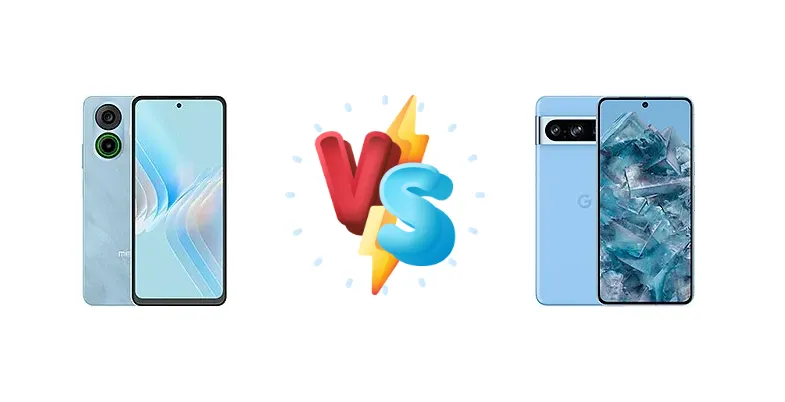
The Meizu Note 21 Pro and Google Pixel 8 Pro represent vastly different approaches to the smartphone market. The Meizu aims to deliver a solid experience at a competitive price point, while the Pixel 8 Pro is Google’s flagship, showcasing its latest AI-powered features and premium hardware. This comparison dissects their key differences to determine which device offers the best value for your money.
🏆 Quick Verdict
For the average user prioritizing camera capabilities, software experience, and long-term support, the Google Pixel 8 Pro is the clear winner. However, the Meizu Note 21 Pro provides a compelling alternative for budget-conscious buyers who prioritize efficiency and don't require cutting-edge features.
| Network |
|---|
| 2G bands | GSM 850 / 900 / 1800 / 1900 | GSM 850 / 900 / 1800 / 1900 |
| 3G bands | HSDPA 850 / 900 / 1900 / 2100 | HSDPA 800 / 850 / 900 / 1700(AWS) / 1900 / 2100 |
| 4G bands | LTE | 1, 2, 3, 4, 5, 7, 8, 12, 13, 14, 17, 18, 19, 20, 25, 26, 28, 29, 30, 38, 39, 40, 41, 46, 48, 66, 71 - G1MNW |
| 5G bands | - | 1, 2, 3, 5, 7, 8, 12, 20, 25, 26, 28, 29, 30, 38, 40, 41, 48, 66, 70, 71, 77, 78, 257, 258, 260, 261 SA/NSA/Sub6/mmWave - G1MNW |
| Speed | HSPA, LTE | HSPA, LTE, 5G |
| Technology | GSM / HSPA / LTE | GSM / HSPA / LTE / 5G |
| Launch |
|---|
| Announced | 2024, September 13 | 2023, October 04 |
| Status | Available. Released 2024, October | Available. Released 2023, October 12 |
| Body |
|---|
| Build | - | Glass front (Gorilla Glass Victus 2), glass back (Gorilla Glass Victus 2), aluminum frame |
| Dimensions | - | 162.6 x 76.5 x 8.8 mm (6.40 x 3.01 x 0.35 in) |
| SIM | Nano-SIM + Nano-SIM | Nano-SIM + eSIM |
| Weight | - | 213 g (7.51 oz) |
| Display |
|---|
| Protection | - | Corning Gorilla Glass Victus 2 |
| Resolution | 1080 x 2400 pixels, 20:9 ratio (~388 ppi density) | 1344 x 2992 pixels, 20:9 ratio (~489 ppi density) |
| Size | 6.78 inches, 111.0 cm2 | 6.7 inches, 108.7 cm2 (~87.4% screen-to-body ratio) |
| Type | IPS LCD, 120Hz, 550 nits | LTPO OLED, 120Hz, HDR10+, 1600 nits (HBM), 2400 nits (peak) |
| Platform |
|---|
| CPU | Octa-core (2x2.2 GHz Cortex-A76 & 6x2.0 GHz Cortex-A55) | Nona-core (1x3.0 GHz Cortex-X3 & 4x2.45 GHz Cortex-A715 & 4x2.15 GHz Cortex-A510) |
| Chipset | Mediatek Helio G99 (6 nm) | Google Tensor G3 (4 nm) |
| GPU | Mali-G57 MC2 | Immortalis-G715s MC10 |
| OS | Flyme OS | Android 14, upgradable to Android 16, up to 7 major Android upgrades |
| Memory |
|---|
| Card slot | microSDXC | No |
| Internal | 256GB 8GB RAM | 128GB 12GB RAM, 256GB 12GB RAM, 512GB 12GB RAM, 1TB 12GB RAM |
| Main Camera |
|---|
| Dual | 64 MP, AF
2 MP | - |
| Features | LED flash, panorama, HDR | Multi-zone Laser AF, Dual-LED flash, Pixel Shift, Ultra-HDR, panorama, Best Take, Zoom Enhance |
| Triple | - | 50 MP, f/1.7, 25mm (wide), 1/1.31", 1.2µm, dual pixel PDAF, OIS
48 MP, f/2.8, 113mm (periscope telephoto), 1/2.55", 0.7µm, dual pixel PDAF, OIS, 5x optical zoom
48 MP, f/2.0, 126˚ (ultrawide), 1/2.0", 0.8µm, dual pixel PDAF |
| Video | Yes | 4K@30/60fps, 1080p@24/30/60/120/240fps; gyro-EIS, OIS, 10-bit HDR |
| Selfie camera |
|---|
| Features | - | HDR, panorama |
| Single | 13 MP | 10.5 MP, f/2.2, 20mm (ultrawide), 1/3.1", 1.22µm, PDAF |
| Video | Yes | 4K@24/30/60fps, 1080p@30/60fps |
| Sound |
|---|
| 35mm jack | Yes | No |
| Loudspeaker | Yes | Yes, with stereo speakers |
| Comms |
|---|
| Bluetooth | 5.3, A2DP | 5.3, A2DP, LE, aptX HD |
| NFC | Yes | Yes |
| Positioning | GPS | GPS (L1+L5), GLONASS (G1), GALILEO (E1+E5a), QZSS (L1+L5) |
| Radio | No | No |
| USB | USB Type-C | USB Type-C 3.2 |
| WLAN | Wi-Fi 802.11 a/b/g/n/ac, dual-band | Wi-Fi 802.11 a/b/g/n/ac/6e/7, tri-band, Wi-Fi Direct |
| Features |
|---|
| Sensors | Fingerprint (side-mounted); unspecified sensors | Fingerprint (under display, optical), accelerometer, gyro, proximity, compass, barometer, thermometer (skin temperature) |
| Battery |
|---|
| Charging | 30W wired | 30W wired, PD3.0, PPS, 50% in 30 min
23W wireless
Reverse wireless
Bypass charging |
| Type | 5000 mAh | Li-Ion 5050 mAh |
| Misc |
|---|
| Colors | Bay Blue, Sandstone, Marble | Obsidian, Porcelain, Bay, Mint |
| Models | - | GC3VE, G1MNW |
| Price | - | € 362.00 / $ 289.97 / £ 329.95 / ₹ 54,999 |
Meizu Note 21 Pro
- More affordable price point
- Efficient Mediatek Helio G99 processor
- Decent performance for everyday tasks
- Inferior camera system compared to Pixel 8 Pro
- Less powerful processor for demanding applications
- Limited software update support
Google Pixel 8 Pro
- Exceptional camera quality and AI features
- Powerful Google Tensor G3 processor
- Long-term software update support
- Significantly higher price
- Can be overkill for basic users
- Potential for thermal throttling under extreme load
Display Comparison
The Google Pixel 8 Pro boasts a significantly brighter display, reaching a measured peak of 1600 nits, ensuring excellent visibility even in direct sunlight. While the Meizu Note 21 Pro’s display specifications are not provided, it’s unlikely to match the Pixel’s brightness. The Pixel 8 Pro likely utilizes an LTPO panel for adaptive refresh rates, contributing to improved battery efficiency, a feature absent in the Meizu. The Pixel’s superior panel technology translates to a more vibrant and responsive viewing experience.
Camera Comparison
The Pixel 8 Pro’s camera system is a major differentiator. While specific sensor details aren’t provided, Google’s computational photography prowess, combined with its advanced image processing algorithms, consistently delivers exceptional image quality. The Pixel 8 Pro excels in both photo and video capture, offering features like Magic Eraser and Best Take. The Meizu Note 21 Pro, while likely offering a capable camera for its price range, cannot compete with the Pixel’s image processing capabilities and overall versatility. The absence of detailed camera specs for the Meizu suggests a focus on affordability rather than cutting-edge imaging technology.
Performance
The core difference lies in the chipsets: the Meizu Note 21 Pro utilizes the Mediatek Helio G99, a 6nm processor geared towards efficiency, while the Pixel 8 Pro is powered by the Google Tensor G3, fabricated on a more advanced 4nm process. This 4nm node allows the Tensor G3 to deliver significantly higher performance and improved thermal efficiency, crucial for sustained workloads. The Tensor G3’s nona-core architecture (1x3.0 GHz Cortex-X3, 4x2.45 GHz Cortex-A715, 4x2.15 GHz Cortex-A510) provides a substantial advantage in multi-tasking and demanding applications compared to the Helio G99’s octa-core configuration (2x2.2 GHz Cortex-A76 & 6x2.0 GHz Cortex-A55). Gamers and power users will find the Pixel 8 Pro far more capable.
Battery Life
The Google Pixel 8 Pro demonstrates impressive battery endurance, achieving 11:14 hours of active use and an endurance rating of 90 hours. Both phones support 30W wired charging, but the Pixel 8 Pro adds the convenience of 23W wireless charging, reverse wireless charging, and bypass charging. The Pixel’s charging capabilities, combined with its efficient Tensor G3 chip, provide a more versatile and user-friendly charging experience. While the Meizu Note 21 Pro’s 30W charging is adequate, it lacks the advanced features offered by the Pixel.
Buying Guide
Buy the Meizu Note 21 Pro if you need a reliable daily driver with decent performance for everyday tasks and value affordability above all else. It’s ideal for users who don’t heavily rely on mobile gaming or advanced camera features. Buy the Google Pixel 8 Pro if you prefer a premium experience with exceptional camera quality, AI-powered features, and guaranteed software updates, and are willing to pay a significant premium for these benefits.
Frequently Asked Questions
❓ Does the Google Tensor G3 chip in the Pixel 8 Pro get noticeably warm during extended gaming sessions?
While the Tensor G3 is a powerful chip, it's known to generate more heat than some competitors. During prolonged, graphically intensive gaming, the Pixel 8 Pro may experience some thermal throttling to maintain stable performance. However, Google has implemented thermal management solutions to mitigate this issue.
❓ How does the 30W charging on the Meizu Note 21 Pro compare to the Pixel 8 Pro in real-world usage?
Both phones support 30W wired charging, but the Pixel 8 Pro’s implementation with PD3.0 and PPS standards allows for potentially faster and more efficient charging. The Pixel 8 Pro also offers 23W wireless and reverse wireless charging, features absent on the Meizu Note 21 Pro, providing greater charging flexibility.
❓ Is the Meizu Note 21 Pro a good option for users who primarily use social media and messaging apps?
Yes, the Meizu Note 21 Pro is well-suited for users with basic smartphone needs. The Mediatek Helio G99 processor is capable of handling social media, messaging, and web browsing without issue. Its affordability makes it a practical choice for those who don't require high-end performance.