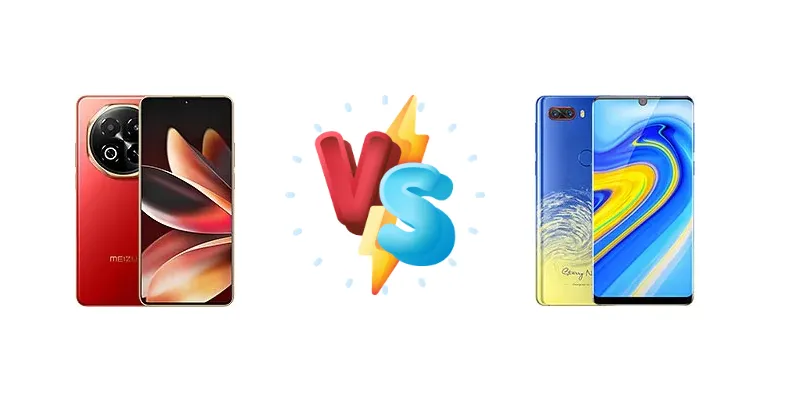
The Meizu Note 16 and ZTE nubia Z18 represent interesting points in smartphone history. The nubia Z18, powered by the Snapdragon 845, was a late-cycle flagship offering premium performance at a declining price. The Meizu Note 16, utilizing the Unisoc T8200, aimed to deliver a compelling experience through efficient design and fast charging, challenging established players with a newer chipset architecture.
🏆 Quick Verdict
For the average user prioritizing sustained performance and established software support, the ZTE nubia Z18 is the better choice. The Snapdragon 845’s superior CPU and GPU performance, despite being an older chip, outweigh the Meizu Note 16’s faster charging and more modern process node.
| Network |
|---|
| 2G bands | GSM 850 / 900 / 1800 / 1900 | GSM 850 / 900 / 1800 / 1900 |
| 3G bands | HSDPA 850 / 900 / 2100 | HSDPA 850 / 900 / 1900 / 2100 |
| 4G bands | 1, 3, 5, 8, 34, 38, 39, 40, 41 | 1, 3, 4, 5, 7, 8, 20, 34, 38, 39, 40, 41 |
| 5G bands | 1, 3, 5, 8, 28, 41, 78 SA/NSA | - |
| Speed | HSPA, LTE, 5G | HSPA 42.2/5.76 Mbps, LTE (6CA) Cat18 1200/150 Mbps |
| Technology | GSM / HSPA / LTE / 5G | GSM / CDMA / HSPA / EVDO / LTE |
| | - | CDMA2000 1xEV-DO |
| Launch |
|---|
| Announced | 2025, May 13 | 2018, September. Released 2018, September |
| Status | Available. Released 2025, May 16 | Discontinued |
| Body |
|---|
| Dimensions | 167.6 x 75.8 x 9.2 mm (6.60 x 2.98 x 0.36 in) | 148.6 x 72.6 x 8.6 mm (5.85 x 2.86 x 0.34 in) |
| SIM | Nano-SIM + Nano-SIM | Nano-SIM + Nano-SIM |
| Weight | 217 g (7.65 oz) | 172 g (6.07 oz) |
| Display |
|---|
| Protection | - | Corning Gorilla Glass 3 |
| Resolution | 1080 x 2460 pixels (~396 ppi density) | 1080 x 2160 pixels, 18:9 ratio (~403 ppi density) |
| Size | 6.78 inches, 109.2 cm2 (~85.9% screen-to-body ratio) | 5.99 inches, 92.6 cm2 (~85.8% screen-to-body ratio) |
| Type | IPS LCD, 120Hz, 1050 nits (peak) | IPS LCD |
| Platform |
|---|
| CPU | Octa-core (2x2.3 GHz Cortex-A76 & 6x2.1 GHz Cortex-A55) | Octa-core (4x2.65 GHz Kryo 385 Gold & 4x1.8 GHz Kryo 385 Silver) |
| Chipset | Unisoc T8200 (6 nm) | Qualcomm SDM845 Snapdragon 845 (10 nm) |
| GPU | Mali-G57 MC2 | Adreno 630 |
| OS | Flyme AIOS 2 | Android 8.1 (Oreo), nubia UI 6 |
| Memory |
|---|
| Card slot | No | No |
| Internal | 128GB 8GB RAM, 256GB 8GB RAM, 256GB 12GB RAM | 64GB 6GB RAM, 128GB 8GB RAM |
| Main Camera |
|---|
| Dual | 50 MP, f/1.8, 26mm (wide), PDAF
2 MP, f/2.4 | 24 MP, f/1.6, dual pixel PDAF, OIS
16 MP, f/1.6, AF |
| Features | LED flash, panorama, HDR | Dual-LED dual-tone flash, HDR, panorama |
| Video | Yes | 4K@30fps, 1080p@30fps |
| Selfie camera |
|---|
| Features | HDR | HDR |
| Single | 8 MP, f/2.0 | 8 MP, f/2.0 |
| Video | Yes | 1080p@30fps |
| Sound |
|---|
| 3.5mm jack | - | No |
| 35mm jack | Yes | No |
| Loudspeaker | Yes, with stereo speakers | Yes |
| | - | 32-bit/384kHz audio |
| Comms |
|---|
| Bluetooth | 5.0, A2DP, LE, aptX HD | 5.0, A2DP, LE |
| NFC | Yes | No |
| Positioning | GPS, GALILEO, BDS | GPS, GLONASS, BDS |
| Radio | Unspecified | No |
| USB | USB Type-C 2.0 | USB Type-C, OTG |
| WLAN | Wi-Fi 802.11 a/b/g/n/ac, dual-band | Wi-Fi 802.11 b/g/n/ac, dual-band, Wi-Fi Direct, DLNA |
| Features |
|---|
| Sensors | Fingerprint (side-mounted), accelerometer, proximity, compass | Fingerprint (rear-mounted), accelerometer, gyro, proximity, compass |
| Battery |
|---|
| Charging | 40W wired, QC3+ | 18W wired, QC4 |
| Type | 6600 mAh | Li-Po 3450 mAh, non-removable |
| Misc |
|---|
| Colors | Black, White, Red | Black, Red, Stary Night |
| Models | - | NX606J |
| Price | About 100 EUR | About 400 EUR |
Meizu Note 16
- Significantly faster 40W charging
- More modern 6nm process node for potential efficiency
- Potentially lower price point
- Less powerful CPU and GPU compared to Snapdragon 845
- Unisoc chipset may have limited software support
- Potential for thermal throttling under sustained load
ZTE nubia Z18
- More powerful Snapdragon 845 processor
- Mature Qualcomm software ecosystem and driver support
- Likely better camera system with potential OIS
- Slower 18W charging
- Older 10nm process node
- Potentially higher price (depending on current market)
Display Comparison
Neither device's display specifications are provided, so a direct comparison is limited. However, given the nubia Z18's flagship positioning, it likely featured a higher-quality panel with potentially better color accuracy and peak brightness. The Meizu Note 16, targeting a more budget-conscious market, may have compromised on display quality to reduce costs. Bezels are likely comparable, reflecting design trends of the era.
Camera Comparison
Without specific camera sensor details, a definitive comparison is difficult. However, the nubia Z18, as a former flagship, likely incorporated a more sophisticated camera system with a larger main sensor and potentially optical image stabilization (OIS). The Meizu Note 16 likely focused on providing a functional camera experience, potentially relying more on software processing. The presence or absence of OIS on the nubia Z18 would be a significant advantage in low-light conditions.
Performance
The core difference lies in the chipsets. The ZTE nubia Z18’s Snapdragon 845 (10nm) boasts a more powerful CPU configuration – 4x2.65 GHz Kryo 385 Gold and 4x1.8 GHz Kryo 385 Silver – compared to the Meizu Note 16’s Unisoc T8200 (6nm) with its 2x2.3 GHz Cortex-A76 and 6x2.1 GHz Cortex-A55. While the T8200 benefits from a smaller 6nm process, offering potential efficiency gains, the Snapdragon 845’s architectural advantages and higher clock speeds translate to superior raw performance. This difference is particularly noticeable in GPU-intensive tasks like gaming. The Snapdragon 845 also benefits from Qualcomm’s optimized software and driver support.
Battery Life
Battery capacity isn't specified for either device. However, the charging speeds are a key differentiator. The Meizu Note 16’s 40W wired charging with QC3+ support is significantly faster than the ZTE nubia Z18’s 18W wired charging with QC4. This means the Meizu Note 16 can replenish its battery much quicker, even if its battery capacity is smaller. QC4 offers more intelligent charging management, but the wattage difference is substantial. The Unisoc T8200’s 6nm process *could* contribute to better battery efficiency, but the Snapdragon 845’s optimizations are also strong.
Buying Guide
Buy the Meizu Note 16 if you prioritize fast charging (40W) and are comfortable with a potentially less refined software experience. This phone is ideal for users who frequently top up their battery throughout the day. Buy the ZTE nubia Z18 if you value consistent performance in demanding applications, gaming, and benefit from Qualcomm’s mature software ecosystem and wider compatibility. This is the better option for power users and gamers.
Frequently Asked Questions
❓ Will the Unisoc T8200 in the Meizu Note 16 struggle with demanding games like PUBG or Genshin Impact?
The Unisoc T8200 is capable of running these games, but you'll likely need to lower graphics settings to maintain a stable frame rate. The Snapdragon 845 in the nubia Z18 offers a smoother experience at higher settings due to its more powerful GPU and optimized drivers.
❓ Does the ZTE nubia Z18's older Snapdragon 845 chipset suffer from significant thermal throttling during extended gaming sessions?
The Snapdragon 845 is known to throttle under sustained load, but the nubia Z18 likely incorporated cooling solutions to mitigate this. While throttling may occur, it's generally less severe than what you might experience with the Unisoc T8200, which may struggle more with heat dissipation.
❓ Is the QC3+ charging on the Meizu Note 16 compatible with my existing QC4 chargers?
Yes, QC3+ is backwards compatible with QC4 chargers. However, you won't benefit from the full capabilities of QC4. The Meizu Note 16 will still charge at the maximum rate supported by QC3+.