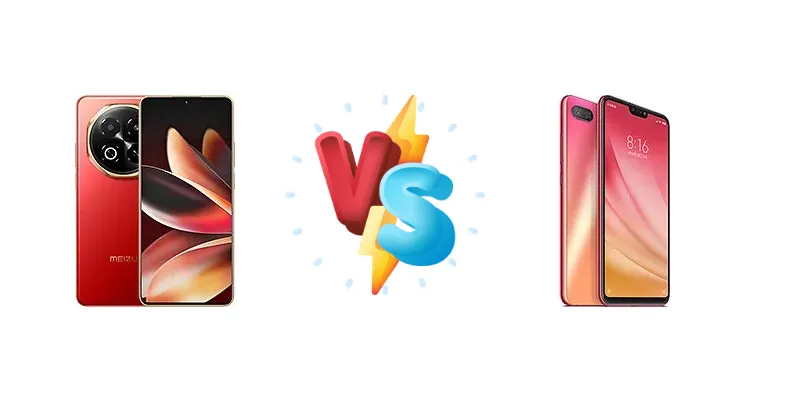
The Meizu Note 16 and Xiaomi Mi 8 Lite represent a fascinating crossroads in the mid-range smartphone market. Released in different eras, they offer distinct approaches to balancing performance, battery life, and affordability. This comparison dives deep into their specifications to determine which device best suits your needs, particularly focusing on the architectural differences between the Unisoc T8200 and Qualcomm Snapdragon 660.
🏆 Quick Verdict
For the average user prioritizing sustained performance and fast charging, the Meizu Note 16 emerges as the stronger contender. Its newer Unisoc T8200 chipset, built on a 6nm process, offers a potential performance edge. However, the Xiaomi Mi 8 Lite’s proven 77-hour endurance rating and established software ecosystem remain compelling advantages.
| Network |
|---|
| 2G bands | GSM 850 / 900 / 1800 / 1900 | GSM 850 / 900 / 1800 / 1900 |
| 3G bands | HSDPA 850 / 900 / 2100 | HSDPA 850 / 900 / 1700(AWS) / 1900 / 2100 - Global |
| 4G bands | 1, 3, 5, 8, 34, 38, 39, 40, 41 | 1, 2, 3, 4, 5, 7, 8, 20, 28, 38, 40 - Global |
| 5G bands | 1, 3, 5, 8, 28, 41, 78 SA/NSA | - |
| Speed | HSPA, LTE, 5G | HSPA 42.2/5.76 Mbps, LTE (2CA) Cat6 300/50 Mbps |
| Technology | GSM / HSPA / LTE / 5G | GSM / CDMA / HSPA / LTE |
| | - | 1, 3, 5, 7, 8, 34, 38, 39, 40, 41 - China |
| Launch |
|---|
| Announced | 2025, May 13 | 2018, September. Released 2018, September |
| Status | Available. Released 2025, May 16 | Discontinued |
| Body |
|---|
| Build | - | Glass front, glass back, aluminum frame |
| Dimensions | 167.6 x 75.8 x 9.2 mm (6.60 x 2.98 x 0.36 in) | 156.4 x 75.8 x 7.5 mm (6.16 x 2.98 x 0.30 in) |
| SIM | Nano-SIM + Nano-SIM | Nano-SIM + Nano-SIM |
| Weight | 217 g (7.65 oz) | 169 g (5.96 oz) |
| Display |
|---|
| Resolution | 1080 x 2460 pixels (~396 ppi density) | 1080 x 2280 pixels, 19:9 ratio (~403 ppi density) |
| Size | 6.78 inches, 109.2 cm2 (~85.9% screen-to-body ratio) | 6.26 inches, 97.8 cm2 (~82.5% screen-to-body ratio) |
| Type | IPS LCD, 120Hz, 1050 nits (peak) | IPS LCD |
| Platform |
|---|
| CPU | Octa-core (2x2.3 GHz Cortex-A76 & 6x2.1 GHz Cortex-A55) | Octa-core (4x2.2 GHz Kryo 260 Gold & 4x1.8 GHz Kryo 260 Silver) |
| Chipset | Unisoc T8200 (6 nm) | Qualcomm SDM660 Snapdragon 660 (14 nm) |
| GPU | Mali-G57 MC2 | Adreno 512 |
| OS | Flyme AIOS 2 | Android 8.1 (Oreo), upgradable to Android 10, MIUI 11 |
| Memory |
|---|
| Card slot | No | microSDXC (uses shared SIM slot) |
| Internal | 128GB 8GB RAM, 256GB 8GB RAM, 256GB 12GB RAM | 64GB 4GB RAM, 64GB 6GB RAM, 128GB 4GB RAM, 128GB 6GB RAM |
| | - | eMMC 5.1 |
| Main Camera |
|---|
| Dual | 50 MP, f/1.8, 26mm (wide), PDAF
2 MP, f/2.4 | 12 MP, f/1.9, 1/2.55", 1.4µm, dual pixel PDAF
Auxiliary lens |
| Features | LED flash, panorama, HDR | LED flash, HDR, panorama |
| Video | Yes | 4K@30fps, 1080p@60/120fps, 1080p@30fps (gyro-EIS) |
| Selfie camera |
|---|
| Features | HDR | Auto HDR |
| Single | 8 MP, f/2.0 | 24 MP, f/2.0, 26mm (wide), 1/2.8", 0.9µm |
| Video | Yes | 1080p@30fps |
| Sound |
|---|
| 3.5mm jack | - | No |
| 35mm jack | Yes | No |
| Loudspeaker | Yes, with stereo speakers | Yes |
| Comms |
|---|
| Bluetooth | 5.0, A2DP, LE, aptX HD | 5.0, A2DP, LE |
| NFC | Yes | No |
| Positioning | GPS, GALILEO, BDS | GPS, GLONASS, BDS |
| Radio | Unspecified | No |
| USB | USB Type-C 2.0 | USB Type-C |
| WLAN | Wi-Fi 802.11 a/b/g/n/ac, dual-band | Wi-Fi 802.11 a/b/g/n/ac, dual-band, Wi-Fi Direct |
| Features |
|---|
| Sensors | Fingerprint (side-mounted), accelerometer, proximity, compass | Fingerprint (rear-mounted), accelerometer, gyro, proximity, compass |
| Battery |
|---|
| Charging | 40W wired, QC3+ | 18W wired, QC3 |
| Type | 6600 mAh | Li-Po 3350 mAh, non-removable |
| Misc |
|---|
| Colors | Black, White, Red | Midnight Black, Aurora Blue, Twilight Gold |
| Models | - | M1808D2TG |
| Price | About 100 EUR | About 360 EUR |
| SAR | - | 0.75 W/kg (head) 1.58 W/kg (body) |
| Tests |
|---|
| Audio quality | - |
Noise -93.5dB / Crosstalk -35.4dB |
| Battery life | - |
Endurance rating 77h
|
| Camera | - |
Photo / Video |
| Display | - |
Contrast ratio: 1453 (nominal), 2.862 (sunlight) |
| Loudspeaker | - |
Voice 67dB / Noise 77dB / Ring 77dB
|
| Performance | - |
AnTuTu: 143257 (v7)
GeekBench: 5894 (v4.4)
GFXBench: 8fps (ES 3.1 onscreen) |
Meizu Note 16
- Faster 40W charging with QC3+ support
- More modern Unisoc T8200 chipset (6nm)
- Potentially better CPU performance with Cortex-A76 cores
- Battery capacity and endurance are unknown
- Unisoc chipset may have limited software optimization compared to Qualcomm
Xiaomi Mi 8 Lite
- Proven 77-hour battery endurance
- Established Snapdragon 660 platform with good software support
- Adequate display contrast ratio for outdoor visibility
- Slower 18W charging
- Older 14nm Snapdragon 660 chipset
Display Comparison
Both the Meizu Note 16 and Xiaomi Mi 8 Lite share a contrast ratio of 1453:1 (nominal) and 2862:1 (sunlight), suggesting similar outdoor visibility. However, detailed panel specifications like peak brightness and color gamut coverage are missing for the Note 16. The Mi 8 Lite’s display performance is adequate for everyday use, but neither device is likely to impress display enthusiasts. The shared contrast ratio indicates a similar LCD technology implementation, but the Note 16’s newer manufacturing date *could* benefit from improved panel calibration.
Camera Comparison
Both phones feature 'Photo / Video' capabilities, but specific details are lacking. Without sensor size, aperture, or image processing details, a direct comparison is difficult. The absence of information suggests neither phone is a standout camera performer. It’s reasonable to assume the Mi 8 Lite, benefiting from Qualcomm’s image signal processor (ISP) in the Snapdragon 660, may offer more consistent image quality. The lack of detail regarding OIS or advanced features suggests both cameras are geared towards casual photography.
Performance
The core difference lies in the chipsets. The Meizu Note 16’s Unisoc T8200, fabricated on a 6nm process, boasts a more modern architecture than the Xiaomi Mi 8 Lite’s Snapdragon 660 (14nm). The T8200’s Cortex-A76 cores, clocked at 2.3 GHz, are significantly more powerful than the Snapdragon 660’s Kryo 260 Gold cores at 2.2 GHz. This translates to potentially faster app loading times and smoother multitasking on the Meizu. However, the Snapdragon 660 benefits from Qualcomm’s mature software optimization and wider app compatibility. The 6nm process of the Unisoc chip should also result in better thermal efficiency, potentially reducing throttling during sustained workloads.
Battery Life
The Xiaomi Mi 8 Lite’s endurance rating of 77 hours is a significant advantage. While the Meizu Note 16’s battery capacity is unknown, its 40W wired charging with QC3+ support is considerably faster than the Mi 8 Lite’s 18W charging with QC3. This means the Note 16 can replenish its battery much quicker, even if its overall capacity is smaller. The faster charging is particularly beneficial for users who frequently run out of battery and need a quick top-up.
Buying Guide
Buy the Meizu Note 16 if you need faster charging speeds and potentially better CPU performance for demanding tasks. This phone is ideal for users who frequently top up their battery throughout the day and appreciate a more modern chipset architecture. Buy the Xiaomi Mi 8 Lite if you prioritize long-lasting battery life and a well-established user experience. This is the better choice for users who need a phone that can reliably last a full day on a single charge and prefer a widely supported software platform.
Frequently Asked Questions
❓ Is the Unisoc T8200 in the Meizu Note 16 comparable to the Snapdragon 720G in terms of gaming performance?
While direct comparisons are difficult without benchmarks, the Unisoc T8200’s Cortex-A76 cores suggest performance approaching the Snapdragon 720G. However, Qualcomm’s Adreno GPU typically offers a more optimized gaming experience, so the Mi 8 Lite might provide smoother frame rates in some titles despite the CPU difference.
❓ Does the Xiaomi Mi 8 Lite still receive software updates and security patches?
Software update support for the Mi 8 Lite is limited, as it's an older device. While it likely received updates to Android 10 or 11, ongoing security patches may be infrequent or unavailable. This is a key consideration for users prioritizing security.
❓ How long does it realistically take to fully charge the Meizu Note 16 with the 40W charger?
With 40W charging, the Meizu Note 16 should be able to charge from 0% to 100% in approximately 60-75 minutes, assuming the battery capacity is around 4000-5000mAh. This is significantly faster than the Mi 8 Lite’s 18W charging.