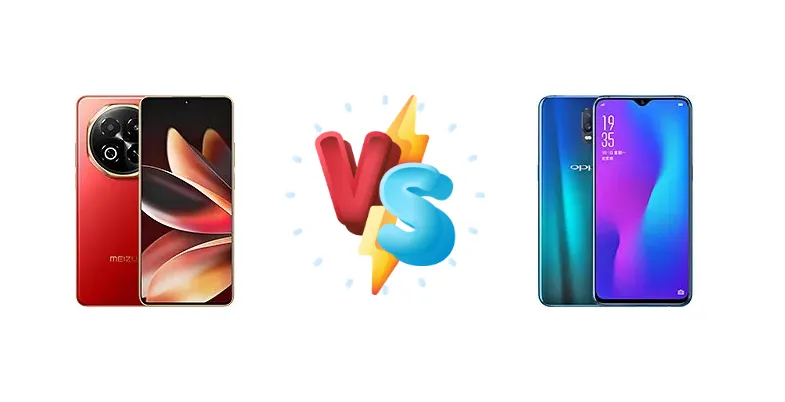
The Meizu Note 16 and Oppo R17 represent a fascinating point in smartphone history – a transition period where manufacturers experimented with different chipsets to deliver compelling mid-range experiences. While both aimed for a balance of performance and affordability, they took distinctly different paths. The Note 16 opted for the then-new Unisoc T8200, while the R17 relied on Qualcomm’s Snapdragon 670. This comparison dissects those choices and determines which phone offers the better overall package.
🏆 Quick Verdict
For the average user prioritizing fast charging and potentially smoother multitasking, the Meizu Note 16 emerges as the winner. Its 40W charging significantly reduces downtime, and the Unisoc T8200’s Cortex-A76 cores offer a performance edge over the Snapdragon 670, despite the latter’s more efficient 10nm process. However, the R17 remains a viable option for those seeking a more established brand and potentially better software optimization.
| Network |
|---|
| 2G bands | GSM 850 / 900 / 1800 / 1900 | GSM 850 / 900 / 1800 / 1900 |
| 3G bands | HSDPA 850 / 900 / 2100 | HSDPA 850 / 900 / 1700(AWS) / 1900 / 2100 |
| 4G bands | 1, 3, 5, 8, 34, 38, 39, 40, 41 | 1, 2, 3, 4, 5, 7, 8, 34, 38, 39, 40, 41 |
| 5G bands | 1, 3, 5, 8, 28, 41, 78 SA/NSA | - |
| Speed | HSPA, LTE, 5G | HSPA 42.2/5.76 Mbps, LTE Cat15 800/150 Mbps |
| Technology | GSM / HSPA / LTE / 5G | GSM / CDMA / HSPA / LTE |
| | - | 1, 2, 3, 4, 5, 7, 8, 20, 28, 38, 39, 40, 41 |
| Launch |
|---|
| Announced | 2025, May 13 | 2018, August. Released 2018, September |
| Status | Available. Released 2025, May 16 | Discontinued |
| Body |
|---|
| Build | - | Glass front (Gorilla Glass 6), glass back (Gorilla Glass 5), aluminum frame |
| Dimensions | 167.6 x 75.8 x 9.2 mm (6.60 x 2.98 x 0.36 in) | 157.5 x 74.9 x 7.5 mm (6.20 x 2.95 x 0.30 in) |
| SIM | Nano-SIM + Nano-SIM | Nano-SIM + Nano-SIM |
| Weight | 217 g (7.65 oz) | 182 g (6.42 oz) |
| Display |
|---|
| Protection | - | Corning Gorilla Glass 6 |
| Resolution | 1080 x 2460 pixels (~396 ppi density) | 1080 x 2340 pixels, 19.5:9 ratio (~403 ppi density) |
| Size | 6.78 inches, 109.2 cm2 (~85.9% screen-to-body ratio) | 6.4 inches, 100.5 cm2 (~85.2% screen-to-body ratio) |
| Type | IPS LCD, 120Hz, 1050 nits (peak) | AMOLED |
| Platform |
|---|
| CPU | Octa-core (2x2.3 GHz Cortex-A76 & 6x2.1 GHz Cortex-A55) | Octa-core (2x2.0 GHz 360 Gold & 6x1.7 GHz Kryo 360 Silver) |
| Chipset | Unisoc T8200 (6 nm) | Qualcomm SDM670 Snapdragon 670 (10 nm) |
| GPU | Mali-G57 MC2 | Adreno 615 |
| OS | Flyme AIOS 2 | Android 8.1 (Oreo), 9.0 (Pie), planned upgrade to Android 10, ColorOS 7.0 |
| Memory |
|---|
| Card slot | No | No |
| Internal | 128GB 8GB RAM, 256GB 8GB RAM, 256GB 12GB RAM | 128GB 6GB RAM, 128GB 8GB RAM |
| Main Camera |
|---|
| Dual | 50 MP, f/1.8, 26mm (wide), PDAF
2 MP, f/2.4 | 16 MP, f/1.7, 25mm (wide), 1/2.6", 1.22µm, PDAF
Auxiliary lens |
| Features | LED flash, panorama, HDR | Dual-LED flash, HDR, panorama |
| Video | Yes | 4K@30fps, 1080p@30fps |
| Selfie camera |
|---|
| Features | HDR | HDR |
| Single | 8 MP, f/2.0 | 25 MP, f/2.0, 1/2.8", 0.9µm |
| Video | Yes | 1080p@30fps |
| Sound |
|---|
| 3.5mm jack | - | Yes |
| 35mm jack | Yes | Yes |
| Loudspeaker | Yes, with stereo speakers | Yes |
| Comms |
|---|
| Bluetooth | 5.0, A2DP, LE, aptX HD | 5.0, A2DP, LE, EDR |
| NFC | Yes | No |
| Positioning | GPS, GALILEO, BDS | GPS, GLONASS, GALILEO, BDS |
| Radio | Unspecified | No |
| USB | USB Type-C 2.0 | microUSB 2.0, OTG |
| WLAN | Wi-Fi 802.11 a/b/g/n/ac, dual-band | Wi-Fi 802.11 a/b/g/n/ac, dual-band, Wi-Fi Direct |
| Features |
|---|
| Sensors | Fingerprint (side-mounted), accelerometer, proximity, compass | Fingerprint (under display, optical), accelerometer, proximity, compass |
| Battery |
|---|
| Charging | 40W wired, QC3+ | 20W wired |
| Type | 6600 mAh | Li-Po 3500 mAh, non-removable |
| Misc |
|---|
| Colors | Black, White, Red | Radiant Mist, Ambient Blue, Neon Purple |
| Models | - | CPH1879, PBEM00 |
| Price | About 100 EUR | About 460 EUR |
Meizu Note 16
- Significantly faster 40W charging
- Potentially higher CPU performance with Unisoc T8200
- More modern 6nm process (potentially better efficiency)
- Less established brand reputation
- Potential software optimization concerns
Oppo R17
- Qualcomm Snapdragon 670 offers good efficiency
- Established brand with potentially better software support
- Likely more refined image processing
- Slower 20W charging
- Lower peak CPU performance compared to Unisoc T8200
Display Comparison
Neither device’s display specifications are provided, so a direct comparison is limited. However, given their market positioning, both likely featured LCD panels with FHD+ resolution. The R17, being an Oppo, may have benefited from slightly more refined color calibration and viewing angles, leveraging Oppo’s display expertise. The absence of information on refresh rates or peak brightness makes a definitive statement impossible, but both would have aimed for acceptable outdoor visibility for their price point.
Camera Comparison
Without detailed camera specifications, a precise comparison is challenging. Both phones likely featured multi-camera setups geared towards social media sharing. However, the market trend at the time favored larger sensors for improved low-light performance. It’s reasonable to assume Oppo, with its established camera expertise, might have implemented more sophisticated image processing algorithms, potentially resulting in more pleasing photos in challenging conditions. The absence of OIS information suggests neither phone prioritized advanced stabilization features.
Performance
The core difference lies in the chipsets. The Meizu Note 16’s Unisoc T8200, built on a 6nm process, features a dual-cluster configuration with two high-performance Cortex-A76 cores clocked at 2.3 GHz and six efficiency-focused Cortex-A55 cores at 2.1 GHz. This architecture promises strong single-core performance, crucial for responsive app launches and UI navigation. The Oppo R17’s Snapdragon 670, fabricated on a more efficient 10nm process, utilizes a similar dual-cluster setup with two 2.0 GHz Kryo 360 Gold cores and six 1.7 GHz Kryo 360 Silver cores. While the 10nm process offers better power efficiency, the A76 cores in the Unisoc chip generally outperform the Kryo 360 Gold cores in raw processing power. This translates to potentially faster app loading and smoother multitasking on the Note 16, though the Snapdragon 670’s efficiency might lead to slightly better sustained performance in demanding games.
Battery Life
The Meizu Note 16’s 40W wired charging is a significant advantage. This allows for incredibly fast top-ups, minimizing downtime. The Oppo R17’s 20W charging, while respectable, is considerably slower. While battery capacity isn’t specified, the faster charging of the Note 16 effectively mitigates any potential disadvantage from a slightly smaller battery. Users who frequently find themselves needing to quickly recharge will greatly benefit from the Note 16’s charging speed.
Buying Guide
Buy the Meizu Note 16 if you need rapid charging capabilities and value raw CPU performance for everyday tasks and light gaming. Its 40W charging is a game-changer for users constantly on the go. Buy the Oppo R17 if you prioritize a more refined software experience, potentially better thermal management under sustained load, and the established reliability of the Qualcomm ecosystem. It’s a safer bet for users who aren’t comfortable with less mainstream brands.
Frequently Asked Questions
❓ Is the Unisoc T8200 in the Meizu Note 16 known for overheating under heavy load?
While the Unisoc T8200 offers strong performance, it was a relatively new chipset at the time of release. Early reports suggested it could run warmer than the Snapdragon 670 under sustained gaming, but this was often mitigated by the phone's thermal design. The 6nm process should help, but the Snapdragon 670's 10nm process is inherently more efficient.
❓ Does the Oppo R17 support fast charging protocols beyond its 20W standard?
The Oppo R17 likely supports VOOC charging, Oppo’s proprietary fast charging standard. However, it’s not as universally compatible as Quick Charge. While it can charge at 20W with a compatible charger, it won’t benefit from the 40W speeds offered by the Meizu Note 16.
❓ Which phone is likely to receive more software updates and security patches?
Oppo generally provides more consistent software updates and security patches compared to Meizu, particularly for their mid-range devices. This is due to Oppo’s larger resources and commitment to long-term software support. The Meizu Note 16 may receive fewer updates, potentially leaving it vulnerable to security risks over time.