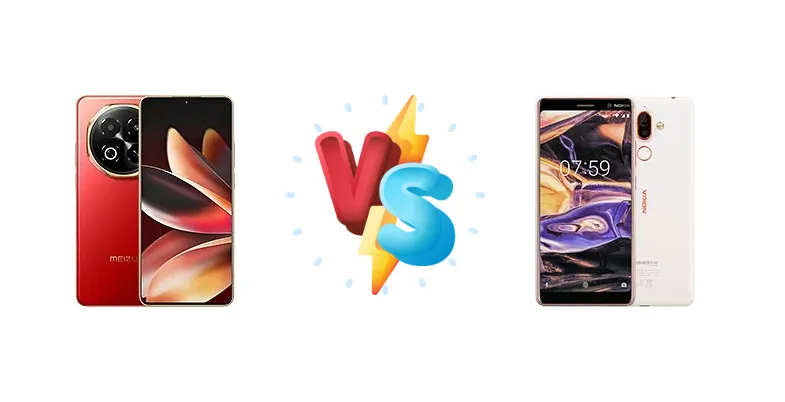
The Meizu Note 16 and Nokia 7 Plus represent distinct approaches to the mid-range smartphone market. The Note 16, arriving later, leverages a newer Unisoc chipset and faster charging, while the Nokia 7 Plus, a well-regarded device from HMD Global, prioritizes battery endurance and a refined software experience. This comparison dissects their key differences to determine which phone best suits your needs.
🏆 Quick Verdict
For users prioritizing rapid charging and potentially better sustained performance in demanding tasks, the Meizu Note 16 is the stronger choice. However, the Nokia 7 Plus’s proven 87-hour endurance rating and established reliability make it ideal for those who value long-lasting battery life above all else.
| Network |
|---|
| 2G bands | GSM 850 / 900 / 1800 / 1900 | GSM 850 / 900 / 1800 / 1900 |
| 3G bands | HSDPA 850 / 900 / 2100 | HSDPA 850 / 900 / 1900 / 2100 |
| 4G bands | 1, 3, 5, 8, 34, 38, 39, 40, 41 | 1, 3, 5, 7, 8, 20, 28, 38, 40, 41 - Global |
| 5G bands | 1, 3, 5, 8, 28, 41, 78 SA/NSA | - |
| Speed | HSPA, LTE, 5G | HSPA 42.2/5.76 Mbps, LTE (2CA) Cat6 300/50 Mbps |
| Technology | GSM / HSPA / LTE / 5G | GSM / CDMA / HSPA / EVDO / LTE |
| | - | 1, 3, 4, 5, 7, 8, 20, 28, 34, 38, 39, 40, 41 - China |
| Launch |
|---|
| Announced | 2025, May 13 | 2018, February 25. Released 2018, April 30 |
| Status | Available. Released 2025, May 16 | Discontinued |
| Body |
|---|
| Build | - | Glass front (Gorilla Glass 3), aluminum back, aluminum frame (6000 series) |
| Dimensions | 167.6 x 75.8 x 9.2 mm (6.60 x 2.98 x 0.36 in) | 158.4 x 75.6 x 8 mm (6.24 x 2.98 x 0.31 in) |
| SIM | Nano-SIM + Nano-SIM | Nano-SIM + Nano-SIM |
| Weight | 217 g (7.65 oz) | 183 g (6.46 oz) |
| Display |
|---|
| Protection | - | Corning Gorilla Glass 3 |
| Resolution | 1080 x 2460 pixels (~396 ppi density) | 1080 x 2160 pixels, 18:9 ratio (~403 ppi density) |
| Size | 6.78 inches, 109.2 cm2 (~85.9% screen-to-body ratio) | 6.0 inches, 92.4 cm2 (~77.2% screen-to-body ratio) |
| Type | IPS LCD, 120Hz, 1050 nits (peak) | IPS LCD |
| Platform |
|---|
| CPU | Octa-core (2x2.3 GHz Cortex-A76 & 6x2.1 GHz Cortex-A55) | Octa-core (4x2.2 GHz Kryo 260 Gold & 4x1.8 GHz Kryo 260 Silver) |
| Chipset | Unisoc T8200 (6 nm) | Qualcomm SDM660 Snapdragon 660 (14 nm) |
| GPU | Mali-G57 MC2 | Adreno 512 |
| OS | Flyme AIOS 2 | Android 8.1 (Oreo), upgradable to Android 10, Android One |
| Memory |
|---|
| Card slot | No | microSDXC (uses shared SIM slot) |
| Internal | 128GB 8GB RAM, 256GB 8GB RAM, 256GB 12GB RAM | 64GB 4GB RAM, 64GB 6GB RAM |
| | - | eMMC 5.1 |
| Main Camera |
|---|
| Dual | 50 MP, f/1.8, 26mm (wide), PDAF
2 MP, f/2.4 | 12 MP, f/1.8, 25mm (wide), 1/2.55", 1.4µm, dual pixel PDAF
13 MP, f/2.6, (telephoto), 1/3.4", 1.0µm, AF, 2x optical zoom |
| Features | LED flash, panorama, HDR | Zeiss optics, dual-LED dual-tone flash, panorama, HDR |
| Video | Yes | 4K@30fps, 1080p@30fps (gyro-EIS) |
| Selfie camera |
|---|
| Features | HDR | Zeiss optics |
| Single | 8 MP, f/2.0 | 16 MP, f/2.0, 1/3.06", 1.0µm |
| Video | Yes | 1080p@30fps |
| Sound |
|---|
| 3.5mm jack | - | Yes |
| 35mm jack | Yes | Yes |
| Loudspeaker | Yes, with stereo speakers | Yes |
| Comms |
|---|
| Bluetooth | 5.0, A2DP, LE, aptX HD | 5.0, A2DP, LE |
| NFC | Yes | Yes |
| Positioning | GPS, GALILEO, BDS | GPS, GLONASS, BDS |
| Radio | Unspecified | No |
| USB | USB Type-C 2.0 | USB Type-C 2.0, OTG |
| WLAN | Wi-Fi 802.11 a/b/g/n/ac, dual-band | Wi-Fi 802.11 a/b/g/n/ac, dual-band, Wi-Fi Direct |
| Features |
|---|
| Sensors | Fingerprint (side-mounted), accelerometer, proximity, compass | Fingerprint (rear-mounted), accelerometer, gyro, proximity, compass |
| Battery |
|---|
| Charging | 40W wired, QC3+ | 18W wired |
| Music play | - | Up to 126 h |
| Stand-by | - | Up to 723 h (3G) |
| Talk time | - | Up to 19 h (3G) |
| Type | 6600 mAh | Li-Ion 3800 mAh, non-removable |
| Misc |
|---|
| Colors | Black, White, Red | Black/Copper, White/Copper |
| Models | - | TA-1041, TA-1062, TA-1046 |
| Price | About 100 EUR | About 490 EUR |
| SAR EU | - | 0.36 W/kg (head) 1.78 W/kg (body) |
| Tests |
|---|
| Audio quality | - |
Noise -38.8dB / Crosstalk -95.9dB |
| Battery life | - |
Endurance rating 87h
|
| Camera | - |
Photo / Video |
| Display | - |
Contrast ratio: 1701:1 (nominal), 3.479 (sunlight) |
| Loudspeaker | - |
Voice 67dB / Noise 71dB / Ring 79dB
|
| Performance | - |
AnTuTu: 140820 (v7)
GeekBench: 5893 (v4.4)
GFXBench: 8.6fps (ES 3.1 onscreen) |
Meizu Note 16
- Faster 40W charging with QC3+ support
- More modern Unisoc T8200 chipset for potentially better performance
- 6nm process node for improved efficiency
- Battery capacity is unknown
- Camera specifications are not detailed
Nokia 7 plus
- Exceptional 87-hour battery endurance
- High display contrast ratio for vibrant visuals
- Proven reliability and software support from HMD Global
- Slower 18W charging
- Older Snapdragon 660 chipset
Display Comparison
Both the Meizu Note 16 and Nokia 7 Plus share a contrast ratio of 1701:1 (nominal) and 3.479 (sunlight), suggesting similar outdoor visibility. However, the context data lacks specifics on panel technology (IPS, AMOLED) or resolution for the Note 16. The Nokia 7 Plus’s display benefits from its high contrast ratio, ensuring vibrant colors and deep blacks. Without further display specs for the Note 16, it’s difficult to assess potential advantages in color accuracy or viewing angles.
Camera Comparison
Both phones are listed with 'Photo / Video' capabilities, but lack specific details. The absence of sensor size or aperture information makes a direct comparison impossible. However, the market positioning of the Nokia 7 Plus suggests a focus on reliable image processing and good low-light performance. The Meizu Note 16, being a newer device, *could* incorporate more advanced image processing algorithms, but this is speculative without further data. It's likely both phones feature a standard multi-camera setup, but without details, assessing their photographic capabilities remains challenging.
Performance
The core difference lies in the chipsets. The Meizu Note 16’s Unisoc T8200 (6nm) utilizes a more modern architecture with Cortex-A76 cores, promising superior single-core performance compared to the Nokia 7 Plus’s Snapdragon 660 (14nm) and its Kryo 260 cores. The 6nm process node of the Unisoc chip also translates to improved power efficiency and potentially less thermal throttling under sustained load. While the Snapdragon 660 is a capable performer, the Unisoc T8200 should offer a noticeable performance uplift, particularly in graphics-intensive applications. The Note 16’s potential for faster RAM speeds (LPDDR4X vs potentially older LPDDR in the 7 Plus) could further enhance responsiveness.
Battery Life
The Nokia 7 Plus boasts an impressive endurance rating of 87 hours, a testament to its efficient chipset and software optimization. The Meizu Note 16 compensates with 40W wired charging (with QC3+ support), significantly faster than the Nokia 7 Plus’s 18W charging. While the Note 16’s battery capacity is unknown, the faster charging allows for quick top-ups, mitigating any potential capacity disadvantage. The Nokia 7 Plus prioritizes longevity, while the Note 16 focuses on minimizing downtime.
Buying Guide
Buy the Meizu Note 16 if you frequently find yourself needing to top up your phone quickly and value the potential performance gains from the newer Unisoc T8200 chipset. Buy the Nokia 7 Plus if you prioritize all-day (and beyond) battery life, a clean Android experience, and a phone with a proven track record of reliability. The Nokia 7 Plus is the better option for users who don't want to worry about daily charging.
Frequently Asked Questions
❓ Is the Unisoc T8200 in the Meizu Note 16 capable of handling demanding games like PUBG or Genshin Impact?
The Unisoc T8200’s Cortex-A76 cores and modern architecture suggest it *should* be capable of running PUBG and Genshin Impact at medium settings. However, sustained performance will depend on the phone’s thermal management. The 6nm process node should help mitigate throttling, but real-world testing is needed to confirm optimal frame rates and stability.
❓ How long does it realistically take to fully charge the Meizu Note 16 with the 40W charger?
With 40W charging and QC3+ support, the Meizu Note 16 should be able to charge from 0% to 100% in approximately 60-75 minutes, assuming a battery capacity around 4000-5000mAh. This is significantly faster than the Nokia 7 Plus’s 18W charging, which would likely take over 2 hours for a full charge.
❓ Does the Nokia 7 Plus still receive software updates and security patches?
The Nokia 7 Plus was a flagship for HMD Global and received excellent software support. While it may not be receiving the latest Android version, it should still be receiving critical security patches for the foreseeable future, ensuring a secure user experience.