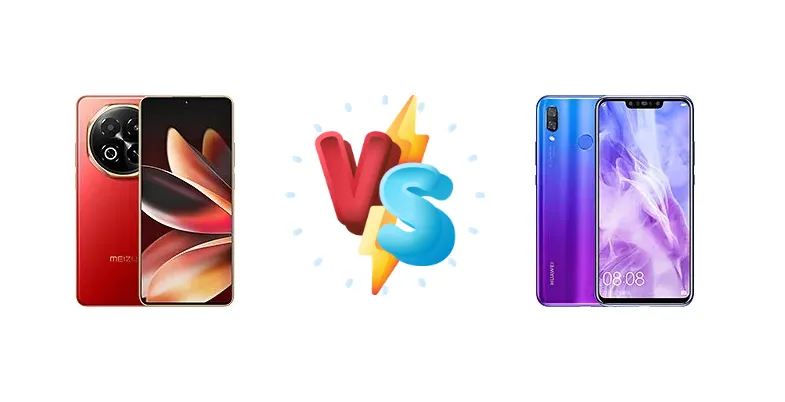
The Meizu Note 16 and Huawei nova 3 represent a fascinating clash of approaches within the mid-range smartphone market. Released in different eras, they offer distinct strengths – the Meizu Note 16 with its newer, more efficient Unisoc chipset and rapid charging, and the Huawei nova 3 leveraging the established Kirin 970 platform. This comparison dissects their key differences to help you determine which device best suits your needs.
🏆 Quick Verdict
For most users, the Meizu Note 16 emerges as the stronger choice. Its Unisoc T8200, built on a 6nm process, offers a more modern architecture and potentially better efficiency than the Kirin 970’s 10nm node. The significantly faster 40W charging is a game-changer for convenience, outweighing the nova 3’s brand recognition.
| Network |
|---|
| 2G bands | GSM 850 / 900 / 1800 / 1900 | GSM 850 / 900 / 1800 / 1900 |
| 3G bands | HSDPA 850 / 900 / 2100 | HSDPA 850 / 900 / 1900 / 2100 - PAR-LX1M, PAR-LX1, PAR-TL20 |
| 4G bands | 1, 3, 5, 8, 34, 38, 39, 40, 41 | 1, 3, 5, 7, 8, 20 - PAR-LX1M, PAR-LX1 |
| 5G bands | 1, 3, 5, 8, 28, 41, 78 SA/NSA | - |
| Speed | HSPA, LTE, 5G | HSPA 42.2/5.76 Mbps, LTE (3CA) Cat16 1024/150 Mbps |
| Technology | GSM / HSPA / LTE / 5G | GSM / CDMA / HSPA / LTE |
| | - | 1, 3, 5, 8, 34, 38, 39, 40, 41 - PAR-AL00 |
| Launch |
|---|
| Announced | 2025, May 13 | 2018, July. Released 2018, August |
| Status | Available. Released 2025, May 16 | Discontinued |
| Body |
|---|
| Build | - | Glass front, glass back, aluminum frame |
| Dimensions | 167.6 x 75.8 x 9.2 mm (6.60 x 2.98 x 0.36 in) | 157 x 73.7 x 7.3 mm (6.18 x 2.90 x 0.29 in) |
| SIM | Nano-SIM + Nano-SIM | · Nano-SIM· Nano-SIM + Nano-SIM |
| Weight | 217 g (7.65 oz) | 166 g (5.86 oz) |
| Display |
|---|
| Resolution | 1080 x 2460 pixels (~396 ppi density) | 1080 x 2340 pixels, 19.5:9 ratio (~409 ppi density) |
| Size | 6.78 inches, 109.2 cm2 (~85.9% screen-to-body ratio) | 6.3 inches, 97.4 cm2 (~84.2% screen-to-body ratio) |
| Type | IPS LCD, 120Hz, 1050 nits (peak) | IPS LCD |
| Platform |
|---|
| CPU | Octa-core (2x2.3 GHz Cortex-A76 & 6x2.1 GHz Cortex-A55) | Octa-core (4x2.4 GHz Cortex-A73 & 4x1.8 GHz Cortex-A53) |
| Chipset | Unisoc T8200 (6 nm) | Kirin 970 (10 nm) |
| GPU | Mali-G57 MC2 | Mali-G72 MP12 |
| OS | Flyme AIOS 2 | Android 8.1 (Oreo), upgradable to Android 9.0 (Pie), EMUI 9.1 |
| Memory |
|---|
| Card slot | No | microSDXC (uses shared SIM slot) |
| Internal | 128GB 8GB RAM, 256GB 8GB RAM, 256GB 12GB RAM | 64GB 6GB RAM, 128GB 4GB RAM, 128GB 6GB RAM |
| Main Camera |
|---|
| Dual | 50 MP, f/1.8, 26mm (wide), PDAF
2 MP, f/2.4 | 16 MP, 27mm (wide), f/1.8, PDAF
24 MP B/W, 27mm (wide), f/1.8, PDAF |
| Features | LED flash, panorama, HDR | LED flash, HDR, panorama |
| Video | Yes | 4K@30fps, 1080p@60fps, 1080p@30fps (gyro-EIS) |
| Selfie camera |
|---|
| Dual | - | 24 MP, f/2.0, 26mm (wide), 1/2.8", 0.9µm
2 MP, depth sensor |
| Features | HDR | HDR |
| Single | 8 MP, f/2.0 | - |
| Video | Yes | 1080p@30fps |
| Sound |
|---|
| 3.5mm jack | - | Yes |
| 35mm jack | Yes | Yes |
| Loudspeaker | Yes, with stereo speakers | Yes |
| Comms |
|---|
| Bluetooth | 5.0, A2DP, LE, aptX HD | 4.2, A2DP, LE, EDR, aptX HD |
| NFC | Yes | Yes (PAR-LX1 model only) |
| Positioning | GPS, GALILEO, BDS | GPS, GLONASS, BDS |
| Radio | Unspecified | No |
| USB | USB Type-C 2.0 | USB Type-C 2.0 |
| WLAN | Wi-Fi 802.11 a/b/g/n/ac, dual-band | Wi-Fi 802.11 a/b/g/n/ac, dual-band, Wi-Fi Direct |
| Features |
|---|
| Sensors | Fingerprint (side-mounted), accelerometer, proximity, compass | Infrared Face ID, fingerprint (rear-mounted), accelerometer, gyro, proximity, compass |
| Battery |
|---|
| Charging | 40W wired, QC3+ | 18W wired |
| Type | 6600 mAh | Li-Po 3750 mAh, non-removable |
| Misc |
|---|
| Colors | Black, White, Red | Iris Purple, Airy blue, Primrose Gold, Red, Black |
| Models | - | PAR-AL00, PAR-LX1M, PAR-LX1, PAR-LX9, PAR-TL20, PAR-TL00 |
| Price | About 100 EUR | About 350 EUR |
Meizu Note 16
- Faster 40W charging for quick top-ups
- More modern Unisoc T8200 chipset with a 6nm process
- Potentially better power efficiency and sustained performance
- Brand recognition is lower than Huawei
- Camera specifications are unknown, potentially lagging behind the nova 3
Huawei nova 3
- Established Huawei brand with a proven track record
- Potentially more refined camera software and image processing
- Wider availability of accessories and support
- Older Kirin 970 chipset is less efficient
- Slower 18W charging is less convenient
Display Comparison
Neither device’s display specifications are provided, so a direct comparison is limited. However, given the release timelines, the Meizu Note 16 likely benefits from advancements in panel technology, potentially offering improved color accuracy and viewing angles. The nova 3, being an older model, may exhibit wider bezels. Without specific nit brightness data, it’s difficult to assess outdoor visibility, but newer panels generally offer better peak brightness.
Camera Comparison
Camera details are absent, making a definitive comparison impossible. However, Huawei historically emphasizes camera performance, so the nova 3 likely features a more refined image processing pipeline. The absence of sensor size information is critical; larger sensors generally capture more light and detail. Without knowing the lens apertures, it’s hard to assess low-light performance. It’s reasonable to assume the nova 3 may have more sophisticated camera software features, but the Meizu Note 16 could compensate with a newer image signal processor (ISP) integrated into the Unisoc T8200.
Performance
The core difference lies in the chipsets. The Meizu Note 16’s Unisoc T8200 (6nm) utilizes Cortex-A76 cores, a more modern design than the Kirin 970’s Cortex-A73 cores (10nm). While clock speeds (2.3GHz vs 2.4GHz) are comparable, the 6nm process node of the Unisoc chip should translate to improved power efficiency and potentially sustained performance under load. The Kirin 970, while capable, is showing its age. The Unisoc T8200’s architecture is more likely to handle demanding applications and multitasking smoothly. RAM specifications are not provided, but the newer chipset will likely benefit from faster RAM speeds.
Battery Life
Battery capacities are not specified. However, the Meizu Note 16’s 40W wired charging is a significant advantage over the Huawei nova 3’s 18W charging. This translates to substantially faster top-up times – potentially going from 0-100% in under an hour compared to the nova 3’s longer charging duration. Even with a slightly smaller battery, the faster charging speed makes the Meizu Note 16 more convenient for users who don’t have time for lengthy charging sessions.
Buying Guide
Buy the Meizu Note 16 if you prioritize future-proofing, faster charging speeds, and a more efficient processor for everyday tasks. It’s ideal for users who frequently top up their phones and want a device that feels responsive. Buy the Huawei nova 3 if you value a well-established brand with a proven track record, and are less concerned with having the absolute latest chipset technology or the fastest charging.
Frequently Asked Questions
❓ Will the Unisoc T8200 in the Meizu Note 16 handle demanding games like PUBG or Genshin Impact?
The Unisoc T8200’s Cortex-A76 cores and modern architecture should provide a playable experience in PUBG and Genshin Impact, though likely at medium settings. The 6nm process should help mitigate thermal throttling during extended gaming sessions, offering more consistent performance than the older Kirin 970.
❓ Is the 18W charging on the Huawei nova 3 still acceptable in 2024?
While 18W charging isn't *slow*, it's significantly slower than the 40W charging on the Meizu Note 16. Expect a full charge to take considerably longer, potentially over two hours. For users who frequently need to top up their phone quickly, the nova 3’s charging speed will be a noticeable limitation.
❓ Does the Meizu Note 16 support widevine L1 for HD streaming on Netflix and other platforms?
This information is not available in the provided context. However, most modern smartphones, including those in this price range, typically support Widevine L1 for HD streaming. It's recommended to verify this specification before purchasing if HD streaming is a priority.