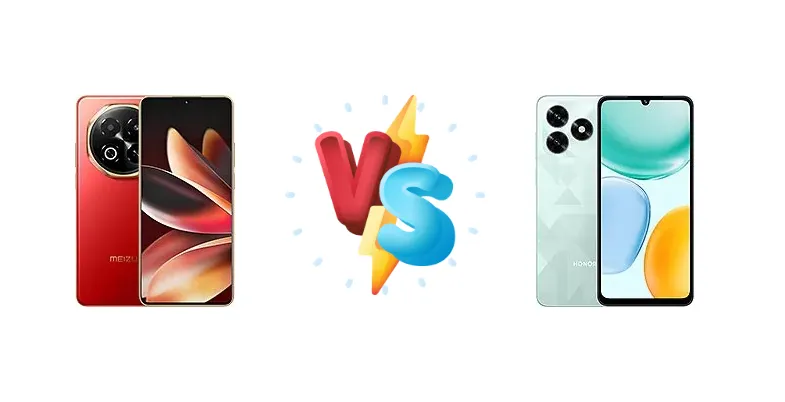
The Meizu Note 16 and Honor Play10A represent distinct approaches to the budget smartphone market. The Note 16, while older, boasts a more advanced 6nm Unisoc T8200 chipset and significantly faster 40W charging. The Play10A counters with a Mediatek Helio G81 and a focus on affordability. This comparison dives deep into the core differences to determine which device delivers the best experience for your money.
🏆 Quick Verdict
For the average user prioritizing performance and convenience, the Meizu Note 16 is the clear winner. Its Unisoc T8200 chipset, built on a 6nm process, offers a noticeable performance advantage over the Play10A’s 12nm Helio G81, and the 40W charging is a game-changer for quick top-ups. However, the Play10A remains a viable option for those on a very tight budget.
| Network |
|---|
| 2G bands | GSM 850 / 900 / 1800 / 1900 | GSM 850 / 900 / 1800 / 1900 |
| 3G bands | HSDPA 850 / 900 / 2100 | HSDPA 850 / 900 / 1900 / 2100 |
| 4G bands | 1, 3, 5, 8, 34, 38, 39, 40, 41 | LTE |
| 5G bands | 1, 3, 5, 8, 28, 41, 78 SA/NSA | - |
| Speed | HSPA, LTE, 5G | HSPA, LTE |
| Technology | GSM / HSPA / LTE / 5G | GSM / HSPA / LTE |
| Launch |
|---|
| Announced | 2025, May 13 | 2025, October 23 |
| Status | Available. Released 2025, May 16 | Available. Released 2025, October 23 |
| Body |
|---|
| Dimensions | 167.6 x 75.8 x 9.2 mm (6.60 x 2.98 x 0.36 in) | 167 x 77 x 7.9 mm (6.57 x 3.03 x 0.31 in) |
| SIM | Nano-SIM + Nano-SIM | Nano-SIM + Nano-SIM |
| Weight | 217 g (7.65 oz) | 186 g (6.56 oz) |
| Display |
|---|
| Resolution | 1080 x 2460 pixels (~396 ppi density) | 720 x 1600 pixels, 20:9 ratio (~260 ppi density) |
| Size | 6.78 inches, 109.2 cm2 (~85.9% screen-to-body ratio) | 6.74 inches, 109.7 cm2 (~85.3% screen-to-body ratio) |
| Type | IPS LCD, 120Hz, 1050 nits (peak) | TFT LCD, 90Hz |
| Platform |
|---|
| CPU | Octa-core (2x2.3 GHz Cortex-A76 & 6x2.1 GHz Cortex-A55) | Octa-core (2x2.0 GHz Cortex-A75 & 6x1.7 GHz Cortex-A55) |
| Chipset | Unisoc T8200 (6 nm) | Mediatek Helio G81 (12 nm) |
| GPU | Mali-G57 MC2 | Mali-G52 MC2 |
| OS | Flyme AIOS 2 | Android 15, MagicOS 9 |
| Memory |
|---|
| Card slot | No | microSDXC (uses shared SIM slot) |
| Internal | 128GB 8GB RAM, 256GB 8GB RAM, 256GB 12GB RAM | 128GB 4GB RAM |
| Main Camera |
|---|
| Dual | 50 MP, f/1.8, 26mm (wide), PDAF
2 MP, f/2.4 | - |
| Features | LED flash, panorama, HDR | LED flash, HDR, panorama |
| Single | - | 50 MP, f/1.8, (wide), PDAF
Auxiliary lens |
| Video | Yes | 1080p@30fps |
| Selfie camera |
|---|
| Features | HDR | - |
| Single | 8 MP, f/2.0 | 5 MP, f/2.2, (wide) |
| Video | Yes | 1080p@30fps |
| Sound |
|---|
| 35mm jack | Yes | Yes |
| Loudspeaker | Yes, with stereo speakers | Yes |
| Comms |
|---|
| Bluetooth | 5.0, A2DP, LE, aptX HD | 5.1, A2DP, LE, aptX HD |
| NFC | Yes | No |
| Positioning | GPS, GALILEO, BDS | GPS, GLONASS, GALILEO, BDS |
| Radio | Unspecified | FM radio |
| USB | USB Type-C 2.0 | USB Type-C 2.0, OTG |
| WLAN | Wi-Fi 802.11 a/b/g/n/ac, dual-band | Wi-Fi 802.11 a/b/g/n/ac, dual-band, Wi-Fi Direct |
| Features |
|---|
| Sensors | Fingerprint (side-mounted), accelerometer, proximity, compass | Fingerprint (side-mounted), accelerometer, proximity |
| Battery |
|---|
| Charging | 40W wired, QC3+ | 15W wired |
| Type | 6600 mAh | Li-Po 5260 mAh |
| Misc |
|---|
| Colors | Black, White, Red | Ocean Cyan |
| Models | - | NLA-LX3 |
| Price | About 100 EUR | About 80 EUR |
Meizu Note 16
- Faster Unisoc T8200 chipset for better performance
- Significantly faster 40W charging with QC3+ support
- Potentially more refined camera system
- May be harder to find or more expensive due to age
- No information on display quality
Honor Play10A
- More affordable price point
- Widely available
- Decent performance for basic tasks
- Slower Mediatek Helio G81 chipset
- Slow 15W charging
- Likely lower-quality display and camera
Display Comparison
Neither device's display specifications are provided, so a direct comparison is limited. However, given the Note 16's positioning, it likely features a higher-quality panel than the Play10A. The Play10A, being a more budget-focused device, likely utilizes a standard LCD panel. The absence of details like refresh rate or resolution makes a definitive statement impossible, but the Note 16's overall positioning suggests a more refined visual experience.
Camera Comparison
Without specific camera sensor details, a detailed comparison is challenging. However, it's reasonable to assume the Meizu Note 16, positioned as a slightly more premium device, likely features a more capable main camera sensor. The image processing capabilities of the Unisoc T8200’s ISP may also be more advanced than the Helio G81’s. The presence of a dedicated ISP within the T8200 could lead to better dynamic range and noise reduction. We can expect the Play10A to include lower-resolution sensors to keep costs down.
Performance
The core difference lies in the chipsets. The Meizu Note 16’s Unisoc T8200, fabricated on a 6nm process, offers a significant advantage in power efficiency and transistor density compared to the Honor Play10A’s 12nm Mediatek Helio G81. The T8200’s Cortex-A76 cores, clocked at 2.3 GHz, are architecturally superior to the Play10A’s 2.0 GHz Cortex-A75 cores, translating to faster single-core performance. While both are octa-core CPUs, the T8200’s more efficient process node means less heat generation under load, potentially leading to sustained performance. The Play10A will be adequate for everyday tasks, but the Note 16 will handle multitasking and more demanding applications more smoothly.
Battery Life
Battery capacity isn't specified for either device, but the charging speeds are drastically different. The Meizu Note 16’s 40W wired charging with QC3+ support is a major advantage, allowing for significantly faster top-ups compared to the Honor Play10A’s 15W charging. Even with a similar battery capacity, the Note 16 will spend less time plugged into the wall. The 40W charging will likely deliver a 0-100% charge in under an hour, while the Play10A will likely take over two hours.
Buying Guide
Buy the Meizu Note 16 if you need a phone that can handle demanding apps and games with relative ease, and if you value fast charging to minimize downtime. Buy the Honor Play10A if you prioritize absolute affordability and are willing to compromise on processing power and charging speed for a lower price point. The Play10A is best suited for basic tasks like calling, texting, and light social media use.
Frequently Asked Questions
❓ Will the Unisoc T8200 in the Meizu Note 16 handle demanding games like PUBG or Call of Duty Mobile?
The Unisoc T8200 is capable of running these games, but you'll likely need to adjust graphics settings to medium or low for a smooth experience. The 6nm process and Cortex-A76 cores provide a performance boost over the Play10A, but it's not a flagship-level chipset.
❓ How much faster is the 40W charging on the Meizu Note 16 compared to the 15W charging on the Honor Play10A in real-world use?
Expect a substantial difference. The Meizu Note 16 can likely charge from 0-100% in under an hour, while the Honor Play10A will likely take over two hours. This means you can quickly top up the Note 16 during short breaks, whereas the Play10A requires a longer charging period.
❓ Is the Mediatek Helio G81 in the Honor Play10A sufficient for everyday tasks like browsing, social media, and calling?
Yes, the Helio G81 is perfectly adequate for these basic tasks. It won't struggle with everyday use, but you may notice slowdowns when multitasking or running more demanding applications.