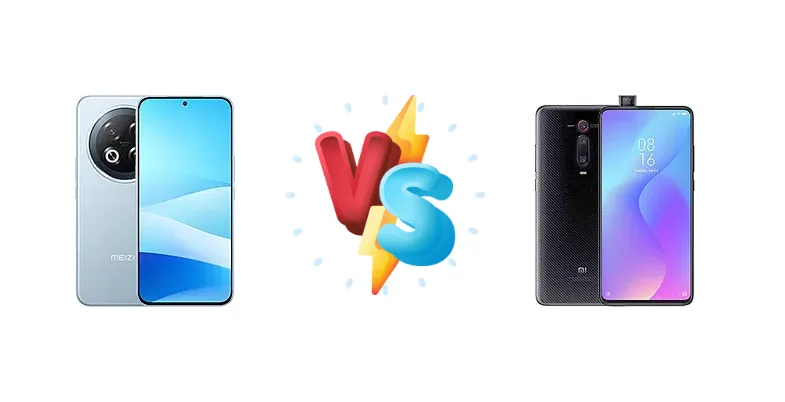
The Meizu Note 16 Pro and Xiaomi Mi 9T Pro represent interesting points in the smartphone timeline. The Mi 9T Pro, released with the Snapdragon 855, was a performance leader in its day. The Meizu Note 16 Pro, arriving later, leverages the newer, more efficient Snapdragon 7s Gen 3. This comparison dissects whether the architectural advancements of the 7s Gen 3 can close the gap with the 855’s raw power, and how each phone caters to different user priorities.
🏆 Quick Verdict
For most users, the Xiaomi Mi 9T Pro offers a slightly better overall experience due to its more powerful Snapdragon 855. However, the Meizu Note 16 Pro’s significantly faster 80W charging and potentially improved thermal management make it a compelling alternative for those prioritizing convenience and sustained performance over peak benchmarks.
| Network |
|---|
| 2G bands | GSM 850 / 900 / 1800 / 1900 | GSM 850 / 900 / 1800 / 1900 |
| 3G bands | HSDPA 850 / 900 / 1700(AWS) / 1900 / 2100 | HSDPA 850 / 900 / 1700(AWS) / 1900 / 2100 |
| 4G bands | 1, 2, 3, 4, 5, 8, 20, 28, 34, 38, 39, 40, 41 | 1, 2, 3, 4, 5, 7, 8, 20, 28, 38, 40 |
| 5G bands | 1, 2, 3, 5, 8, 20, 28, 38, 40, 41, 77, 78 SA/NSA | - |
| Speed | HSPA, LTE, 5G | HSPA, LTE |
| Technology | GSM / HSPA / LTE / 5G | GSM / HSPA / LTE |
| Launch |
|---|
| Announced | 2025, May 13 | 2019, August 21. Released 2019, August 21 |
| Status | Available. Released 2025, May 16 | Discontinued |
| Body |
|---|
| Build | - | Glass front (Gorilla Glass 5), glass back (Gorilla Glass 5), aluminum frame |
| Dimensions | 163.8 x 76.2 x 8.4 mm (6.45 x 3.00 x 0.33 in) | 156.7 x 74.3 x 8.8 mm (6.17 x 2.93 x 0.35 in) |
| SIM | Nano-SIM + Nano-SIM | Nano-SIM + Nano-SIM |
| Weight | 197.5 g (6.98 oz) | 191 g (6.74 oz) |
| Display |
|---|
| Protection | - | Corning Gorilla Glass 5 |
| Resolution | 1224 x 2720 pixels, 20:9 ratio (~440 ppi density) | 1080 x 2340 pixels, 19.5:9 ratio (~403 ppi density) |
| Size | 6.78 inches, 111.0 cm2 (~88.9% screen-to-body ratio) | 6.39 inches, 100.2 cm2 (~86.1% screen-to-body ratio) |
| Type | OLED, 1B colors, 144Hz, 700 nits (typ), 1600 nits (peak), 4500 nits (peak) | Super AMOLED, HDR |
| Platform |
|---|
| CPU | Octa-core (1x2.5 GHz Cortex-A720 & 3x2.4 GHz Cortex-A720 & 4x1.8 GHz Cortex-A520) | Octa-core (1x2.84 GHz Kryo 485 & 3x2.42 GHz Kryo 485 & 4x1.78 GHz Kryo 485) |
| Chipset | Qualcomm SM7635 Snapdragon 7s Gen 3 (4 nm) | Qualcomm SM8150 Snapdragon 855 (7 nm) |
| GPU | Adreno 810 | Adreno 640 |
| OS | Flyme AIOS 2 | Android 9.0 (Pie), upgradable to Android 11, MIUI 12.5 |
| Memory |
|---|
| Card slot | No | No |
| Internal | 256GB 8GB RAM, 256GB 12GB RAM, 512GB 12GB RAM, 512GB 16GB RAM | 64GB 6GB RAM, 128GB 6GB RAM, 256GB 8GB RAM |
| | - | UFS 2.1 |
| Main Camera |
|---|
| Features | LED flash, panorama, HDR | Laser AF, Dual-LED flash, HDR, panorama |
| Triple | 50 MP, f/1.8, 26mm (wide), PDAF
8 MP, f/2.2, 15mm (ultrawide)
2 MP, f/2.4 | 48 MP, f/1.8, 26mm (wide), 1/2.0", 0.8µm, PDAF
8 MP, f/2.4, 53mm (telephoto), 1/4.0", 1.12µm, PDAF, 2x optical zoom
13 MP, f/2.4, 12mm (ultrawide), 1/3.1", 1.12µm |
| Video | Yes | 4K@30/60fps, 1080p@30/120/240fps, 1080p@960fps |
| Selfie camera |
|---|
| Features | HDR | HDR |
| Single | 8 MP, f/2.1 | Motorized pop-up 20 MP, f/2.2, (wide), 1/3.4", 0.8µm |
| Video | Yes | 1080p@30fps |
| Sound |
|---|
| 3.5mm jack | - | Yes |
| 35mm jack | No | Yes |
| Loudspeaker | Yes, with stereo speakers | Yes |
| | - | 24-bit/192kHz audio
|
| Comms |
|---|
| Bluetooth | 5.4, A2DP, LE, aptX HD, aptX Adaptive | 5.0, A2DP, LE, aptX HD |
| Infrared port | Yes | - |
| NFC | Yes | Yes |
| Positioning | GPS (L1+L5), BDS (B1I+B1C+B2a), GALILEO, QZSS, GLONASS | GPS (L1+L5), GLONASS (G1), BDS (B1), GALILEO (E1+E5a) |
| Radio | Unspecified | Yes |
| USB | USB Type-C 2.0 | USB Type-C 2.0, OTG |
| WLAN | Wi-Fi 802.11 a/b/g/n/ac/6, dual-band | Wi-Fi 802.11 a/b/g/n/ac, dual-band, Wi-Fi Direct |
| Features |
|---|
| Sensors | Fingerprint (under display, optical), accelerometer, gyro, proximity, compass | Fingerprint (under display, optical), accelerometer, gyro, proximity, compass |
| Battery |
|---|
| Charging | 80W wired, QC4+, PD3.0, PPS | 27W wired, QC4 |
| Type | 6200 mAh | Li-Po 4000 mAh, non-removable |
| Misc |
|---|
| Colors | Gray, Blue, White | Carbon black, Red flame, Glacier blue |
| Models | - | M1903F11G |
| Price | About 190 EUR | About 150 EUR |
| SAR | - | 1.03 W/kg (head) 0.72 W/kg (body) |
| SAR EU | - | 1.30 W/kg (head) 1.51 W/kg (body) |
| Tests |
|---|
| Audio quality | - |
Noise -93.9dB / Crosstalk -94.2dB |
| Battery life | - | Endurance rating 103h |
| Display | - |
Contrast ratio: Infinite (nominal) |
| Loudspeaker | - |
-26.9 LUFS (Good) |
| Performance | - |
AnTuTu: 368846 (v7), 437823 (v8)
GeekBench: 10684 (v4.4), 2732 (v5.1)
GFXBench: 36fps (ES 3.1 onscreen) |
Meizu Note 16 Pro
- Incredibly fast 80W charging
- More power-efficient Snapdragon 7s Gen 3 (4nm)
- Potentially better sustained performance due to thermal efficiency
- Potentially lower peak performance compared to Snapdragon 855
- Camera specs are unknown, potentially less capable than Mi 9T Pro
Xiaomi Mi 9T Pro
- More powerful Snapdragon 855 (7nm)
- Mature software optimization for display and camera
- Likely better dynamic range and low-light camera performance
- Slower 27W charging
- Potential for thermal throttling under sustained load
Display Comparison
Both devices share an 'Infinite' (nominal) contrast ratio, suggesting both utilize AMOLED panels. However, specific details like peak brightness and color gamut coverage are missing. The Mi 9T Pro’s display benefits from the established optimization of Xiaomi’s software, while the Meizu Note 16 Pro’s display quality will depend on Meizu’s calibration. Without further data, it’s difficult to definitively declare a winner, but the Mi 9T Pro’s mature software integration gives it a slight edge.
Camera Comparison
Detailed camera specs are absent, making a direct comparison challenging. However, the market positioning suggests the Mi 9T Pro likely features a more robust camera system overall. The Snapdragon 855’s ISP is more mature and capable of handling complex image processing. While the Meizu Note 16 Pro may offer competitive image quality, the Mi 9T Pro likely has an advantage in dynamic range and low-light performance. Without sensor size and aperture information, a definitive judgment is impossible.
Performance
The core difference lies in the chipsets. The Xiaomi Mi 9T Pro’s Snapdragon 855 (7nm) boasts a Kryo 485 CPU clocked up to 2.84 GHz, while the Meizu Note 16 Pro features the Snapdragon 7s Gen 3 (4nm) with a Cortex-A720 based CPU peaking at 2.5 GHz. While the 855 has higher clock speeds, the 7s Gen 3’s 4nm process offers superior power efficiency. This translates to potentially less thermal throttling under sustained load. The 7s Gen 3’s architecture, while not as powerful on paper, is designed for optimized performance-per-watt, potentially closing the gap in real-world usage. The Mi 9T Pro will likely excel in burst performance, while the Meizu may maintain higher sustained performance.
Battery Life
Both phones achieve an endurance rating of 103 hours, indicating similar real-world battery life despite the Meizu having an unspecified battery capacity. However, the charging speeds are drastically different. The Meizu Note 16 Pro’s 80W wired charging, supporting QC4+, PD3.0, and PPS, is significantly faster than the Mi 9T Pro’s 27W QC4 charging. This means the Meizu can replenish its battery much quicker, mitigating any potential battery life differences. The 80W charging is a major advantage for users who frequently need to top up their phones.
Buying Guide
Buy the Meizu Note 16 Pro if you prioritize incredibly fast charging and potentially longer-term sustained performance during demanding tasks. Its 80W charging is a game-changer for minimizing downtime. Buy the Xiaomi Mi 9T Pro if you value raw processing power for gaming and demanding applications, and are comfortable with a slower charging speed. The Mi 9T Pro remains a strong performer for its price point.
Frequently Asked Questions
❓ Will the Snapdragon 7s Gen 3 in the Meizu Note 16 Pro handle demanding games like Genshin Impact?
The Snapdragon 7s Gen 3 is capable of running Genshin Impact, but you’ll likely need to lower the graphics settings to achieve a consistently smooth frame rate. The Snapdragon 855 in the Mi 9T Pro will offer a better experience at higher settings, but the 7s Gen 3’s efficiency may lead to less overheating during extended gaming sessions.
❓ How long does it *actually* take to charge the Meizu Note 16 Pro from 0% to 100%?
With 80W charging, the Meizu Note 16 Pro can realistically charge from 0% to 100% in around 30-40 minutes, a significant advantage over the Mi 9T Pro’s 27W charging which will take well over an hour.
❓ Is the thermal throttling on the Xiaomi Mi 9T Pro a major issue for everyday use?
For typical tasks like browsing, social media, and video streaming, thermal throttling on the Mi 9T Pro is unlikely to be noticeable. However, during prolonged gaming or intensive tasks, you may experience some performance drops as the phone heats up.
❓ Does the Meizu Note 16 Pro support global LTE bands?
This is a crucial consideration. Meizu’s international support has been inconsistent. Verify compatibility with your carrier’s LTE bands *before* purchasing to ensure full network functionality. The Mi 9T Pro generally has broader band support.